Clear Sky Science · en
Self-folding of thick paper via continuous solution supply analyzed by FTIR spectroscopy
Paper That Folds Itself
Imagine a flat sheet of paper that quietly folds itself into a strong three-dimensional shape, without hinges, motors, or human hands. This study shows how to make relatively thick, sturdy paper do exactly that, using nothing more than a carefully supplied liquid. The work points toward future packages that assemble themselves, paper-based gadgets that pop into shape on demand, and soft robotic parts made from everyday, recyclable materials.
Why Folding Thick Paper Is Hard
Artists and engineers alike have long been fascinated by origami, because folding flat sheets can produce surprisingly strong, flexible structures. Turning this art into technology, however, runs into a practical problem: useful devices need to be made from thicker, tougher sheets that can bear loads and survive repeated use. Earlier methods that used inkjet printers to deposit reactive liquids onto paper could make thin sheets bend, but they struggled to fold thicker paper all the way to a sharp 180-degree crease. Once the paper became about a tenth of a millimeter thick, the liquid simply did not penetrate deeply enough to create a strong, uniform bending force.
A Gentle Soak Instead of a Single Splash
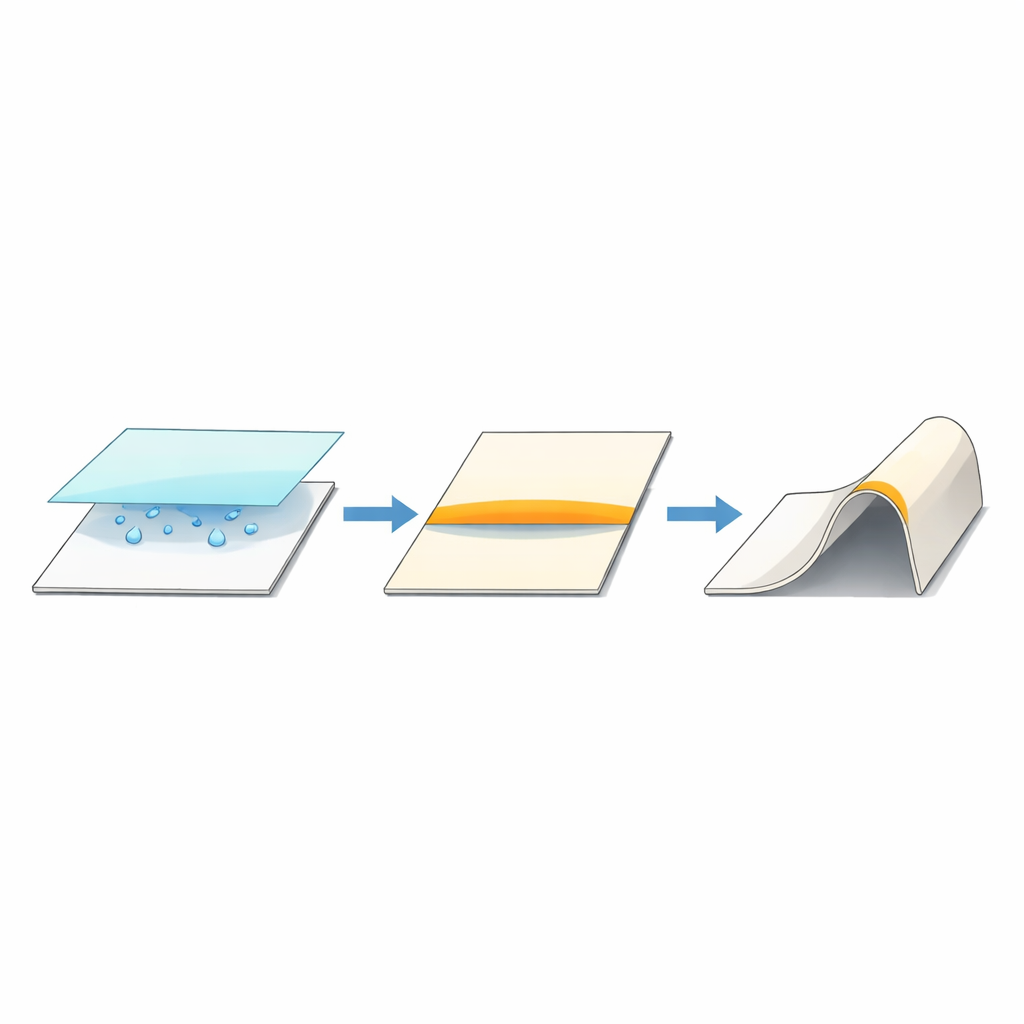
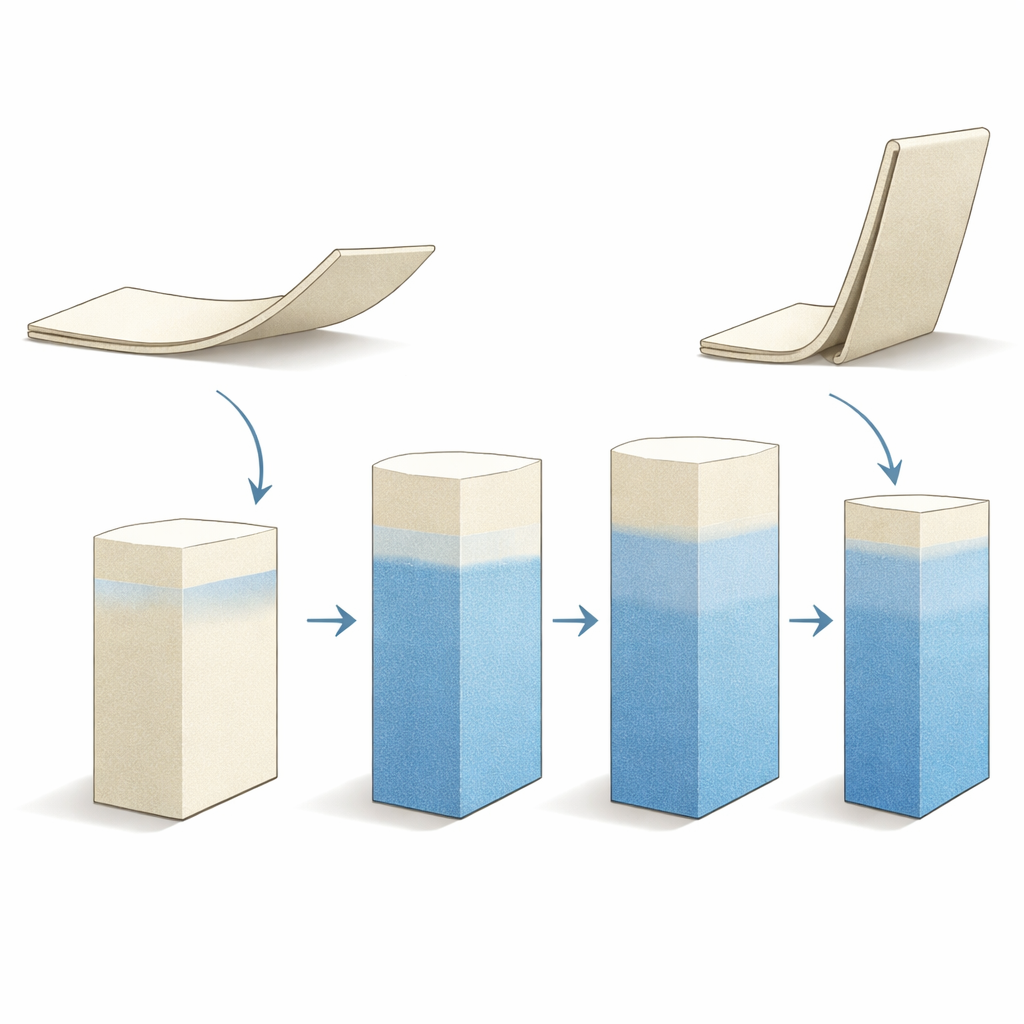
The researchers tackled this limitation by changing how the liquid is delivered. Instead of a quick squirt from an inkjet nozzle, they laid a piece of filter paper soaked with water-based solution onto the target region of the sheet. This acted like a small, controlled reservoir that steadily fed liquid into the paper over several minutes. During this “loading” period, the solution slowly seeped through the entire thickness of the paper, rather than staying near the surface. Computer simulations of diffusion in the thickness direction confirmed this idea: with only a brief surface deposit, the liquid front stalls close to the top, but with continuous supply, a broad, deeply soaked band forms inside the sheet before any folding even begins.
From Invisible Bonds to Visible Bends
Folding happens because the soaked region expands and contracts differently from the dry region, creating internal stresses that bend the sheet. To understand what is happening at the molecular level, the team used infrared spectroscopy, a technique that detects how chemical bonds vibrate when exposed to light. By comparing the front and back surfaces of the treated area, they measured how hydrogen bonds in the cellulose fibers changed as more liquid penetrated. When only the front surface was significantly altered, the spectra from the two sides looked different, and the paper folded only partway. As the continuous soaking drove the solution deeper, the signals from both sides became almost identical, revealing that the chemical state had become nearly uniform through the thickness. Under these conditions, the paper could fold completely to 180 degrees and hold its shape.
Dialing In the Perfect Fold
Because the filter paper method controls how much solution enters the sheet over time, the researchers could tune the folding angle by adjusting the soaking time and the width of the printed line. Longer contact and higher liquid uptake led to larger folding angles, even when the printed lines were narrow. With this approach they achieved full 180-degree folds in paper 153 micrometers thick—beyond what inkjet-only methods had managed. Using patterned filter paper on both sides of the sheet, they demonstrated intricate self-folding designs, including a Miura-ori pattern that opens and closes like an accordion and a corrugated structure with repeating waves, both formed automatically as the treated paper dried.
What This Means for Everyday Objects
At its heart, the study shows that a simple change—from a short, shallow wetting to a slow, deep soak—can turn an ordinary sheet of thick paper into a programmable, self-folding material. When the liquid penetrates evenly from front to back, the internal forces are strong and balanced enough to pull the paper into precise three-dimensional shapes and keep it there. Because the method works with common cellulose-based paper and modest equipment, it offers a promising route to mass-produced, eco-friendly structures: protective packaging that absorbs shocks, foldable components for soft robots, and compact devices that ship flat and assemble themselves when activated.
Citation: Odagiri, Y., Fukatsu, Y., Kawagishi, H. et al. Self-folding of thick paper via continuous solution supply analyzed by FTIR spectroscopy. Sci Rep 16, 9154 (2026). https://doi.org/10.1038/s41598-026-40473-y
Keywords: self-folding paper, origami engineering, smart materials, paper-based devices, soft robotics