Clear Sky Science · en
Thermal, geological and biological processes shape the internal fabric and fluorescence of amber from La Cumbre, Dominican Republic
Why this glowing stone matters
Amber is already a favorite among jewelry lovers and fossil hunters, but some pieces from the Dominican Republic hide an extra surprise: under daylight they shine with an eerie blue or green glow. This study looks inside those rare stones from the La Cumbre mine to find out what makes them so special. By tracing how heat from ancient volcanoes, forest fires, and even fungi worked together over millions of years, the authors show that the story of this amber is really a story about how living forests, violent geology, and tiny microbes can leave lasting fingerprints in a single gemstone.
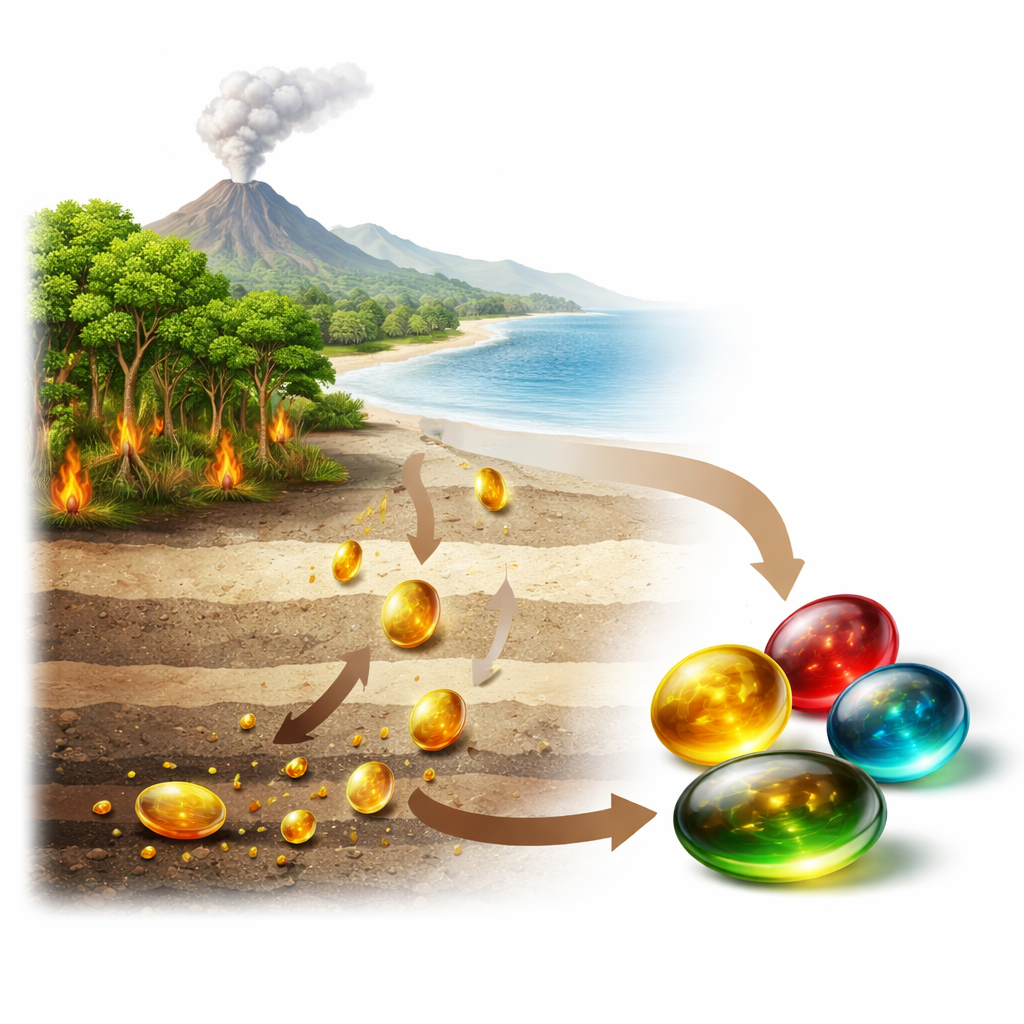
Where the strange amber is found
The unusual amber comes from the mountains of northern Dominican Republic, where fossil tree resin is mined from rocks laid down in a shallow sea near river deltas about 20–15 million years ago. Most pieces are the familiar yellow or red, but miners also find small amounts of blue- and green-fluorescent amber that are highly prized on the gem market. All of these pieces likely came from the same type of tropical tree, yet they ended up with different colors and optical tricks. This raised a key puzzle: if the source tree was the same, what in the environment turned some resin into ordinary amber and some into glowing blue-green gems?
Looking inside the stone
To answer that, the researchers examined amber samples of all colors under stereoscopic and electron microscopes and measured their elemental and molecular make-up. Inside the yellow and red pieces they saw networks of rounded resin “bubbles,” separated by thin seams filled with clay and carbonate minerals, forming patterns that look like dried, cracked mud. Blue amber showed an even more striking foamy texture, full of pores and oval cavities, while some green amber displayed swirling, wave-like bands. Mineral grains rich in iron, zinc, titanium, and even native copper were especially common in red amber, hinting that hot, mineral-rich fluids once moved through the resin-bearing rocks.
Fire, heat, and tiny helpers
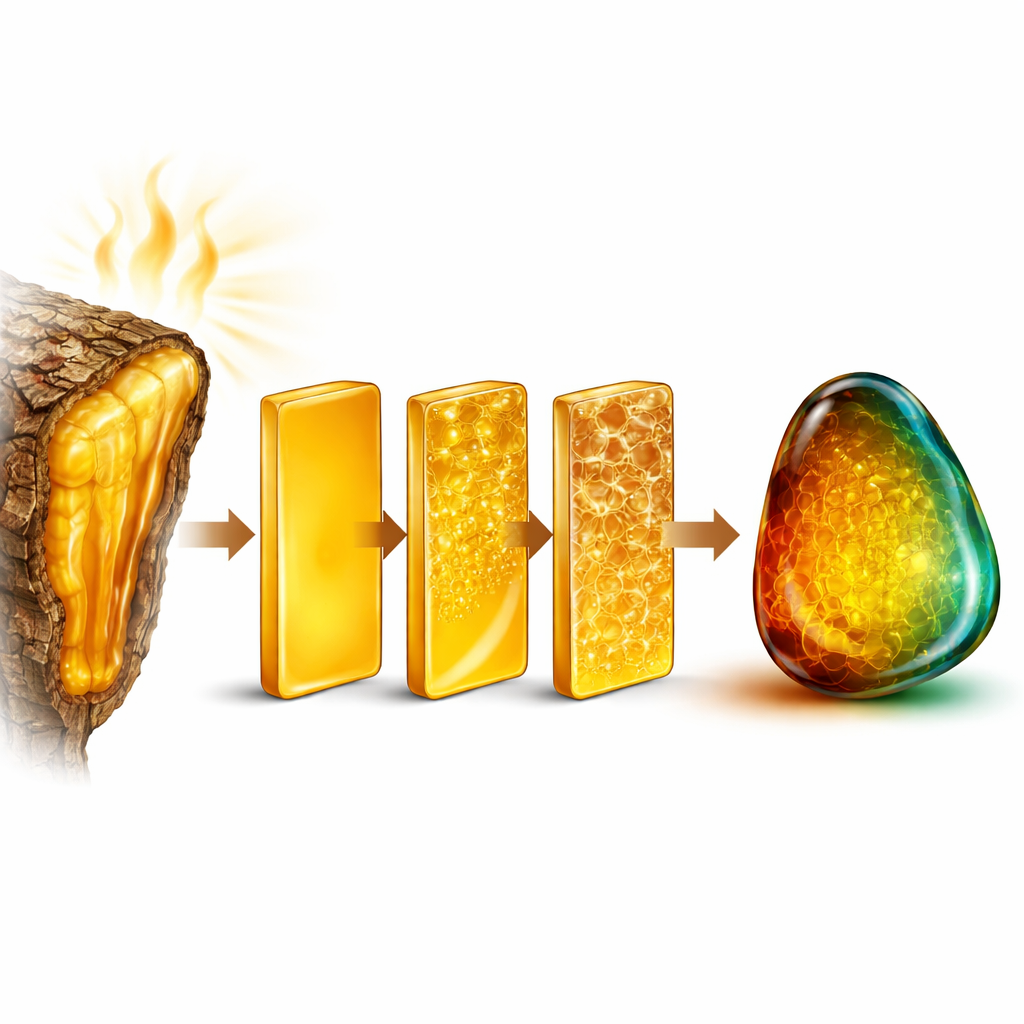
The bubble networks and crack patterns suggest the resin was heated strongly after it oozed from the trees—likely by nearby volcanic activity or forest fires. Heating would make the sticky resin boil, foam, dry, and shrink, freezing in place a sponge-like interior and a “sunbaked” surface. At the same time, burial in oxygen-poor mud allowed iron and sulfur to form tiny clusters of pyrite crystals inside the still-soft resin. Chemical tests showed that most amber colors share a similar basic composition, but green amber stands out with less carbon and more oxygen and a suite of long, straight hydrocarbon chains, signs that it may be less “mature” and not fully rearranged at the molecular level. In one blue sample the team also detected perylene, a pigment-like molecule that other studies link to fungi that digest wood and resin. This hints that microbes may have colonized some fresh resin, leaving behind colorful compounds that survived fossilization.
How the glow is created
The blue or bluish‑green glow appears mainly in a thin outer shell of the amber pieces, and it changes with viewing angle, shifting from blue to green as the stone is turned. Combined with the observed crack networks near the surface, this suggests that the glow is driven largely by physics: white sunlight scattering and reflecting through a very fine, irregular microstructure created by heating and drying. In other words, the stone’s glow is shaped by how light interacts with countless tiny interfaces inside the outer layer, not just by what molecules are present. The sporadic presence of perylene shows that biology can add to the effect in some pieces, but it is probably not the main cause of the widespread fluorescence.
The bigger story in a small gem
In the end, the authors conclude that the rare blue and green amber from La Cumbre is the product of a long chain of events: trees oozed resin in a tropical forest shaken by volcanoes; fires and heat caused the resin to bubble, crack, and partly char; mineral-rich waters and seafloor mud added metallic grains and clays; and fungi sometimes invaded and left molecular traces. Together, these thermal, geological, and biological forces sculpted the internal fabric and daylight glow of the amber. For a casual observer, this means that the shimmering blue flash in a polished stone is not a simple dye, but a visible record of ancient eruptions, wildfires, and microorganisms, all frozen in a drop of fossilized tree tears.
Citation: Natkaniec-Nowak, L., George, C., Pańczak, J. et al. Thermal, geological and biological processes shape the internal fabric and fluorescence of amber from La Cumbre, Dominican Republic. Sci Rep 16, 9299 (2026). https://doi.org/10.1038/s41598-026-40461-2
Keywords: Dominican amber, blue amber fluorescence, fossil resin, volcanic heating, amber microstructure