Clear Sky Science · en
Effects of a bloodless diet on fitness and malaria susceptibility in Anopheles mosquitoes from Burkina Faso
Why feeding mosquitoes without blood matters
Most people know mosquitoes for their itchy bites, but in many parts of the world they are also deadly, carrying malaria parasites from person to person. To fight malaria, researchers often raise huge numbers of mosquitoes in the lab to test new tools, from vaccines to genetic control methods. Traditionally, these mosquitoes must be fed on blood from animals, which is expensive, logistically difficult, and raises animal‑welfare concerns. This study asked a simple, practical question with big implications: can a carefully designed blood‑free diet keep malaria mosquitoes healthy and infectious enough for research, without relying on animal blood?
A new kind of “meal” for mosquitoes
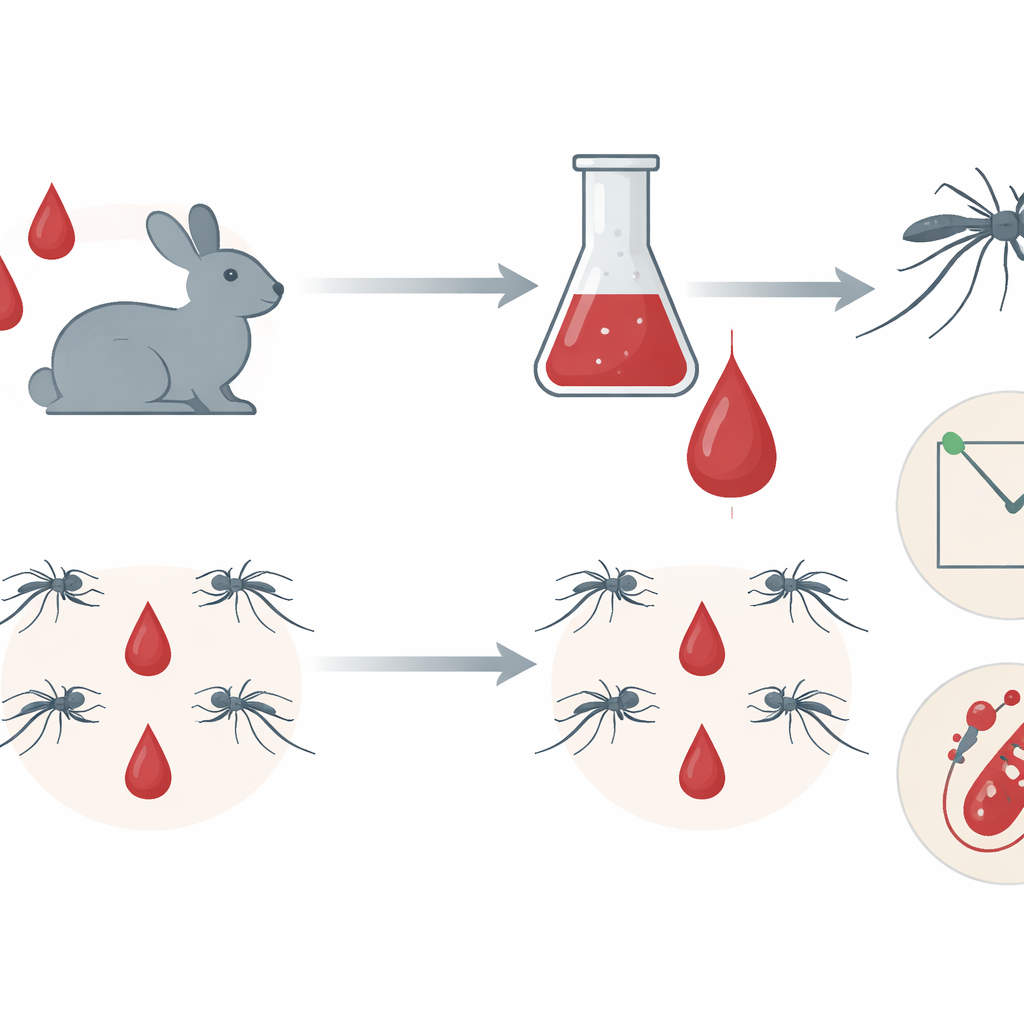
Scientists in Burkina Faso and Portugal worked with three important malaria mosquito strains, including two insecticide‑resistant strains caught recently in Burkina Faso and a long‑used laboratory strain from Kenya. Instead of feeding females on rabbit blood, they tested a dry, patented mix called Bloodless, which is dissolved in water and offered through a warm membrane, much like a normal blood meal. The team ran two parallel colonies side by side for seven generations: one always fed with animal blood, the other always with the Bloodless diet. Because these mosquitoes live in a region where malaria is common, and because the strains are close to wild populations, the results are highly relevant to real‑world control efforts.
Checking body size and basic health
To see whether the artificial diet produced weaker or smaller mosquitoes, the researchers measured the wings of hundreds of males and females, a standard proxy for body size and overall condition. In early generations, size differences between the two diets were small and depended on sex and strain. By the seventh generation, however, a clear pattern emerged: mosquitoes reared on the Bloodless diet tended to have slightly larger wings than those fed on animal blood, especially in two of the three strains. Larger body size can benefit mosquitoes in mating and flight, which is important for releasing strong males in techniques like the Sterile Insect Technique. These findings suggest that, at least in the lab, the artificial diet does not stunt mosquito growth and may even provide more consistent nutrition than variable batches of animal blood.
Does the malaria parasite still thrive?
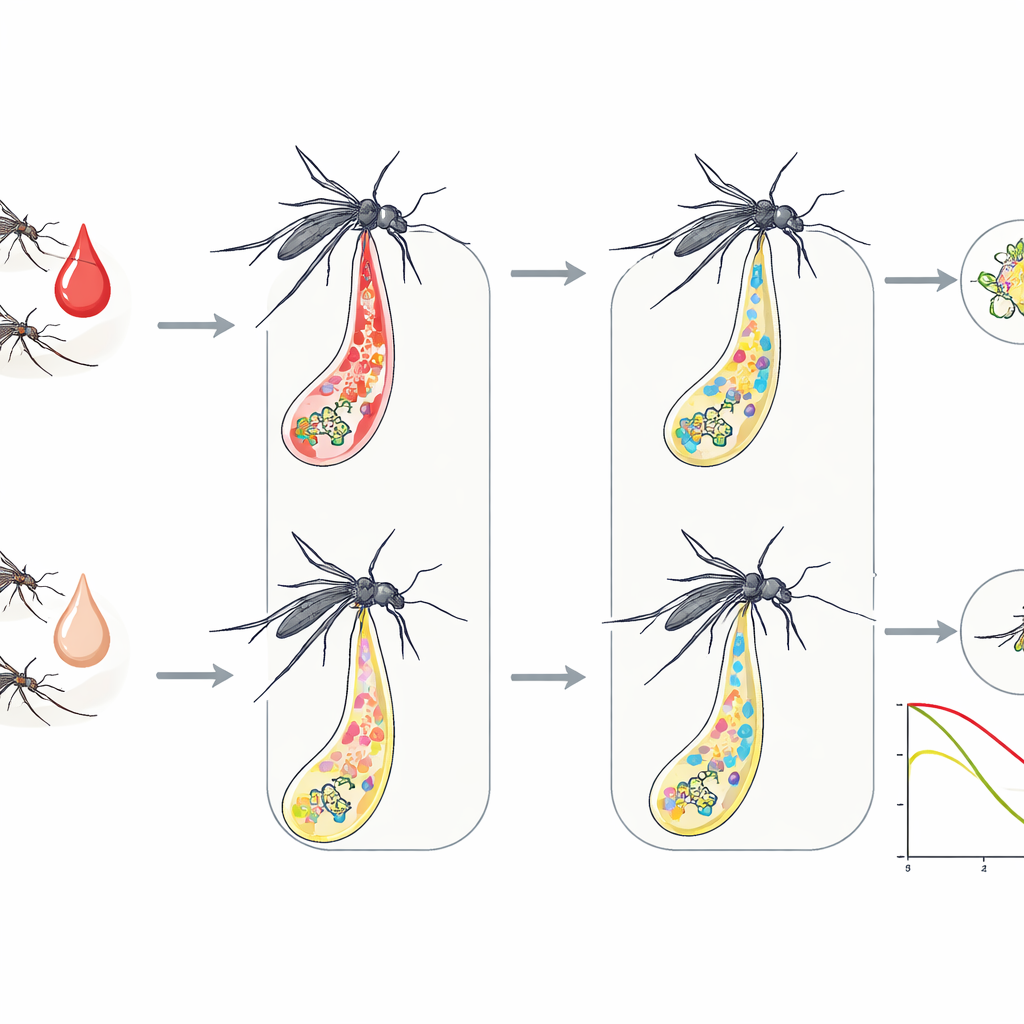
For malaria research and for testing new vaccines and drugs, it is crucial that lab mosquitoes become infected with the parasite in a realistic way. The team exposed female mosquitoes from both diet groups to blood drawn from local children naturally carrying sexual stages of the malaria parasite, Plasmodium falciparum. They then checked the mosquitoes’ stomachs a week later for tiny parasite stages called oocysts, counting how many mosquitoes were infected and how many oocysts each carried. Across species and generations, infection levels in Bloodless‑fed mosquitoes were broadly similar to those in blood‑fed ones. In one later generation, blood‑fed mosquitoes showed a somewhat higher proportion of infections, but the number of parasites in infected insects did not differ. Overall, the artificial diet preserved the mosquitoes’ ability to host the malaria parasite, a key requirement for meaningful transmission studies.
How long do these mosquitoes live?
Another vital question is lifespan: only mosquitoes that live long enough after feeding can pass malaria on to humans. The researchers followed groups of males and females from both diet lines through several generations, recording how many were alive each day. In the third generation, survival was similar for mosquitoes on both diets, though females lived longer than males, as is typical. By the seventh generation, however, a notable shift appeared: mosquitoes reared on the Bloodless diet survived longer than those reared on animal blood, regardless of species. This extended lifespan may reflect the stable, well‑balanced nutrients in the artificial diet compared with variable natural blood, and it means Bloodless can support colonies that live long enough for realistic infection and transmission experiments.
What this means for fighting malaria
Put simply, this study shows that a blood‑free diet can raise malaria mosquitoes that are at least as large, long‑lived, and capable of carrying the parasite as those fed on animal blood, over multiple generations. For scientists and public health programs, that opens the door to large‑scale mosquito rearing without relying on constant animal blood supplies, easing costs and ethical concerns. It also supports the development of new control tools—from sterile males to transmission‑blocking vaccines—by providing a reliable, standardized way to produce test mosquitoes. Before such diets are widely adopted for field‑linked programs, the authors recommend trials in semi‑natural settings and close discussion with vector control practitioners and policy makers, but the message is encouraging: we may not need blood to keep the fight against malaria moving forward.
Citation: de Sales Hien, D.F., Sare, I., Sib, A.M.A.P. et al. Effects of a bloodless diet on fitness and malaria susceptibility in Anopheles mosquitoes from Burkina Faso. Sci Rep 16, 8632 (2026). https://doi.org/10.1038/s41598-026-40458-x
Keywords: mosquito rearing, malaria transmission, artificial bloodless diet, vector control, Anopheles gambiae