Clear Sky Science · en
SFD-YOLO for small-object fragment impact detection in warhead target-plate testing
Seeing the Smallest Signs of Impact
When a warhead explodes in a controlled test, engineers learn how dangerous it really is by studying the tiny marks its fragments leave on large metal plates. Today, that inspection is still often done by hand, which is slow, tiring, and prone to mistakes—especially when most impact marks are barely visible specks. This paper presents an artificial-intelligence approach called SFD-YOLO that can automatically spot those minuscule scars in real time, even under dust, fog, blur, and changing light, promising faster and more reliable safety and performance assessments.
Why Tiny Holes Matter
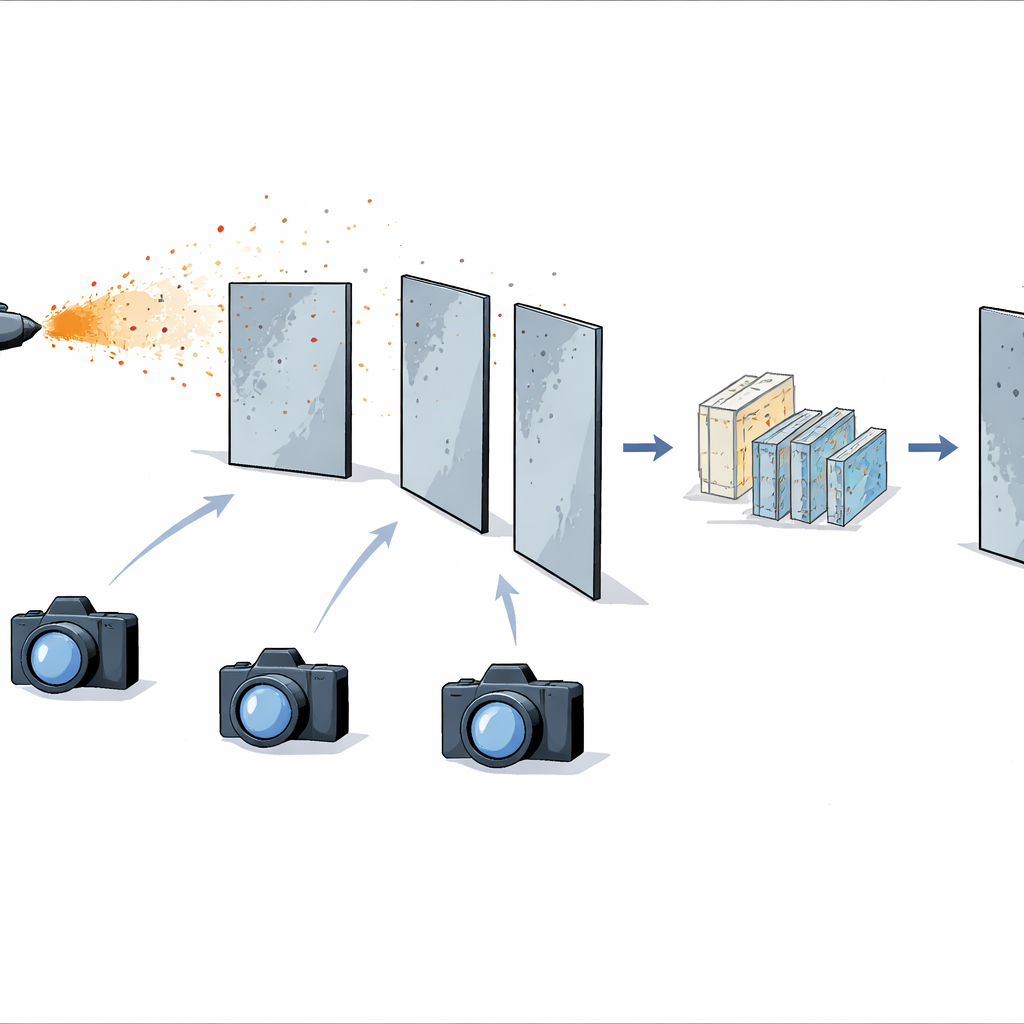
In warhead testing, metal target plates are arranged in a ring around an explosive charge. When the device detonates, high-speed fragments slam into the plates, leaving either clean holes where they pass through or shallow dents where they only strike the surface. By counting where and how many of each type appear, engineers can infer how fragments spread through space and how lethal they would be to real equipment. But the marks are very small and densely clustered, and outdoor test ranges are filled with dust, glare, and bad weather. Human inspectors and traditional image-processing tools struggle to keep up, making it hard to get accurate, timely measurements.
Teaching a Network to Look Once, But Carefully
Modern object-detection systems based on deep learning can scan images and draw boxes around items of interest in a fraction of a second. Among these, the YOLO family of algorithms is known for striking a good balance between speed and accuracy. However, standard versions tend to miss very small objects that occupy only a handful of pixels—exactly the situation in fragment impact images. To tackle this, the authors build on the latest YOLOv11 model and tailor it specifically for tiny marks on shiny metal, redesigning several key components so the network pays more attention to faint details without becoming too large or slow.
Sharpening Focus on Flecks and Specks
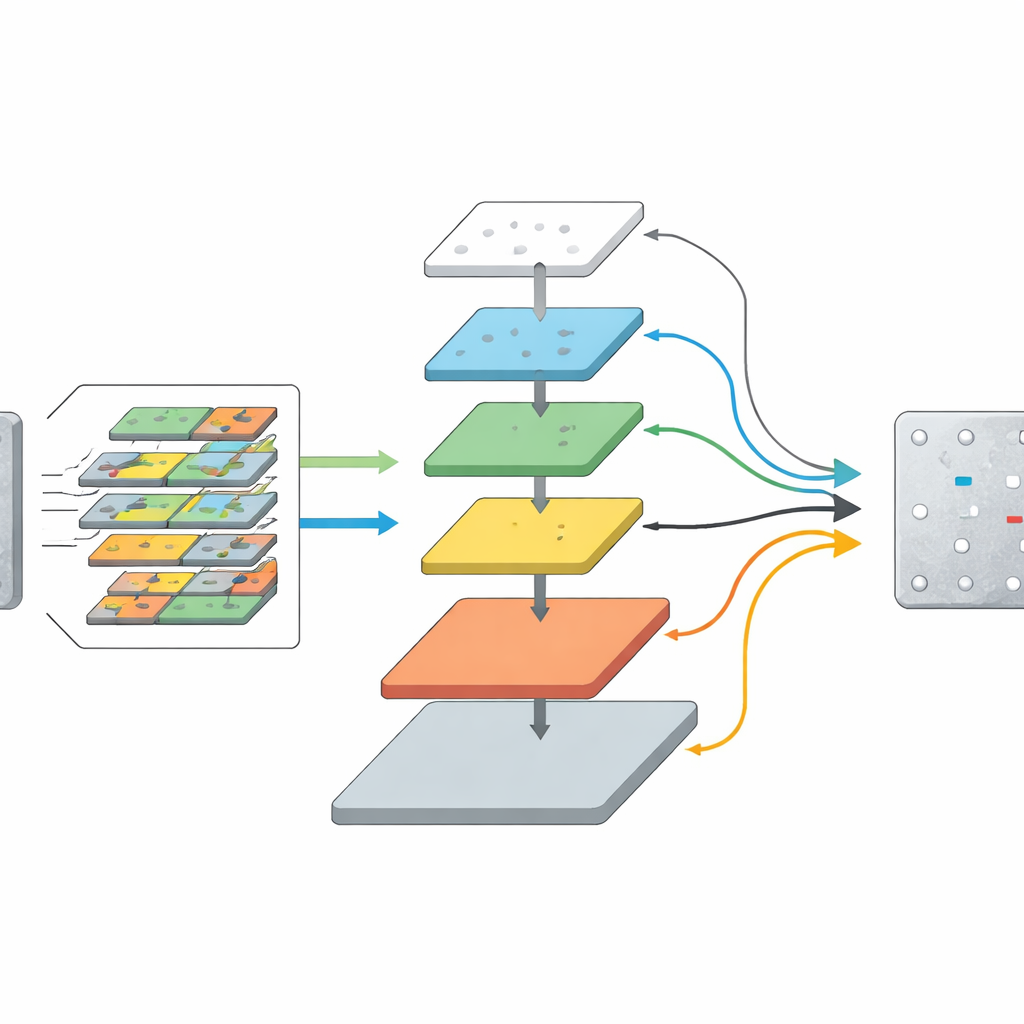
The first improvement lies in how the network digests raw images. The authors introduce a feature-processing block that cleans up what the network sees along two dimensions at once: where features appear in the image and which channels carry the most useful information. This block suppresses repeated or unhelpful patterns and boosts subtle edges and textures that hint at a true impact. They also add a lightweight extraction module that keeps the model compact by using more efficient operations, so it can run quickly on standard hardware while still preserving the delicate signals from tiny fragment scars.
Seeing at Multiple Scales at the Same Time
Because tiny impacts can be easily washed out when images are repeatedly shrunk inside a neural network, the authors redesign the decision-making part of the system as well. Instead of looking at three levels of detail, SFD-YOLO adds a fourth, higher-resolution layer dedicated to the smallest marks. A special feature pyramid structure gradually blends fine detail from shallow layers with broader context from deeper layers, helping the network keep track of both where a mark is and how it stands out from the background. The result is a system that can distinguish between through-holes and surface dents, even when they are packed tightly together on a reflective plate.
Putting the System to the Test
To train and judge their method, the researchers assembled a dedicated image collection from real static-blast experiments, capturing thousands of high-resolution photos of target plates and manually labeling more than twenty thousand impacts. Nearly nine out of ten marks in this collection qualify as “small” by common computer-vision standards, making it a challenging test bed. SFD-YOLO not only outperforms a range of popular detection models, including several other YOLO variants and transformer-based systems, but does so with just over two million adjustable parameters while processing over a hundred images per second. The model also holds up better than its closest baseline when images are blurred, darkened, brightened, or overlaid with synthetic fog and dust, which mimic harsh field conditions.
From Test Range to Factory Floor
In plain terms, the study shows that a carefully tuned neural network can spot and classify pinprick-sized damage marks on large metal plates with very high reliability, and do it fast enough for real-time use during explosive testing. SFD-YOLO turns what was once a laborious manual counting task into an automated, robust measurement tool. Beyond warhead evaluation, the same ideas could be applied to other situations where tiny flaws on metal surfaces matter, such as inspecting rolled steel, power-grid hardware, or other industrial components for defects that are easy for humans—and standard algorithms—to miss.
Citation: Liu, H., Ding, Y., You, W. et al. SFD-YOLO for small-object fragment impact detection in warhead target-plate testing. Sci Rep 16, 9291 (2026). https://doi.org/10.1038/s41598-026-40457-y
Keywords: small object detection, fragment impact testing, metal surface inspection, YOLO neural networks, industrial defect detection