Clear Sky Science · en
Performance optimization of wire EDM of Nitinol shape memory alloy using BBD RSM and TLBO with alumina nano graphene and MWCNT Powder mixed dielectric
Sharper Tools for Smart Metals
From self-expanding stents to shape-shifting aircraft parts, a metal called Nitinol sits at the heart of many high‑tech devices. But this remarkable material is notoriously hard to cut and finish without damaging its surface. This study explores a clever way to machine Nitinol more quickly and gently by sprinkling tiny engineered particles into the cutting fluid of a spark‑based process, pointing toward smoother medical implants and more reliable aerospace components.
Why Cutting Nitinol Is So Challenging
Nitinol is a nickel–titanium alloy famous for “remembering” its shape and for bending without breaking. Those same qualities make it difficult to machine using traditional drills or mills: tools wear quickly, surfaces overheat, and microscopic cracks can form. To get around this, manufacturers increasingly use wire electrical discharge machining, or WEDM, where a thin wire and rapid sparks erode the metal without physical contact. Yet even WEDM must be tuned with care. The strength of each spark and the timing between pulses determine how fast material is removed and how smooth the final surface becomes, which is especially critical for parts that go inside the human body.
Adding Smart Powders to the Spark Bath
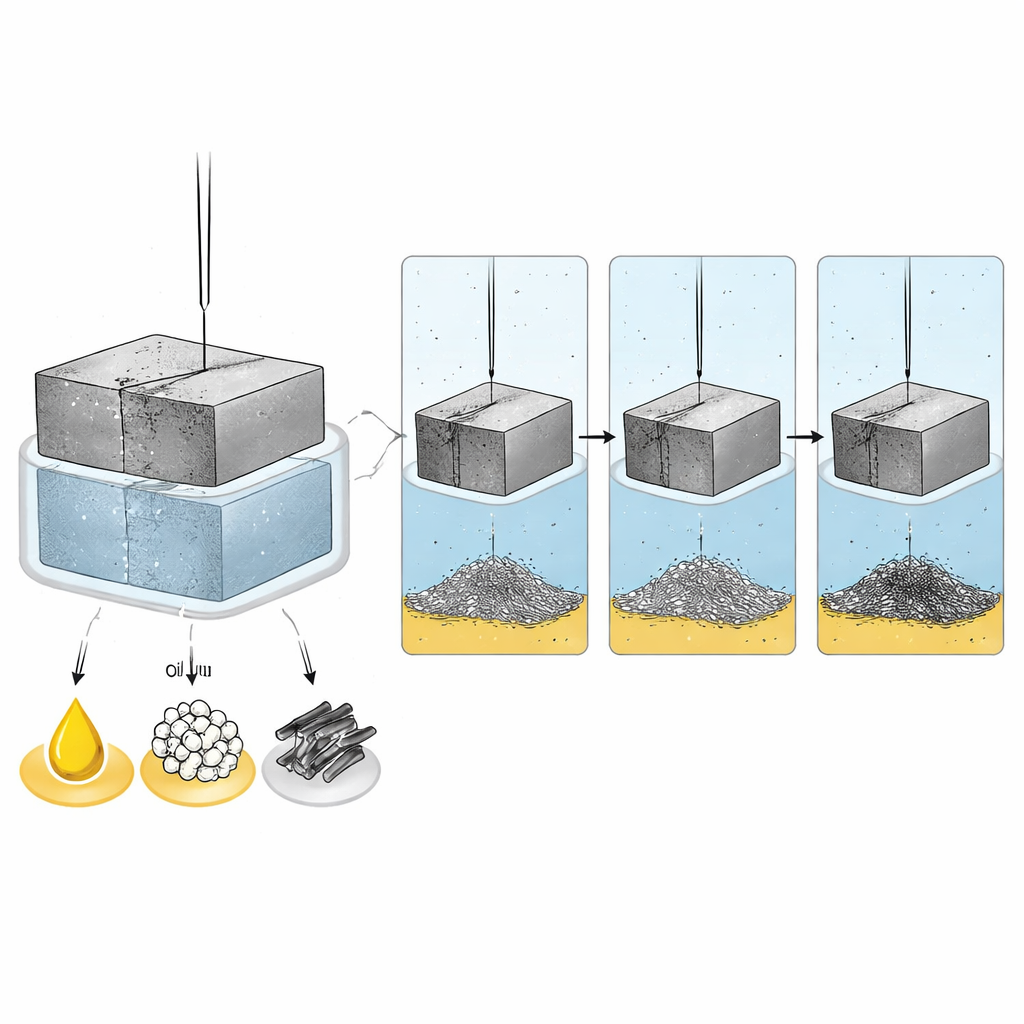
The researchers tested whether mixing different nanopowders into the insulating oil that surrounds the wire and workpiece could make WEDM both faster and gentler. They focused on three additives: tiny alumina particles (a ceramic), ultra-thin graphene sheets, and slender multi‑walled carbon nanotubes. These powders were first carefully synthesized and checked under powerful microscopes to confirm their size and structure. In the experiments, each powder was added at the same low concentration to the cutting fluid while three key machine settings—the spark strength, the time the spark stayed on, and the time it stayed off—were systematically varied. For each combination, the team measured how much Nitinol was removed per minute and how rough the resulting surface was.
Finding the Best Recipe with Data and Algorithms
Because the process involves many interacting factors, the team used a structured experimental design to cover the space of settings efficiently and then built mathematical models that link inputs to outcomes. Statistical tests showed these models were highly trustworthy, explaining more than 96 percent of the variation in cutting rate and surface roughness. To move beyond simple trial‑and‑error, the researchers then turned to an optimization strategy inspired by classroom learning. In this approach, virtual “students” explore different combinations of settings, learn from the best “teacher” solution, and gradually home in on better and better trade‑offs between cutting speed and smoothness.
Why Carbon Nanotubes Stand Out
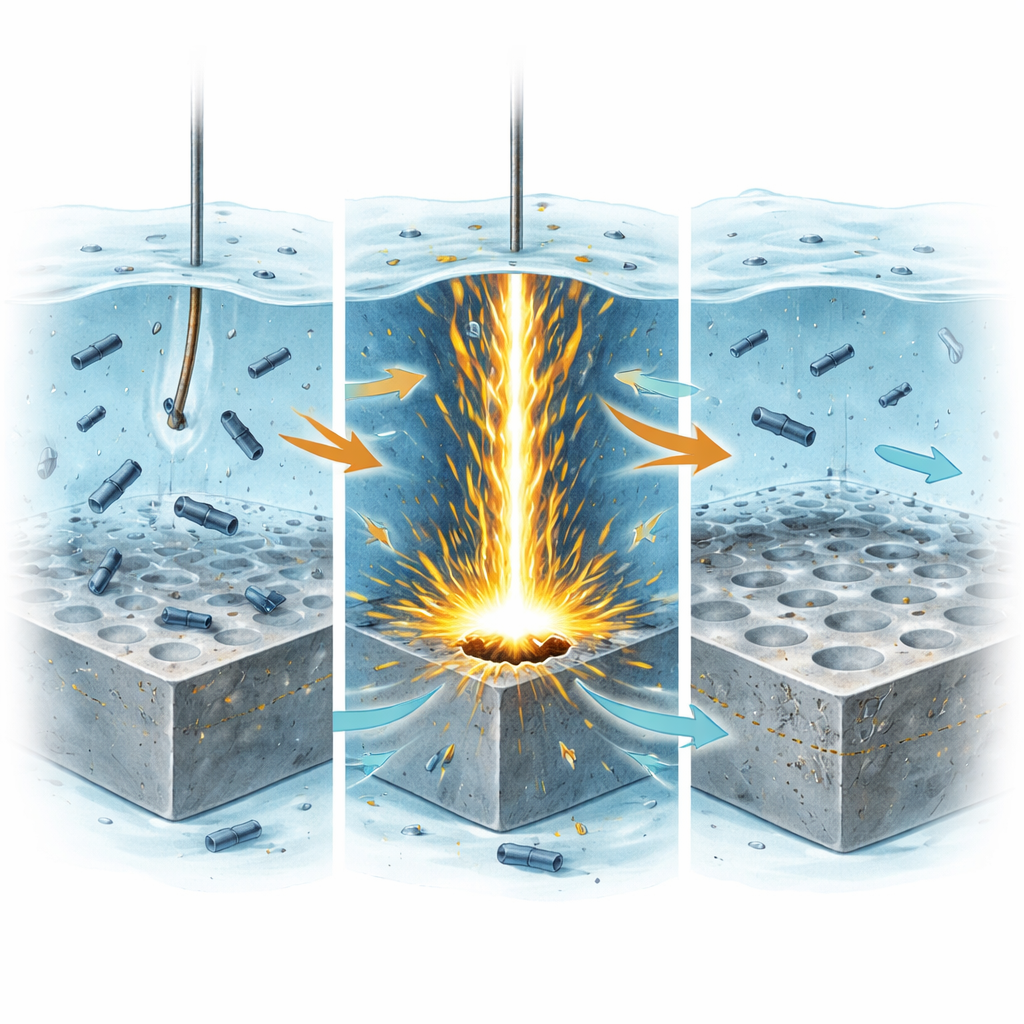
Across all tests, the cutting current emerged as the most powerful lever: stronger sparks removed more metal but tended to roughen the surface. The on‑time of each spark behaved similarly, while longer rest times between sparks allowed the fluid to clear away debris and cool the surface, improving smoothness. Comparing powders, alumina gave only modest gains, graphene did better, and carbon nanotubes consistently performed best. Thanks to their excellent ability to conduct heat and electricity and their long, tubular shape, nanotubes helped form stable spark channels and carried heat and molten metal away more evenly. Under settings tuned by the learning algorithm, the nanotube‑enhanced process removed Nitinol about 60 percent faster and produced surfaces roughly three‑quarters smoother than conventional WEDM without any powder. Electron microscope images confirmed that nanotube‑assisted cuts had fewer pits, cracks, and re‑solidified debris than all other cases.
A Smoother Path for Shape‑Shifting Metals
In everyday terms, this work shows that sprinkling the right kind of carbon nanotubes into the spark bath turns a harsh cutting tool into a much finer scalpel for Nitinol. By combining careful experiments, statistical modeling, and an algorithm that searches for balanced settings, the study outlines a practical recipe for faster machining and cleaner surfaces. That means future Nitinol parts—from biomedical implants to precision actuators—could be made more efficiently and with fewer microscopic flaws, improving both performance and reliability.
Citation: Rehman, I.U., Chaudhari, R., Vora, J. et al. Performance optimization of wire EDM of Nitinol shape memory alloy using BBD RSM and TLBO with alumina nano graphene and MWCNT Powder mixed dielectric. Sci Rep 16, 9507 (2026). https://doi.org/10.1038/s41598-026-40446-1
Keywords: Nitinol machining, wire EDM, nanopowder dielectric, carbon nanotubes, surface roughness