Clear Sky Science · en
Uncovering the bactericidal potential of extract and multi-targeting phytochemicals from Mirabilis longiflora L. leaves against multidrug-resistant Pseudomonas aeruginosa and Bacillus cereus
Why a garden shrub matters for superbugs
Antibiotic-resistant infections are turning once-routine illnesses into life-threatening crises. Two culprits, Pseudomonas aeruginosa and Bacillus cereus, can shrug off many standard drugs and form stubborn biofilms that shield them from treatment. This study explores an unlikely ally against these “superbugs”: the leaves of Mirabilis longiflora, an ornamental shrub long used in traditional medicine for wounds and skin problems. By combining classic lab tests with modern computer modeling, the researchers ask whether this plant hides compounds that can hit several bacterial weak points at once.
A plant with a medical backstory
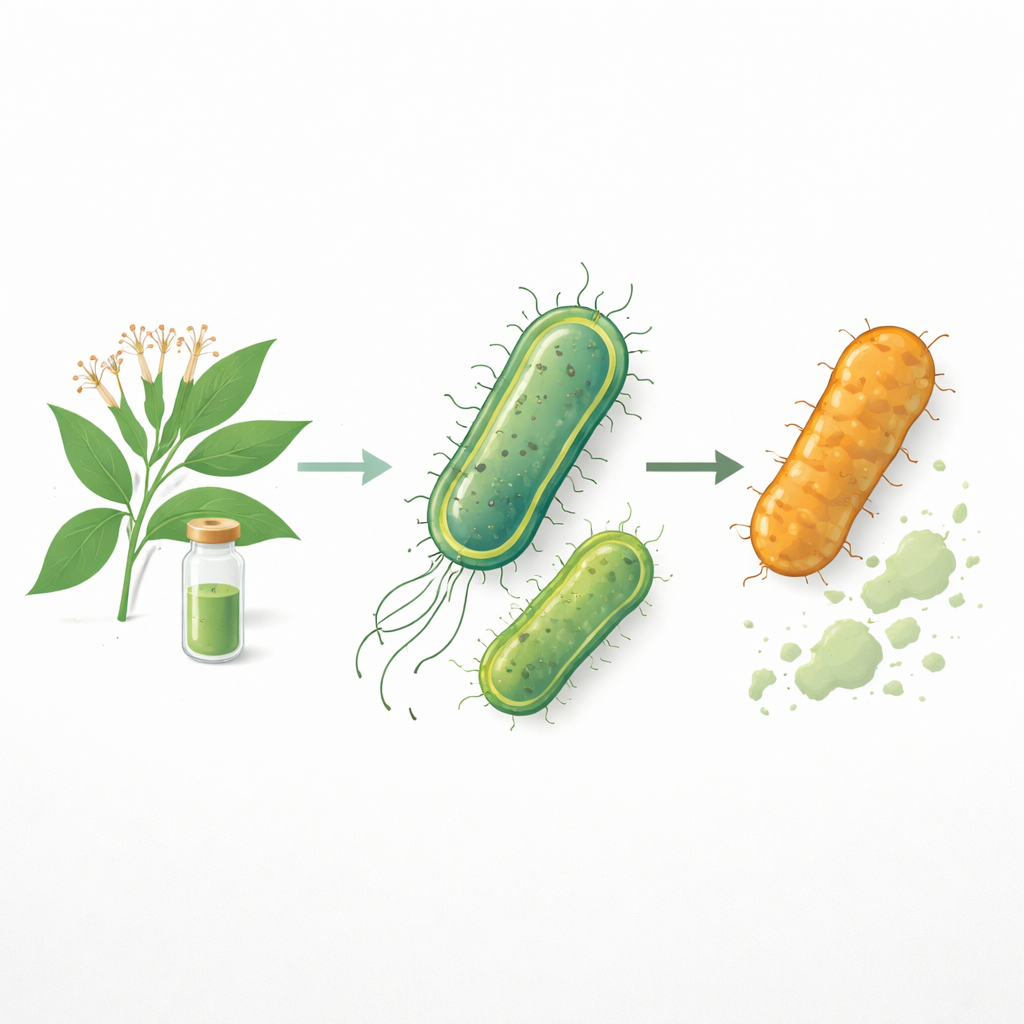
Mirabilis longiflora, sometimes called Sweet 9 o’clock, has been used in Bangladeshi folk medicine to treat infections, headaches, and skin conditions. Yet its effects on modern multidrug-resistant bacteria had not been examined. The team prepared a methanol extract from the plant’s leaves and first cataloged what types of natural chemicals it contained. Simple color-based tests showed a rich mix of flavonoids, tannins, terpenoids, steroids, saponins, sugars, proteins, and ketones—classes of molecules often associated with antimicrobial and anti-inflammatory activity. Infrared spectroscopy and gas chromatography–mass spectrometry (GC–MS) then revealed 33 distinct compounds, providing a chemical “fingerprint” of the extract.
Putting the leaf extract to the test
To see whether this complex mixture could stop dangerous bacteria, the researchers challenged laboratory strains of multidrug-resistant P. aeruginosa (a problematic hospital pathogen) and B. cereus (a toxin-producing food and wound bacterium). Using agar-well diffusion, they placed different doses of the leaf extract into wells in bacteria-covered plates and measured the clear zones where growth was halted. The extract suppressed both species in a dose-dependent way, creating larger kill zones at higher concentrations. Further tests measured the minimum concentration needed to stop growth and the amount required to actually kill the bacteria. The extract was particularly potent against P. aeruginosa, needing less material to fully eradicate this microbe than to clear B. cereus.
Hunting a multitarget molecule in silico
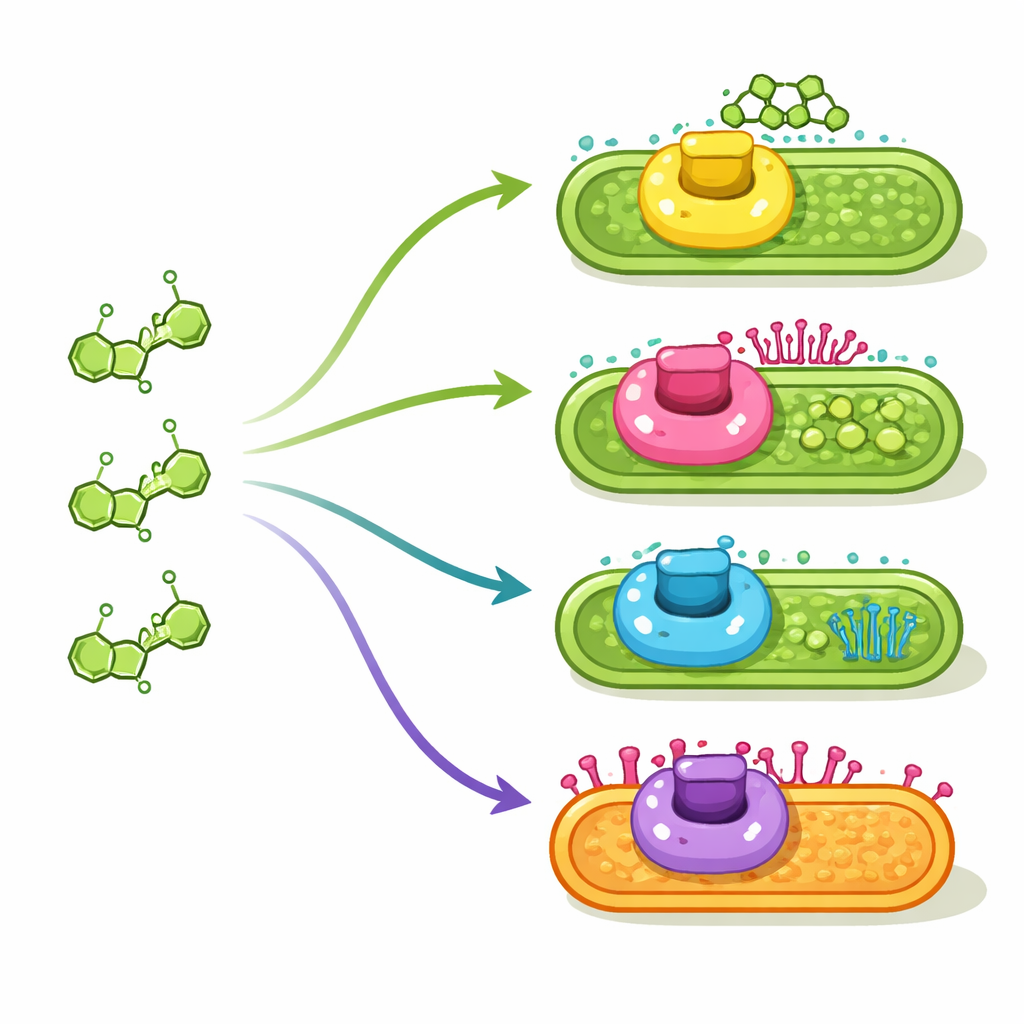
Because the extract contains many compounds, the scientists turned to computer modeling to identify which one might be the real workhorse. From the 33 GC–MS-identified phytochemicals, they docked each virtually against four key bacterial proteins: LasR and LpxC in P. aeruginosa, and FosB and PlcR in B. cereus. These proteins help bacteria communicate, build protective outer layers, form biofilms, and resist antibiotics. A single small ketone-like molecule, named 6-Hydroxy-4,4,7a-trimethyl-5,6,7,7a-tetrahydrobenzofuran-2(4H)-one, stood out. It bound more strongly, in the simulations, to all four targets than the control drug ampicillin, which these strains resist in real life. The compound also showed promising “drug-likeness,” including good predicted absorption, suitable solubility, and low predicted toxicity.
Watching the interaction in motion
Docking snapshots are only part of the story, so the team ran long molecular dynamics simulations to see whether the plant molecule stayed snugly in place when the proteins and solvent were allowed to move as they would in living cells. Over 100 nanoseconds of simulated time, the compound formed stable complexes with LasR, LpxC, FosB, and PlcR, with only modest structural wobbling. Analyses of atomic motion, compactness, and contact patterns all suggested that the molecule can sit comfortably in the active pockets of these enzymes and regulators. In effect, one small natural compound appears capable of tugging on several control levers that bacteria use to communicate, build their outer defenses, and resist treatment.
What this means for future treatments
For non-specialists, the key message is that a traditional medicinal plant has yielded a promising chemical candidate that may weaken multiple resistance mechanisms in two hard-to-treat bacterial species at once. The leaf extract itself already shows direct antibacterial activity in the lab, and computer studies highlight one compound that might be doing much of the heavy lifting by targeting several bacterial proteins simultaneously. While this work is still at the test-tube and computer stage—and must be followed by animal and clinical studies—it supports the idea that plants remain a powerful source of new tools against antibiotic-resistant infections. In the long race between evolving microbes and modern medicine, multitarget molecules like this one could help tilt the odds back in our favor.
Citation: Akhter, S., Talukder, M.E.K., Islam, M.T. et al. Uncovering the bactericidal potential of extract and multi-targeting phytochemicals from Mirabilis longiflora L. leaves against multidrug-resistant Pseudomonas aeruginosa and Bacillus cereus. Sci Rep 16, 9853 (2026). https://doi.org/10.1038/s41598-026-40444-3
Keywords: antibiotic resistance, medicinal plants, Pseudomonas aeruginosa, Bacillus cereus, biofilm inhibitors