Clear Sky Science · en
Critical shifts of fluids in shale nanopores under confinement effects using a modified Redlich Kwong equation of state
Why tiny rock pores matter for our energy future
Deep underground, shale rock holds vast stores of oil and gas inside pores so small that thousands could fit across a human hair. In these tight spaces, fluids no longer behave like the familiar liquids and gases we see at the surface. This paper explores how being squeezed into such nano-sized pores changes the basic boiling and condensation behavior of hydrocarbons, and offers a new mathematical tool to predict those changes. Better understanding this hidden world can help make shale development more efficient and less uncertain.
Fluids in tight spots behave differently
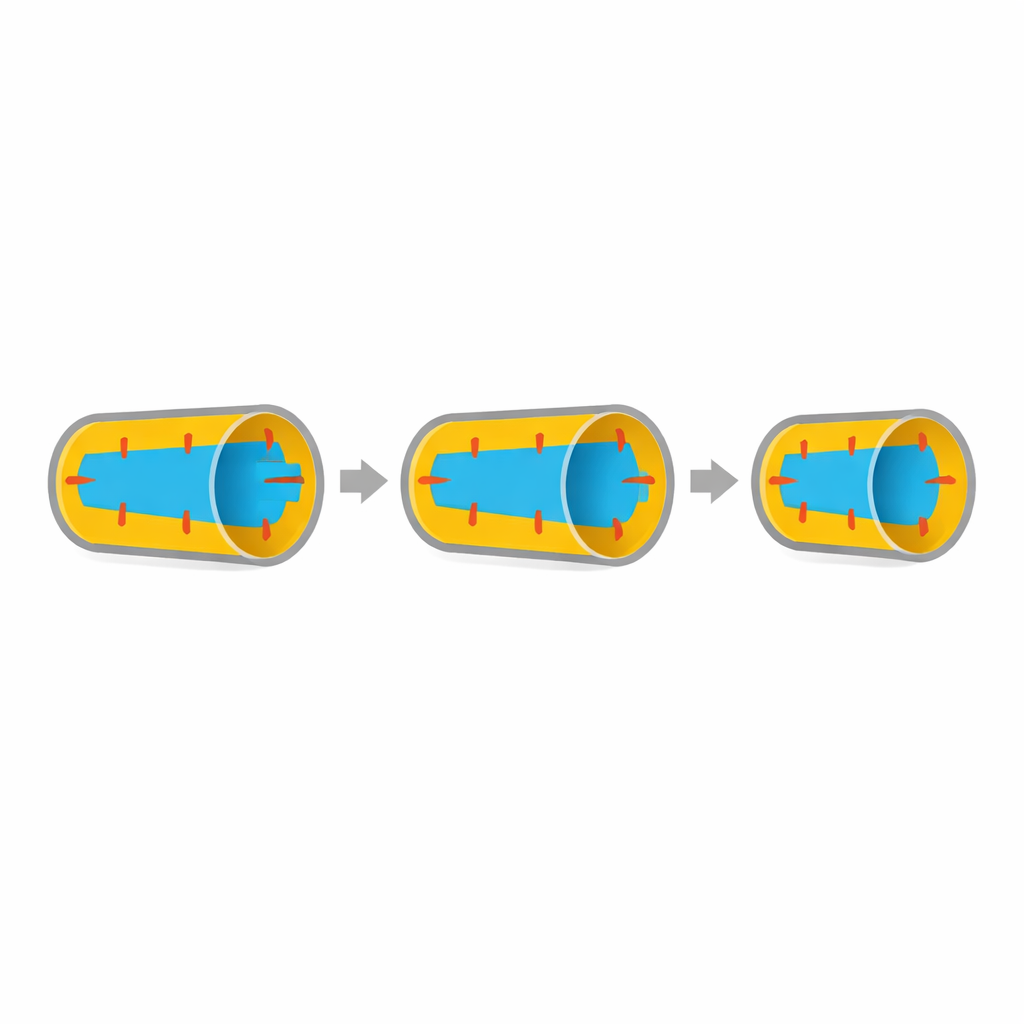
In conventional oil and gas reservoirs, pores are relatively large, and standard models do a reasonable job of describing how fluids change phase with pressure and temperature. Shale, by contrast, is dominated by pores only 1–100 nanometers across, often combined with tiny fractures. In these cramped conditions, forces between fluid molecules and the pore walls become as important as the forces among the molecules themselves. Molecules crowd around the walls, forming adsorbed layers, while only those in the pore center move more freely. This uneven distribution leads to shifts in key properties such as density, viscosity, and, crucially, the critical temperature and pressure that mark the boundary between liquid-like and gas-like behavior.

Where older models fall short
For decades, engineers have relied on equations of state—compact mathematical formulas that relate pressure, volume, and temperature—to describe fluids. The Redlich–Kwong equation is one such widely used tool, especially for natural gas components like methane and other alkanes. However, it assumes fluids are uniform and far from solid surfaces, conditions that break down inside shale nanopores. Experiments and molecular simulations have shown that when pore radii shrink below a few tens of nanometers, the apparent critical temperature and pressure of confined fluids can drop by more than 10–20 percent compared with bulk values. Traditional equations of state cannot capture these shifts because they ignore strong solid–fluid attractions and the loss of free volume caused by adsorption on pore walls.
Building a better description of nano-confined fluids
The authors extend the Redlich–Kwong framework by explicitly accounting for two linked effects of confinement. First, they introduce a correction to the effective space available to freely moving molecules, based on both the thickness of the adsorbed layer and how much denser that layer is than the central “bulk-like” region. As pores get narrower or adsorption becomes stronger, more molecules are locked near the wall and fewer remain in the free phase, shrinking the effective molar volume. Second, they refine the term in the equation that represents attractive forces so it includes the enhanced interaction between molecules and the pore walls. By enforcing the usual mathematical conditions that define a critical point, they derive analytical formulas that relate the shifted critical temperature and pressure of confined fluids to these correction factors.
Linking pore size to shifts in fluid behavior
To turn the modified equation into a practical prediction tool, the team gathers published experimental and simulation data on how critical properties of various simple hydrocarbons change in nano-sized pores. They define a dimensionless pore size that combines the physical pore radius with the thickness of the adsorbed layer, which helps collapse data from molecules of different sizes onto common trends. Fitting these trends yields simple power-law relationships between pore size and the relative change in critical temperature and pressure. When this calibrated model is tested against independent data—for example, methane confined in very small pores—it reproduces observed shifts well as long as the effective pore is not too large, roughly corresponding to situations where nano-confinement is truly dominant.
What the results reveal about shale pores
Using their modified equation, the authors explore how critical properties evolve as pore diameter shrinks. For n-butane and similar hydrocarbons, both critical temperature and pressure are predicted to decline sharply as pores narrow below about 10–20 nanometers, then gradually approach bulk values as pores widen. The model also suggests that smaller, simpler molecules, such as methane, experience stronger confinement effects than larger alkanes, because their size makes them more sensitive to the potential field near the walls. Overall, the work reinforces that in the nano-scale pores typical of shale, adsorption and wall interactions profoundly reshape when and how fluids condense or vaporize.
Why this matters for shale development
For non-specialists, the key message is that shale reservoirs cannot be treated as miniature versions of conventional fields. When fluids are squeezed into nano-sized pores, they obey different “rules” of phase change, and standard tools may misjudge how much oil or gas can be produced and under what conditions. The modified Redlich–Kwong equation developed in this study offers a compact way to fold confinement and adsorption into those rules, improving the reliability of numerical reservoir models. While the approach still assumes relatively simple pore shapes and static conditions, it provides a useful starting point for designing better recovery strategies and, ultimately, making more informed decisions about exploiting shale resources.
Citation: Zhou, B., Wu, X., Li, B. et al. Critical shifts of fluids in shale nanopores under confinement effects using a modified Redlich Kwong equation of state. Sci Rep 16, 9497 (2026). https://doi.org/10.1038/s41598-026-40434-5
Keywords: shale nanopores, confined fluids, fluid adsorption, critical property shift, equation of state