Clear Sky Science · en
A miniature, subterranean, blind cobitid loach, Gitchak nakana, new genus and species, is the first groundwater-dwelling fish from Northeast India
A Tiny Fish Hidden Beneath Our Feet
Most of us think of wildlife as something we see in forests, rivers, or oceans. This study reveals a very different kind of creature: a miniature, blind fish living its entire life in groundwater far below a small village in Assam, Northeast India. The discovery of this animal, named Gitchak nakana, opens a new window into a secret underground world and shows how life can adapt in astonishing ways to darkness, isolation, and scarce food.
A Strange Neighbor in a Village Well
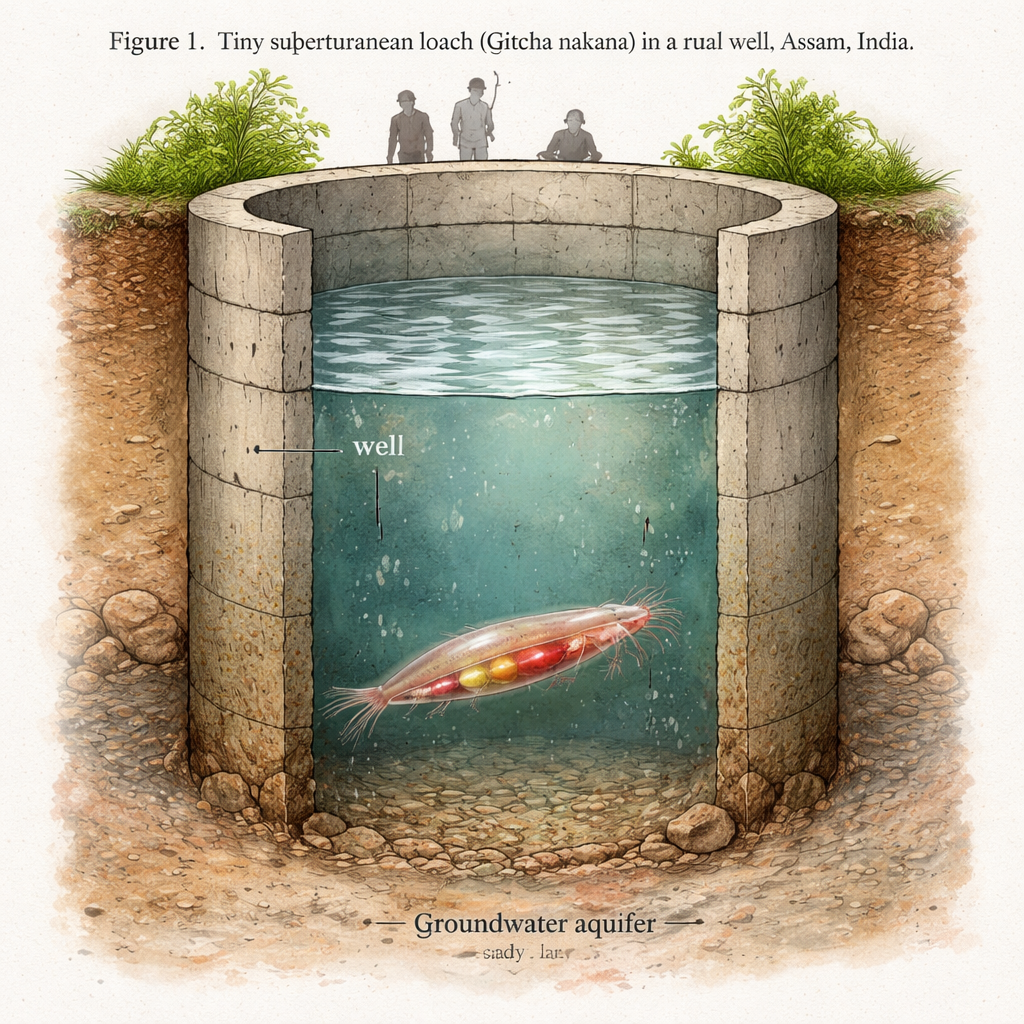
The story began when villagers cleaning a hand-dug well noticed tiny, pale fish in the pumped-out water. Scientists investigated and found that all 13 specimens came from this single well, fed by clear groundwater stored in deep layers of sand and gravel. Unlike cave streams that can be entered and explored, this kind of underground water—known as an aquifer—is normally inaccessible. The fish therefore represent the first known groundwater-dwelling species from Northeast India, and the first member of their loach family found in such a habitat in the region. Their presence suggests that an entire hidden community of subterranean animals may exist beneath the Brahmaputra valley.
Living Without Light, Color, or Eyes
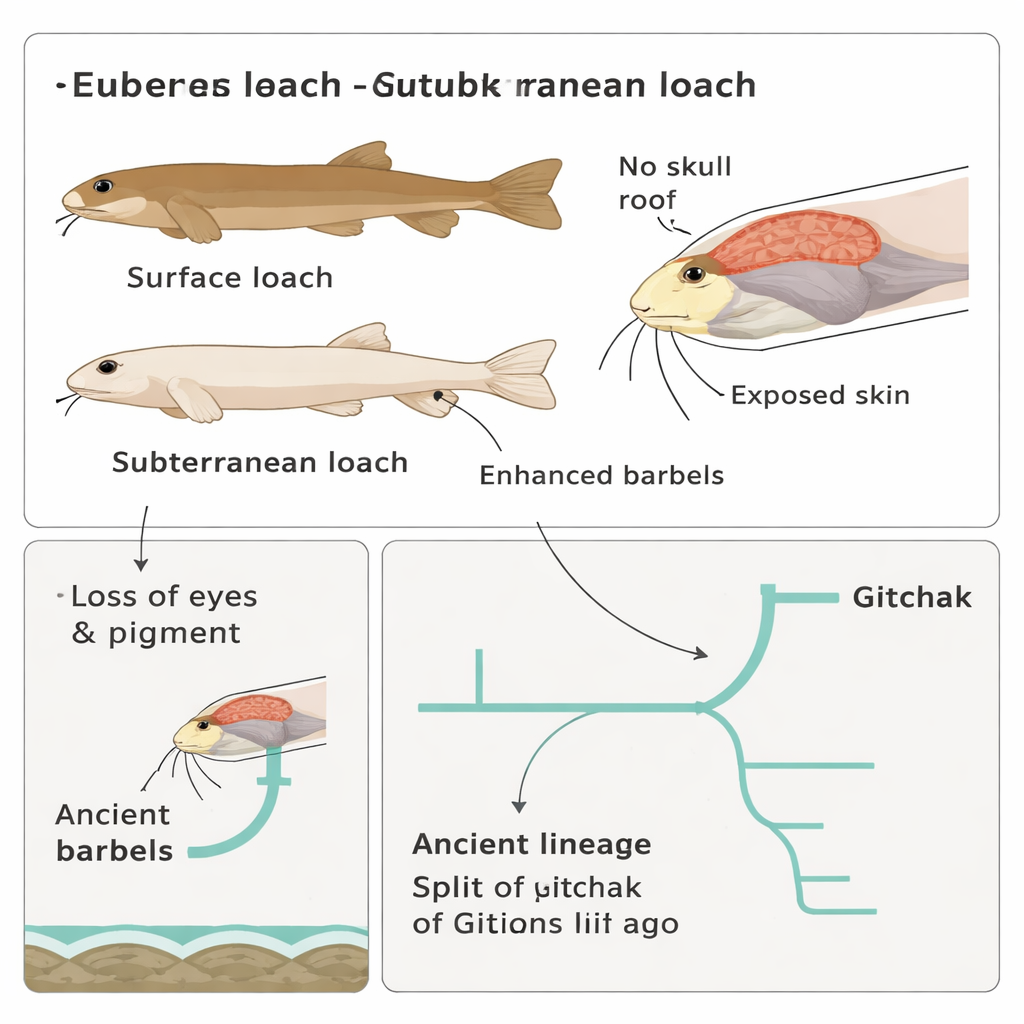
Life in total darkness has reshaped Gitchak nakana. The fish are tiny, no more than two centimeters long, and their bodies are almost completely transparent, appearing blood-red because internal organs and blood vessels show through the skin. They have no functional eyes; only a tiny speck of pigment marks where eyes would normally be. Instead of vision, they rely on a crown of long whisker-like structures, called barbels, around the mouth and snout. These barbels are rich in blood vessels and taste buds, allowing the fish to feel and taste their surroundings in murky, cramped underground spaces where food is scarce and light never reaches.
A Skull With a Window to the Brain
When the researchers used high-resolution micro‑CT scanning to look inside the fish, they found something never before seen in this group: the top of the skull is completely open. In other loaches, bones form a solid roof over the brain. In Gitchak nakana, these bones stop short, leaving a large gap so that the brain is covered only by skin. The fish also has unusually long supporting bones for the throat region and an enlarged internal gas-filled organ, the swim bladder, housed in an extended bony capsule. These features make the skeleton extremely lightweight and simplified, a pattern seen in other miniature fishes that reach adulthood while still keeping many juvenile traits.
Life Strategy in a Food-Poor World
Reproduction in this hidden species is also unusual. Instead of producing hundreds or thousands of tiny eggs, as typical loaches do, adult females of Gitchak nakana carry only a handful of very large eggs arranged in a single row inside the body. The authors suggest that these large eggs give rise to comparatively large, well-provisioned offspring that can begin feeding on the same limited food resources as adults. In an environment where nutrients are scarce and unpredictable, betting on a few robust young, rather than many fragile ones, may be a better route to survival.
An Ancient Lineage in a Young Landscape
DNA analyses show that Gitchak nakana is not just a local oddity but a distinct branch on the loach family tree. It is most closely related to certain loaches from southern India, including other subterranean forms, yet it diverged from these relatives at least 20–45 million years ago. This is striking because the sediments that currently host its aquifer are geologically young, likely less than a million years old. The authors propose that either aquifer habitats like this have existed in the region for a very long time, being renewed as rivers shift and deposit new layers, or that the ancestors of Gitchak nakana once lived in surface waters and only later retreated underground.
Why This Hidden Fish Matters
To a non-specialist, Gitchak nakana might look like a tiny, ghostly fish of little consequence. Yet it encapsulates big ideas in evolution, geology, and conservation. Its extreme adaptations—loss of eyes, see‑through body, open skull roof, miniature size, and unusual breeding strategy—show how far life can change to cope with permanent darkness. Its discovery in a single village well warns that fragile groundwater ecosystems may harbor unique species that can be lost before they are even known to science. Protecting underground water, therefore, is not only about human drinking supplies; it is also about safeguarding remarkable lineages like Gitchak nakana that have been evolving in the dark for tens of millions of years.
Citation: Britz, R., Marak, W.K., Velentina, K. et al. A miniature, subterranean, blind cobitid loach, Gitchak nakana, new genus and species, is the first groundwater-dwelling fish from Northeast India. Sci Rep 16, 7746 (2026). https://doi.org/10.1038/s41598-026-40425-6
Keywords: subterranean fish, groundwater aquifer, miniature loach, evolutionary adaptation, Northeast India biodiversity