Clear Sky Science · en
Standardized quantum transistor block enables differentiable learning on gait dynamics
Turning Walking Patterns into Early Health Clues
Walking may feel effortless, but the way we move carries a wealth of hidden information about our health, especially for people with conditions like multiple sclerosis. This paper explores a new kind of building block for quantum-inspired computers—a "quantum transistor"—and tests whether networks made from these blocks can reliably recognize walking patterns from data collected by smart socks. Instead of chasing headline-grabbing quantum speedups, the authors focus on something more down-to-earth: creating a standardized, well-understood component that engineers can plug into future hybrid classical–quantum systems.
A New Kind of Switch for Quantum Circuits
In everyday electronics, transistors act as tiny switches that amplify signals and make modern computing possible. They are powerful not just because they work, but because they are standardized: designers know exactly how they behave, how much they amplify, and when they saturate. This paper proposes a quantum analogue called the Quantum Transistor, or QT. Each QT takes in one numerical signal between minus one and one and produces one output in the same range, using a simple two-qubit quantum circuit. In the particular version studied here, the circuit never actually entangles its two qubits, which makes its behavior easy to analyze and even to simulate efficiently on ordinary computers. The key point is that its input–output curve is smooth, bounded, and transistor-like: small changes in the input are amplified in a predictable middle region, while very large inputs cause the output to flatten out.
Building a Hybrid Pipeline from Socks to Decisions
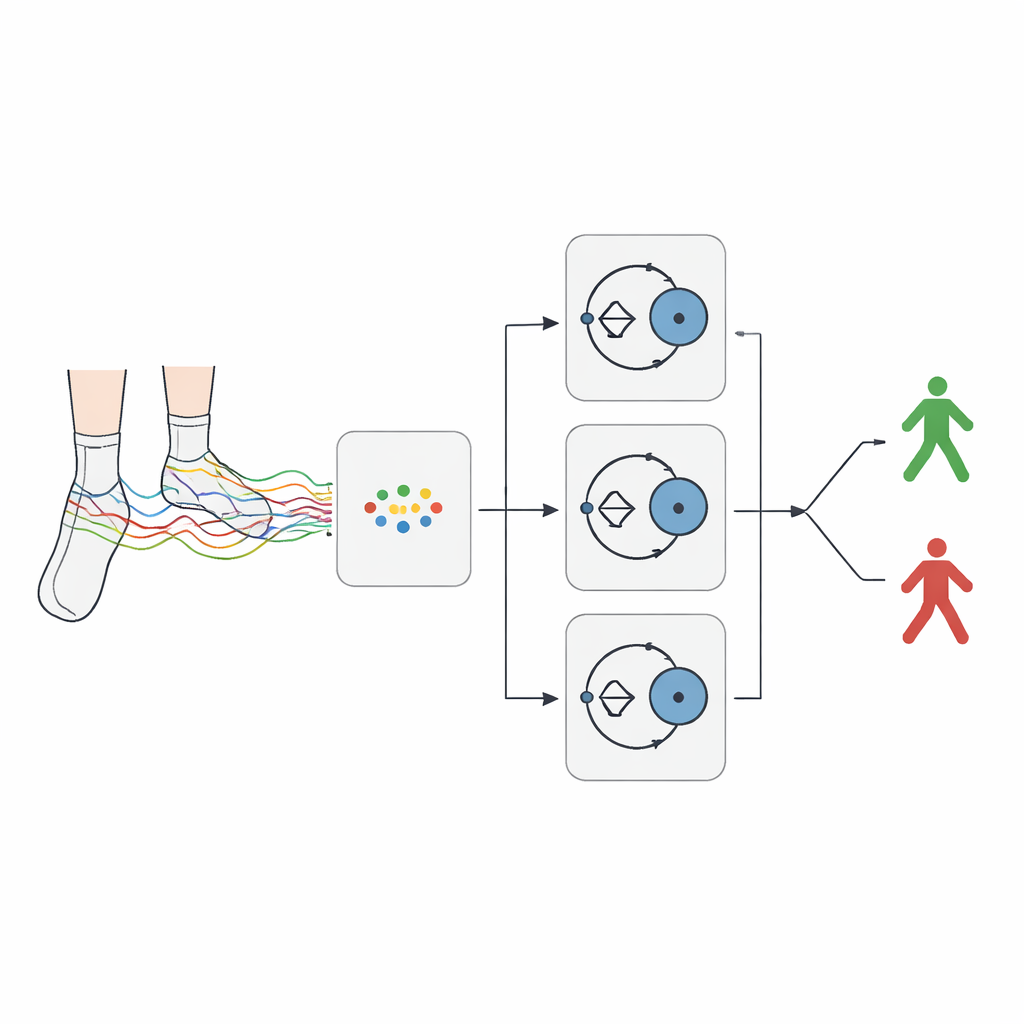
To see whether this standardized quantum block is useful in practice, the authors tackle a real clinical problem: detecting walking segments in people with multiple sclerosis using instrumented socks. The socks record pressure and motion signals from both feet at high speed. These raw readings are carefully synchronized and transformed into spectrogram "images" that reveal how the frequency content of the motion changes over time, which is well suited to capturing the regular rhythm of gait. A small classical layer then compresses each 40-by-12 spectrogram into eight normalized numbers, acting like a compact lens that summarizes the most informative aspects of the signal before it reaches the quantum part of the system.
Stacking Quantum Transistors Like Circuit Blocks
On top of this classical front end, the authors build a three-layer network of Quantum Transistors arranged in a 4–3–2 pattern: four QTs in the first layer, three in the second, and two in the third. Each QT consumes a single number and outputs a new one, with the layers chained so that selected outputs from one layer feed directly into the corresponding QTs in the next. In the prototype studied here, only one path through this stack—the second QT in each layer—actually influences the final decision; the others are kept for monitoring and future extensions. The network is trained with standard gradient-based methods, taking advantage of the QT’s neat mathematical form to compute exact derivatives. During training, the researchers observe that the internal QT outputs move away from their saturated extremes and settle into the sensitive mid-range, mirroring how classical transistors are biased to operate where they amplify signals most effectively.

How Well Does It Recognize Gait?
The authors evaluate their QT-based model on a carefully curated dataset where smart socks capture real-world activity, and an automated labeling engine identifies sustained walking periods using frequency analysis. They follow strict subject-aware cross-validation so that people seen in training are never reused in testing, and they tune the decision threshold on validation data to maximize the F1 score, a balance of precision and recall. Under this rigorous setup, the QT network achieves an average accuracy of about 96 percent and an F1 score around 0.93 on held-out subjects. Compact classical models with a similar number of adjustable parameters perform slightly better, and larger neural networks—especially a Transformer-style encoder—do better still. Importantly, the classical models also enjoy richer input information, because they operate directly on the full spectrograms rather than on the eight-number summaries fed to the QT stack.
Why a Quantum Transistor Still Matters
Although the QT network does not beat the strongest classical methods on this dataset, that is not the authors’ goal. Their main achievement is to show that a tiny, standardized quantum block can be given a clear input–output contract, predictable gain, and simple tests for correct behavior, much like a classical transistor. Because each QT has fixed depth, bounded outputs, and analytic formulas describing how it responds and how noise deforms its signals, hardware and software teams can reason about resource needs, calibration, and robustness in a transparent way. This makes the QT block a promising foundation for future hybrid systems, especially in settings where quantum sensors or quantum data are already present and where reliability and interpretability matter as much as raw accuracy.
Citation: Villalba-Díez, J., Ordieres-Meré, J. Standardized quantum transistor block enables differentiable learning on gait dynamics. Sci Rep 16, 9506 (2026). https://doi.org/10.1038/s41598-026-40424-7
Keywords: quantum transistor, variational quantum circuits, gait analysis, wearable sensors, hybrid classical–quantum models