Clear Sky Science · en
Genotype-dependent salt tolerance mechanisms in wheat–Thinopyrum introgression lines revealed by ion transporter gene expression and seedling phenotyping
Why salty soils threaten our daily bread
Much of the world’s wheat is grown on land that is slowly turning salty, as irrigation water evaporates and leaves minerals behind. Salt in the soil makes it harder for plants to take up water and can poison their cells, reducing harvests that millions depend on. This study explores whether genes borrowed from hardy wild grasses can help wheat seedlings cope with salty conditions, offering a glimpse of how breeders might safeguard future food supplies.
Borrowing toughness from wild grass cousins
Modern bread wheat is productive but only moderately tolerant of salt. In contrast, some wild relatives in the Thinopyrum group can grow in soils that would quickly stunt regular crops. The researchers created three “introgression lines” of wheat that each carry a different chromosome or chromosome segment from these wild grasses. Before testing their performance, the team used colorful chromosome staining techniques, a kind of genetic microscopy, to confirm that each wheat line really contained the intended piece of Thinopyrum DNA and that the plants were genetically stable. This step ensured that any differences in salt tolerance could be confidently linked to the presence of the wild chromosomal segments.
Testing seedlings in salty water
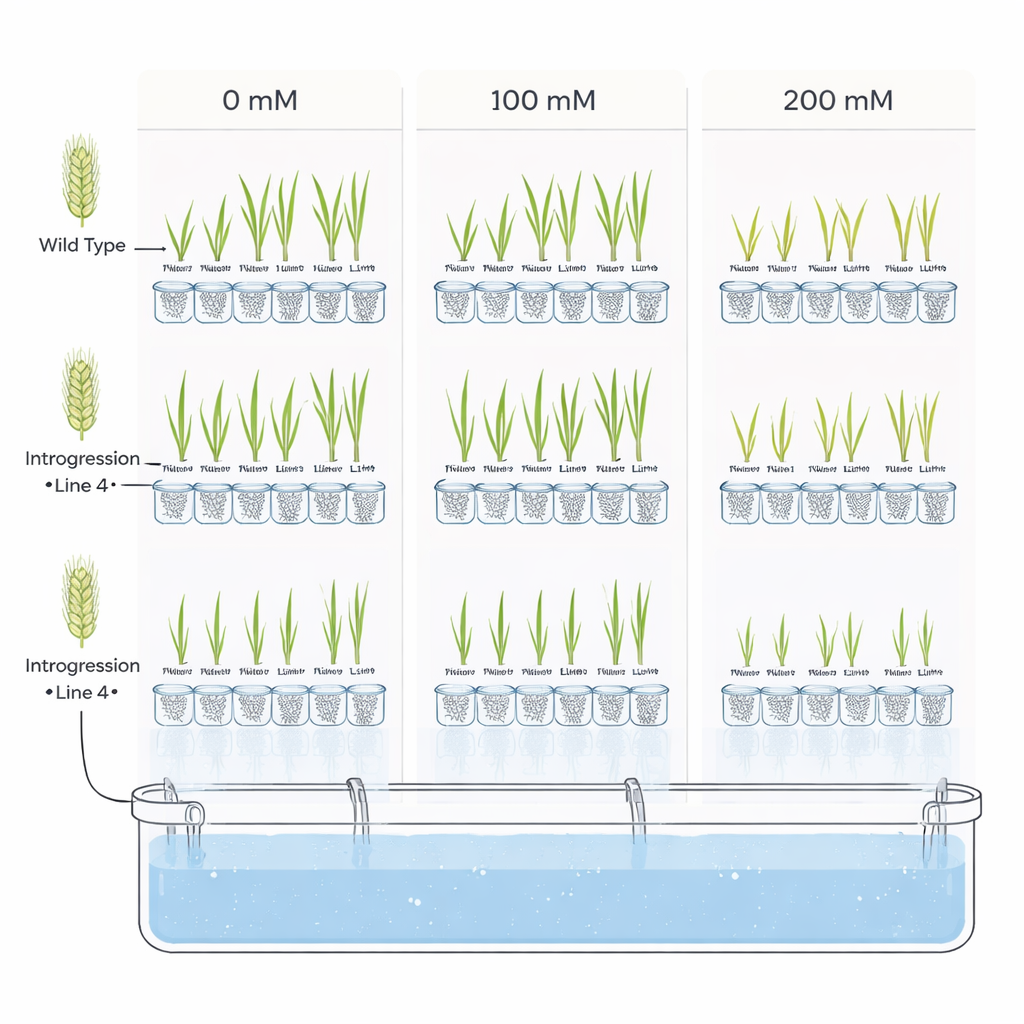
To see how these lines behaved under stress, the scientists compared them with two standard wheat varieties during germination and early growth. Seeds were sprouted on paper or in hydroponic solution containing no added salt or increasingly salty levels of sodium chloride, similar to what plants might encounter in problem fields. The team measured how many seeds germinated, how fast they did so, and how long the first root (radicle) and shoot (coleoptile and young leaves) grew. They also used imaging software to capture detailed root traits such as total length, surface area, volume, and thickness. As expected, higher salt sharply reduced both root and shoot growth in all plants, but the degree of damage varied strongly among genotypes.
Which wheat handled salt best?
Across the tests, the introgression lines generally performed better than or similar to their wheat parents under salty conditions. One line, in which a Thinopyrum chromosome replaced wheat chromosome 3D (called the 3St(3D) substitution line), stood out. Even at high salt levels, its seeds germinated reliably and its roots and shoots shrank less than those of the standard varieties. Another line carrying a different wild segment showed particularly strong root systems at moderate salt, helping seedlings explore more soil despite the stress. Overall, the ranking in salt tolerance during germination placed the 3St(3D) line at the top, followed by the other two introgression lines, and finally the conventional wheats, one of which proved clearly sensitive.
Peering inside cells to see how they cope with salt
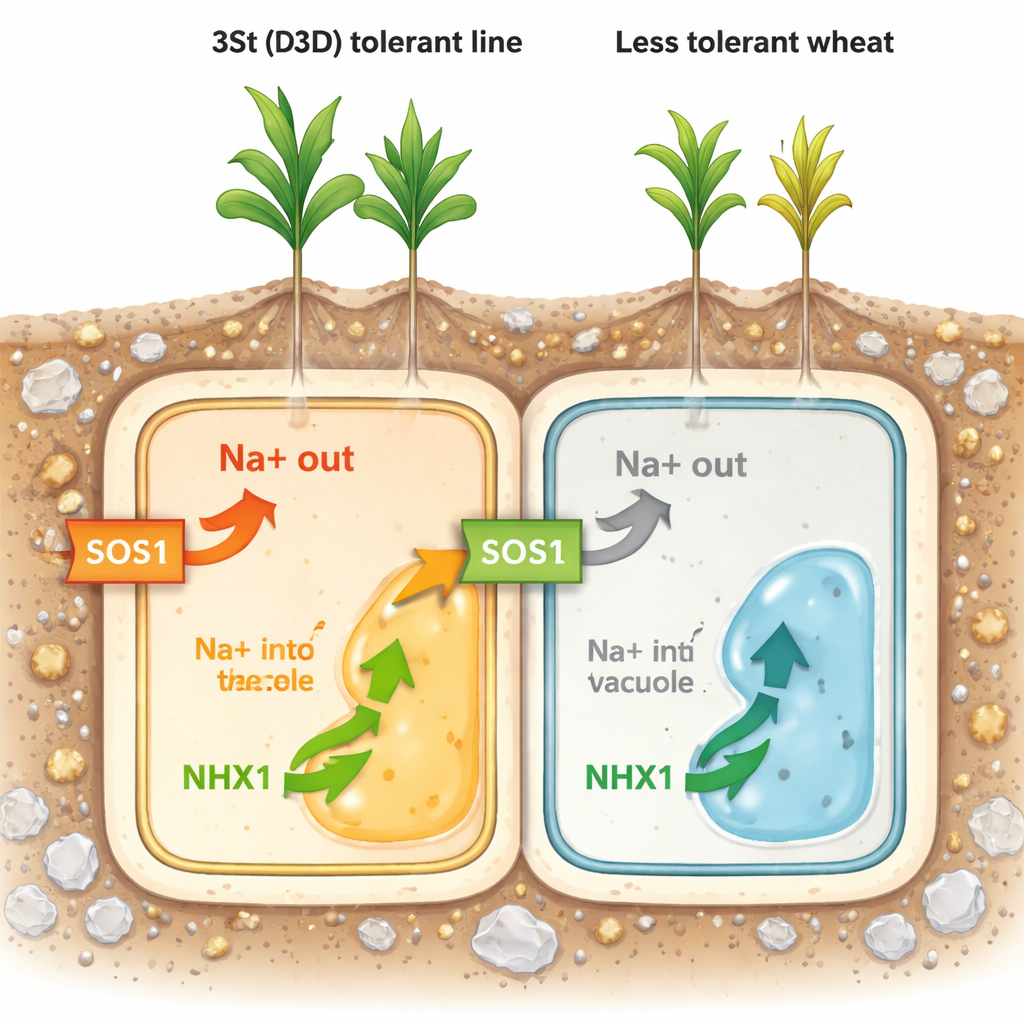
To move beyond visible traits, the researchers examined the activity of key genes that help cells survive when sodium builds up. These genes include HKT transporters that control how much sodium moves through the plant, SOS genes that pump sodium out of cells, and NHX genes that lock it away in internal storage compartments called vacuoles. By measuring gene activity separately in the young root and shoot tissues of seedlings under different salt levels, the team uncovered distinct response patterns among the lines. In the 3St(3D) line, two genes in particular—TaSOS1 and TaNHX1—became strongly more active under salt stress, suggesting that this genotype is especially good at both pushing sodium back out into the surroundings and sequestering excess inside safe internal “salt closets.”
What this means for future wheat fields
For non-specialists, the key message is that the way a wheat plant reacts to salt depends not only on how it looks above ground, but on hidden genetic switches that manage sodium inside its cells. By importing chromosome pieces from salt-hardy wild grasses, breeders can boost these protective systems without necessarily harming yield potential. The study identifies the 3St(3D) line as a particularly promising candidate: its seedlings stay more vigorous on salty water, and its internal sodium pumps and storage systems are more strongly engaged. Such lines provide valuable starting material for breeding wheat that can maintain growth and yield on increasingly saline soils, helping to keep bread on tables in a changing climate.
Citation: Gholizadeh, F., Janda, T., Varga, B. et al. Genotype-dependent salt tolerance mechanisms in wheat–Thinopyrum introgression lines revealed by ion transporter gene expression and seedling phenotyping. Sci Rep 16, 7647 (2026). https://doi.org/10.1038/s41598-026-40421-w
Keywords: wheat, salt stress, crop breeding, wild relatives, ion transport