Clear Sky Science · en
Response surface modeling and correlation analyses of mechanical and non-destructive properties in graphene–date palm fiber reinforced concrete
Stronger, Greener Buildings from Everyday and High-Tech Ingredients
Concrete holds up our homes, bridges, and skyscrapers, but it has two big problems: it cracks easily and it carries a heavy environmental footprint. This study looks at an unusual pairing—a cutting-edge carbon nanomaterial and a common agricultural waste, date palm fibers—to see whether together they can produce concrete that is both tougher and more sustainable. By testing many recipes and using advanced statistics, the researchers show how to get the best mix of strength, durability, and climate impact.
Why Mix Tree Fibers into Concrete?
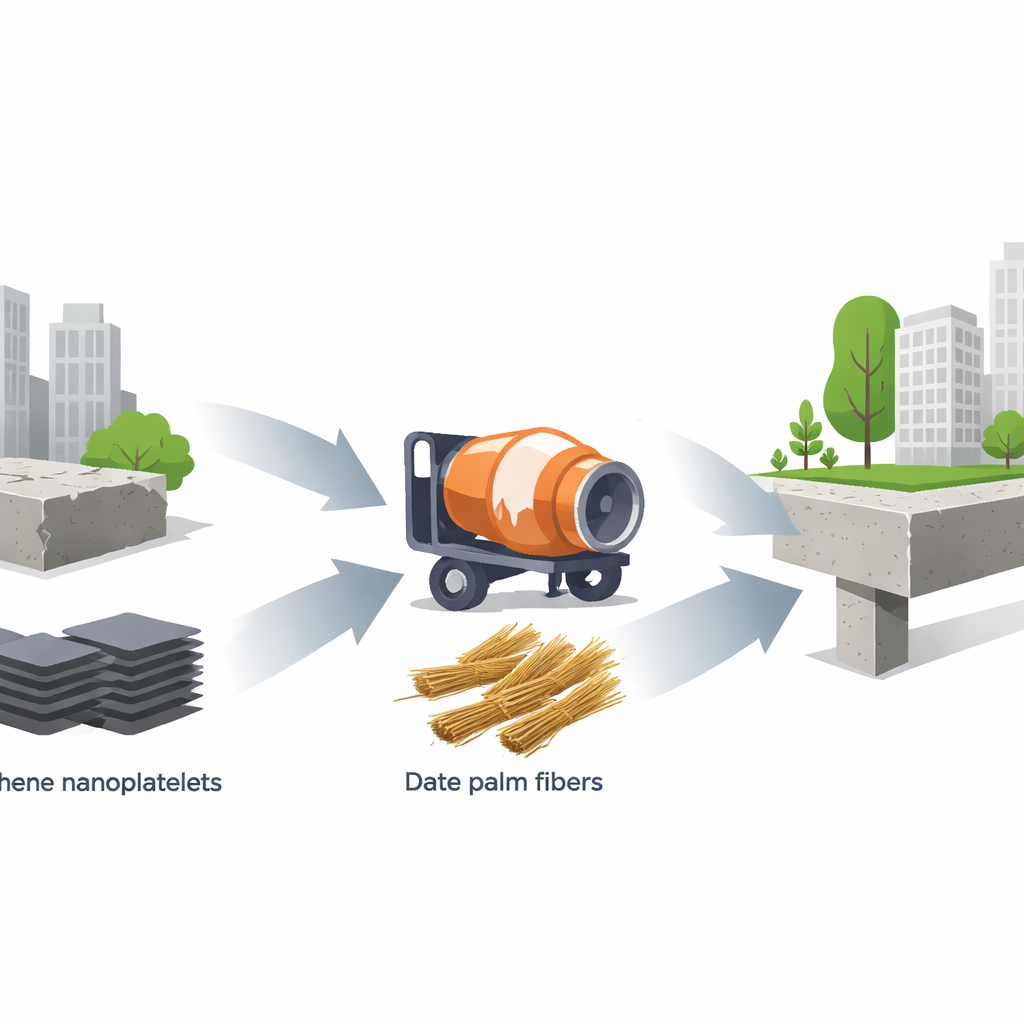
Concrete is excellent at withstanding squeezing forces but weak when pulled or bent, which is why it tends to crack. One long-standing idea is to add fibers that act like tiny stitches, helping hold the material together when small cracks form. Date palm trees, widely grown in arid regions, produce large amounts of fibrous waste that is usually discarded. In this work, the team cleaned and treated these fibers, then chopped them into short lengths before adding them to concrete. At modest amounts, the fibers helped the concrete resist cracking, increasing its ability to carry loads in compression, tension, and bending. However, when too many fibers were added, they created extra voids and clumps inside the concrete, which actually weakened it and reduced some benefits.
What Does Graphene Add to the Mix?
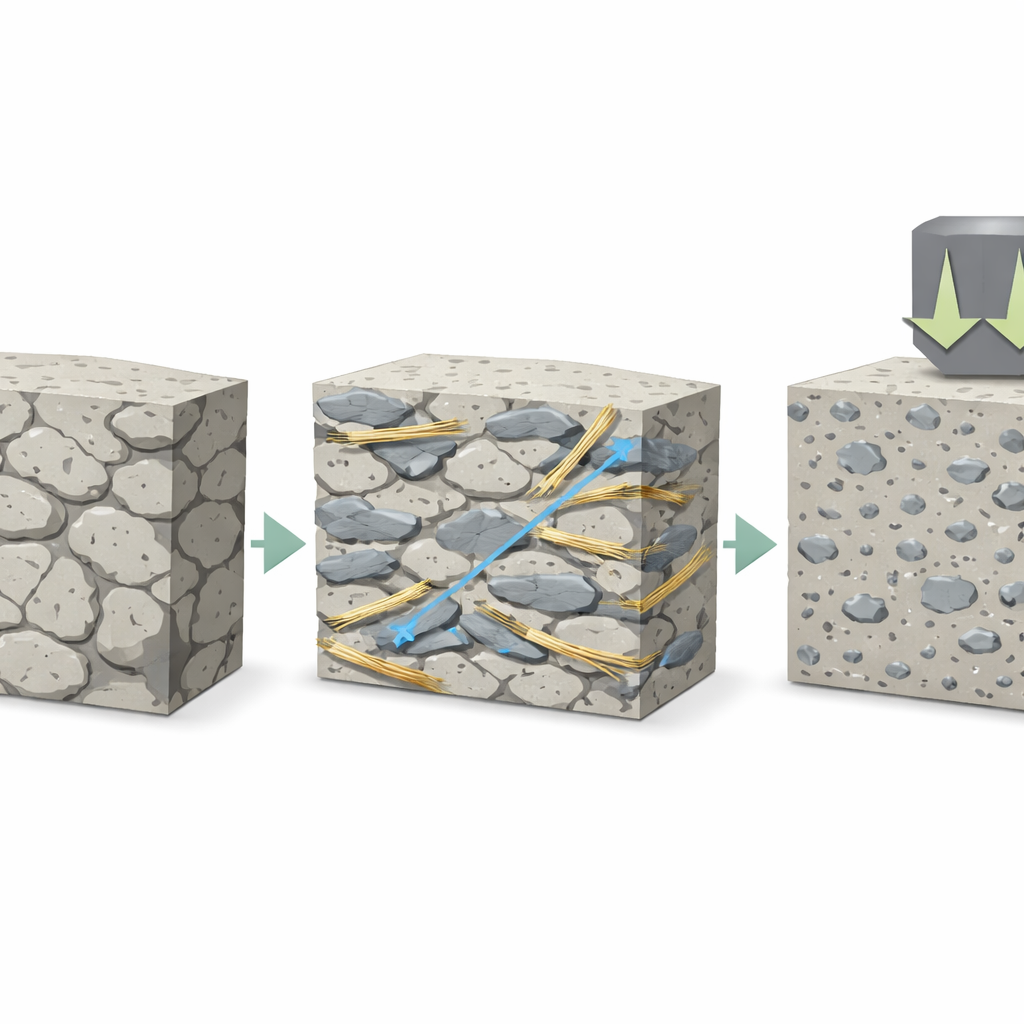
Graphene nanoplatelets are stacks of ultra-thin carbon sheets with exceptional stiffness and strength. Even in tiny doses—less than a quarter of one percent by weight—they can pack into the microscopic gaps in cement paste, making the hardened material denser and more uniform. In the experiments, increasing the graphene content steadily boosted key properties such as compressive strength, stiffness, and speed of sound waves through the concrete, a common non-destructive test of quality. The concrete became more resistant to cracking and deformation because the nano-sized plates helped redirect stress and tighten the internal structure.
Finding the Sweet Spot Between Strength and Sustainability
Instead of changing one ingredient at a time, the researchers designed eleven different mixes, varying the amounts of graphene nanoplatelets and date palm fibers together. They then used a statistical tool called response surface modeling to build mathematical maps showing how this two-ingredient “recipe space” affects five important traits: compressive strength, bending strength, tensile strength, stiffness, and ultrasonic pulse velocity. These maps revealed a strong synergy: when graphene was near its upper tested level and fiber content stayed moderate, the concrete’s strength jumped dramatically—by more than 40 percent compared with ordinary concrete. Pushing the fiber content too high, however, reversed some of these gains because of extra porosity and weak spots.
Testing Hidden Connections Inside the Material
To see how different measures of performance move together, the team performed correlation analyses. They found that most mechanical properties were tightly linked: if a mix had high compressive strength, it almost always also had high stiffness and bending strength. In contrast, the ultrasonic pulse test, which measures how quickly sound travels through concrete, showed only moderate connection to these properties. That means sound-based tests are useful but cannot fully replace direct strength tests. By combining multiple measures in a more advanced analysis, the researchers showed that a smart mix of non-destructive readings can still serve as a strong stand-in for actual strength, offering a promising route for monitoring real structures without damaging them.
Balancing Carbon Cost with Performance
The team also considered the climate cost of each mix. Manufacturing cement and graphene both emits significant carbon dioxide, while the date palm fibers were treated as nearly carbon-free because they come from waste and require little processing. Adding fibers alone improved the ratio of strength to emissions, making those mixes more eco-efficient than standard concrete. Graphene, on the other hand, greatly boosted strength but also raised the embodied carbon. By feeding all the data into a multi-objective optimization, the researchers pinpointed an optimal recipe: about 0.2 percent graphene nanoplatelets and 1 percent date palm fiber. This combination delivered very high strength and stiffness, along with respectable eco-efficiency and excellent agreement between the predicted and measured results.
What This Means for Future Construction
For non-specialists, the takeaway is clear: it is possible to engineer concrete that is tougher and more durable while making clever use of natural waste fibers. A careful sprinkle of graphene nanoplatelets tightens the material from the nanoscale up, and modest amounts of date palm fiber help hold cracks in check. When tuned together, these ingredients can yield concrete that carries heavier loads and better resists damage, while reducing reliance on purely synthetic reinforcements. Although graphene’s carbon footprint and cost remain challenges, the study offers a blueprint for designing next-generation “green” concretes that balance strength, durability, and environmental responsibility.
Citation: Abdou Elabbasy, A.A., Almaliki, A.H., Khan, M.B. et al. Response surface modeling and correlation analyses of mechanical and non-destructive properties in graphene–date palm fiber reinforced concrete. Sci Rep 16, 9440 (2026). https://doi.org/10.1038/s41598-026-40412-x
Keywords: sustainable concrete, graphene nanoplatelets, date palm fiber, fiber reinforced concrete, eco-efficient materials