Clear Sky Science · en
Producer organizations, productivity and sustainable intensification practices in oil palm production
Why small farmers and forests both matter
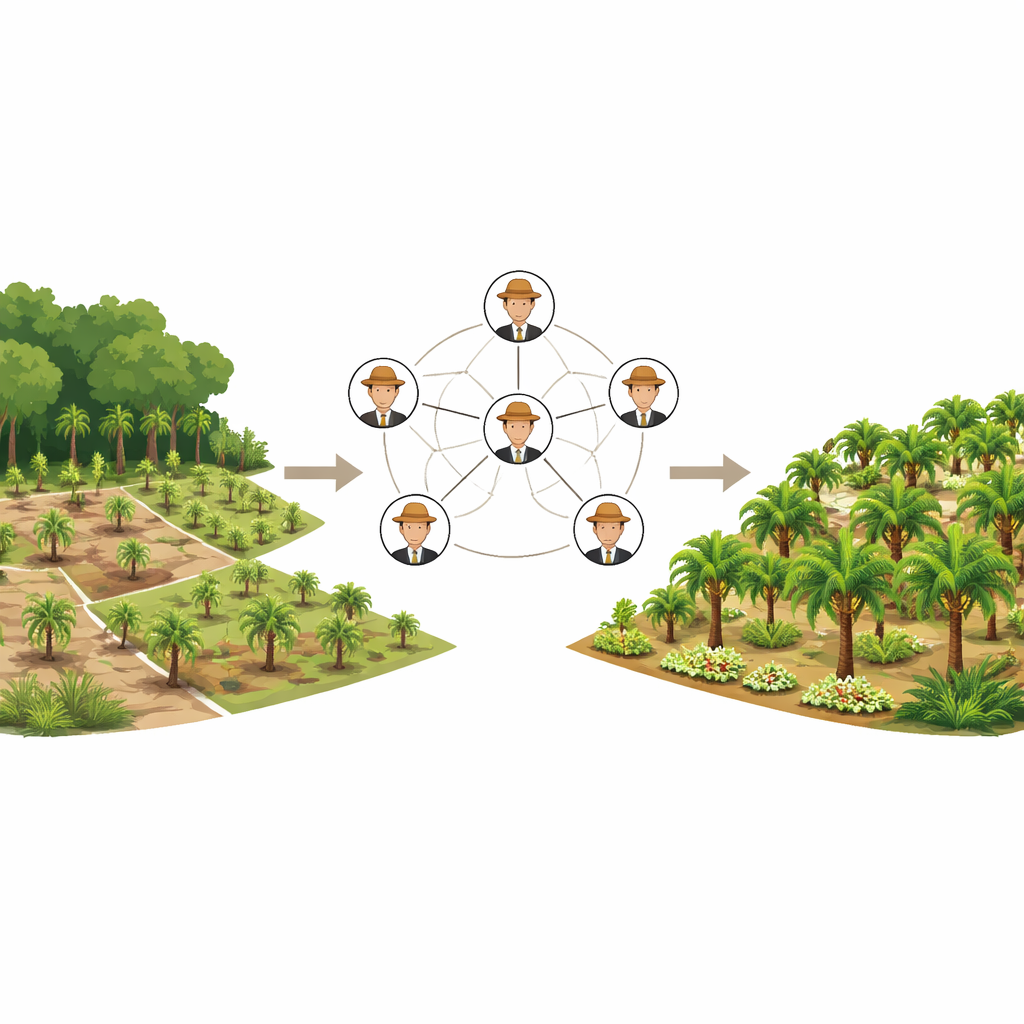
Across the tropics, palm oil helps millions of families earn a living, but its rapid expansion has often come at the expense of forests and wildlife. In Cameroon and other African countries, many small farmers are planting more oil palm by clearing new land instead of getting better harvests from the plots they already have. This study asks a simple but powerful question: can farmer groups help smallholders grow more oil palm on existing land in ways that also protect the environment?
Growing more without cutting more
Oil palm is a remarkably productive crop, and demand for its oil is rising worldwide. In Cameroon, smallholders dominate the sector and rely on it for cash income and food. Yet their yields are low, partly because they have limited access to good advice, inputs, and markets. Rather than intensifying production, many respond by expanding into nearby forests, adding to deforestation and biodiversity loss. The authors explore a different path known as “sustainable intensification” – raising yields on current land while reducing harm to soils, water, and forests – and ask how this might work in smallholder oil palm landscapes.
Simple practices with big potential
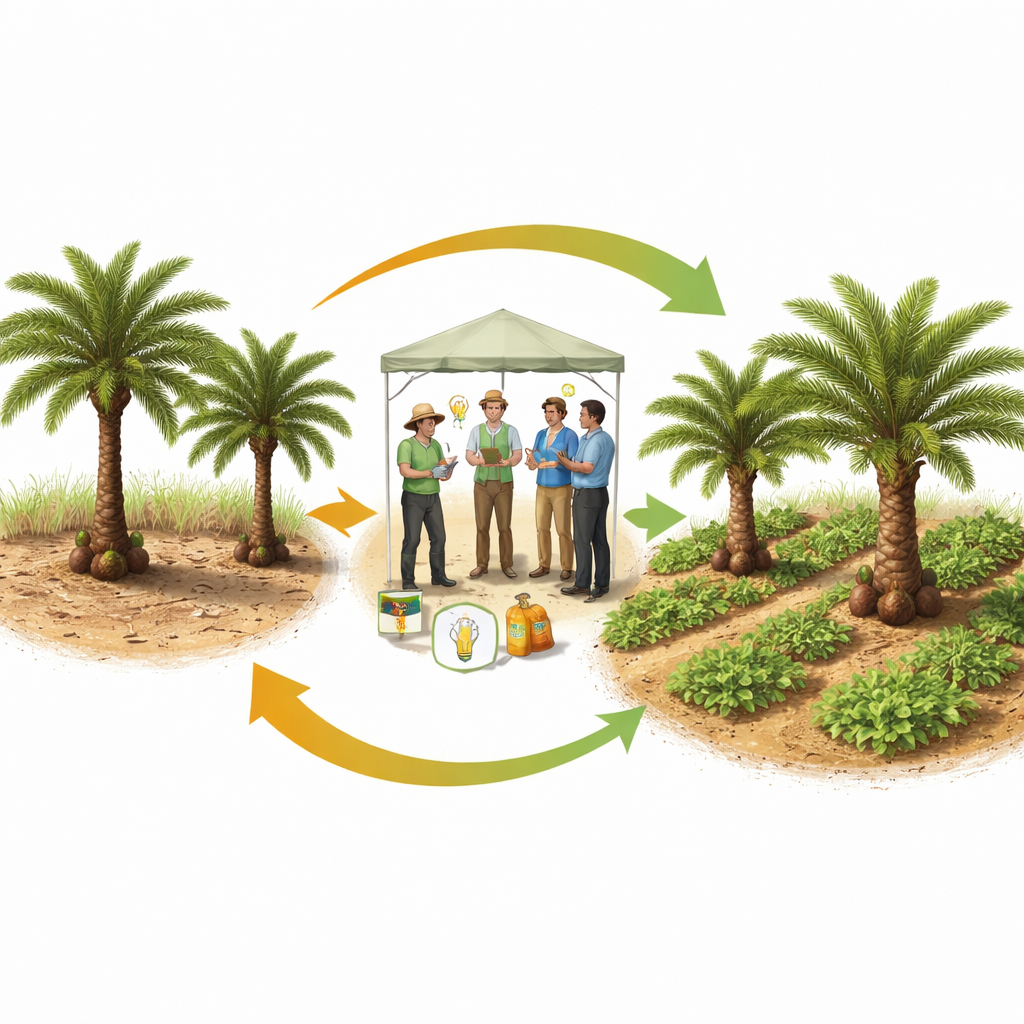
The study focuses on two straightforward field practices that can boost both harvests and soil health. Mulching, using pruned palm fronds and other plant residues to cover the soil, helps retain moisture, adds organic matter, and reduces erosion. Intercropping, planting other crops such as legumes or food crops between oil palms, can improve soil fertility, diversify diets and incomes, and make better use of space, especially when palms are young. Together, these practices can raise yields and reduce pressure to clear new land. However, they require knowledge, labor, and in some cases inputs that many farmers struggle to access on their own.
How farmer groups change the game
Producer organizations – local farmer groups and cooperatives – offer a way to overcome these barriers. They can organize training on good farming practices, negotiate better prices, arrange access to credit and inputs, and create spaces where farmers learn from one another. The researchers surveyed 329 smallholder oil palm farmers in Cameroon’s Littoral region, collecting detailed information on their fields, harvests, use of mulching and intercropping, and whether they belonged to a producer organization. They then applied several statistical approaches designed to mimic “what if” scenarios, estimating not only how members fare compared with non-members, but also how non-members might perform if they joined.
What the numbers reveal
Across multiple models, membership in producer organizations was strongly linked to higher output from oil palm. After accounting for many other factors, farmers in these groups produced about half again as much oil palm fruit and obtained substantially higher yields per hectare than similar non-members. The analysis also suggested that non-members could gain even more than current members if they were to join, based on their existing characteristics. Membership was clearly associated with greater use of mulching and intercropping: group members were much more likely to cover the soil with palm residues and to grow additional crops between trees. The study further found that producer organizations were tied to farmers’ psychological traits, including confidence in their own abilities, sense of control over outcomes, hope for the future, and willingness to take calculated risks – all factors known to influence whether people adopt new practices. Gender mattered too: male-headed households saw clearer gains in yield, while women-headed households appeared to benefit more in terms of adopting mulching and intercropping, even if yield impacts were less obvious in the short term.
Why this matters for people and the planet
For readers concerned about both rural livelihoods and tropical forests, these findings highlight an encouraging pathway. By helping farmers organize, share knowledge, and access resources, producer organizations can make it easier for smallholders to adopt simple, sustainable practices that raise yields on existing plots. In Cameroon’s oil palm landscapes, this means more fruit bunches per tree, healthier soils, and more diverse crops and incomes without automatically pushing the agricultural frontier deeper into forests. While the study is based on one region and cannot prove cause and effect with absolute certainty, it provides strong evidence that strengthening farmer groups is a practical lever for “more from less” – more income and food security for smallholders, and less pressure on the Congo Basin’s remaining forests.
Citation: Tabe-Ojong, M.P.J., Geffersa, A.G. & Sibhatu, K.T. Producer organizations, productivity and sustainable intensification practices in oil palm production. Sci Rep 16, 7818 (2026). https://doi.org/10.1038/s41598-026-40384-y
Keywords: oil palm smallholders, producer organizations, sustainable intensification, mulching and intercropping, Cameroon agriculture