Clear Sky Science · en
Social comparison and maladaptive emotion regulation are associated with poorer mental health in social media users
Why our online lives matter for our feelings
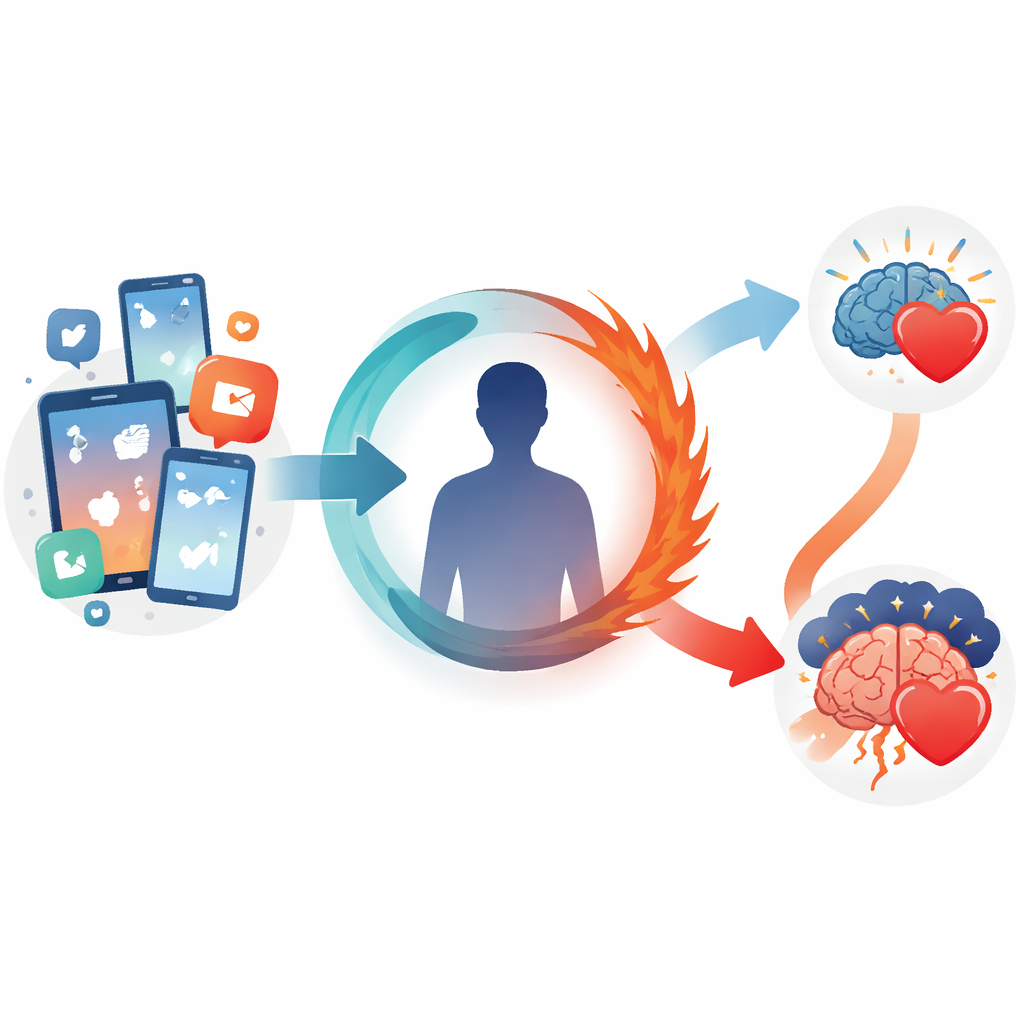
Scrolling through social media has become as routine as brushing our teeth, yet worries about its impact on our moods and minds keep growing. This study looks beyond simple "screen time" to ask a more subtle question: what exactly are we doing and feeling while we are online, and how does that shape our mental health? By focusing on habits like constantly comparing ourselves to others and getting stuck in unhelpful ways of dealing with emotions, the researchers show that the quality of our online engagement may matter far more than the number of minutes spent on our phones.
Who was studied and what was measured
The research drew on a nationally representative sample of 1,707 people in Spain, aged 16 to 75, with roughly equal numbers of women and men and participants from every region of the country. Instead of relying only on memories of how much time they spend online, participants shared objective screen-time data from their smartphones. They also answered established questionnaires that assessed symptoms of anxiety and depression, anger and displaced aggression, how often they compare themselves with others, and how often they use unhelpful emotion habits such as self-blame, rumination (mentally replaying negative events), catastrophizing (imagining the worst), and blaming others.
Not all users and not all platforms are alike
The study found clear differences across gender, age groups, and favorite platforms. Women spent more time on social media than men and, on average, showed higher levels of depression, anxiety, social comparison, and maladaptive ways of regulating emotion. Age made a large difference: people in Generation Z (16–30) reported the most time on social media, the highest tendency to compare themselves to others, and the greatest burden of depression, anxiety, anger, and unhelpful emotion habits. These tendencies steadily decreased across Millennials and Generation X, reaching the lowest levels among Boomers (56–75). Different preferred platforms also clustered with different emotional profiles, even after taking age into account, suggesting that the design and culture of specific apps can nudge users toward more or less emotionally risky ways of engaging.
What links social media to mood problems
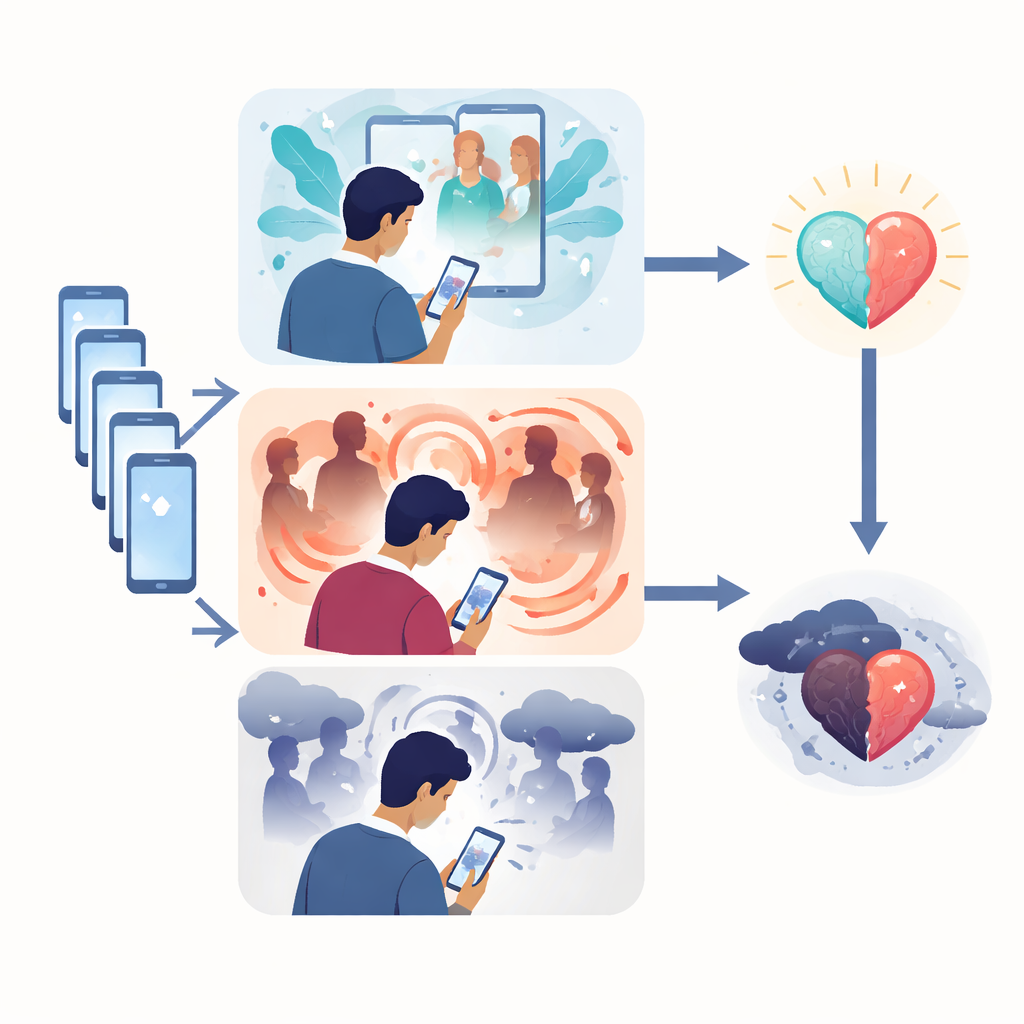
When the researchers examined how all the variables were connected, they found that total time on social media was only weakly related to mental health on its own. What mattered much more was what happened in people’s minds as they used these platforms. Heavy use was associated with more frequent social comparison, and those who compared themselves more were, in turn, more likely to rely on maladaptive emotion regulation strategies. These unhelpful habits were strongly tied to higher anger, anxiety, and depression. In statistical models, social comparison and maladaptive emotion regulation formed a chain that linked time spent on social media to worse emotional outcomes, explaining a substantial share of the variation in symptoms across people.
Why young people, especially young women, may be at risk
The patterns were especially pronounced in younger users. Generation Z, who have grown up immersed in digital technology, spend more time on visually driven platforms where curated images and highlight reels are the norm. For many, this means frequent "upward" comparisons to people who appear more attractive, successful, or socially connected. Combined with a stronger tendency to ruminate and catastrophize, this can create a vicious cycle: social media triggers self-doubt and envy, unhelpful thinking styles keep those feelings alive, and distress in turn fuels more searching and scrolling. The study also highlights anger and displaced aggression as important outcomes: frustration born from constant comparison or online conflict can spill over into relationships offline.
What this means for everyday life
Overall, the findings suggest that social media is not inherently harmful, and simply cutting down screen time may do little for most adults. Instead, problems arise when frequent online use goes hand in hand with constant self-comparison and rigid, self-punishing ways of handling emotions. For individuals, this points to practical levers: becoming more mindful of when scrolling is driven by low mood, limiting exposure to content that reliably triggers envy or insecurity, and learning healthier strategies to cope with difficult feelings before reacting online. For parents, educators, and policymakers, the study underscores the value of teaching emotional skills and critical thinking about online content, particularly for younger generations, so that social platforms can be used in ways that support rather than undermine mental health.
Citation: Castillo-Gualda, R., Rathje, S. & Ramos-Cejudo, J. Social comparison and maladaptive emotion regulation are associated with poorer mental health in social media users. Sci Rep 16, 9479 (2026). https://doi.org/10.1038/s41598-026-40371-3
Keywords: social media and mental health, social comparison, emotion regulation, screen time quality, Generation Z