Clear Sky Science · en
Faecal sac energy in common swifts (Apus apus) as a function of mass and nest identity
Why Bird Parents Eating Poop Matters
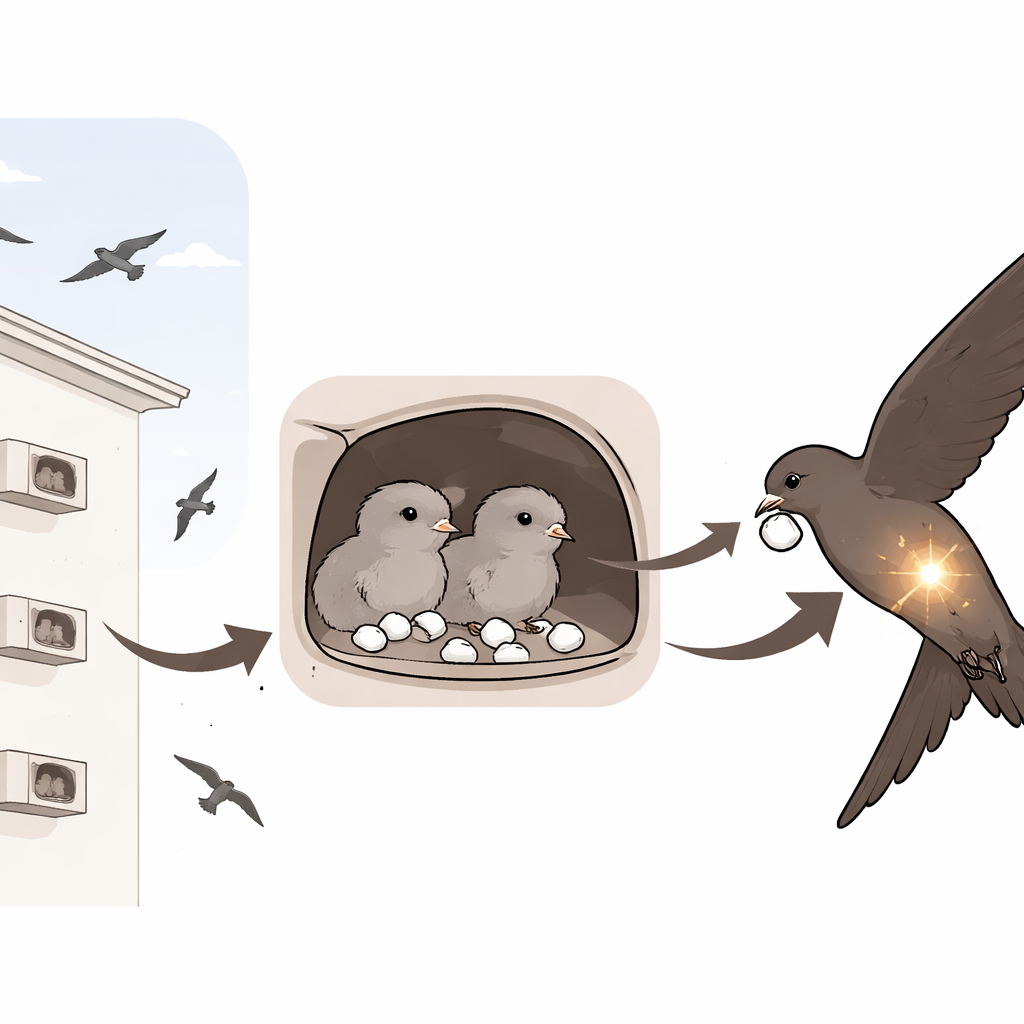
For many birds, raising chicks is a high‑energy marathon. Parents must spend long hours catching food while also keeping the nest clean and safe. One puzzling behavior seen in several species, including the Common Swift, is that parents sometimes eat their chicks’ droppings. This study asks a simple but important question: just how much energy is locked up in those neat, mucus‑wrapped bundles of waste, and could eating them meaningfully help the parents cope with the costs of parenthood?
Aerial Athletes With Tight Energy Budgets
Common Swifts are extreme fliers that spend almost their entire lives on the wing, landing only briefly to breed in nest boxes or crevices. To feed their chicks, adults sweep through the air collecting insects into dense boluses, which they then deliver back at the nest. This lifestyle is energetically expensive: swifts may travel tens of kilometers to find food and use energy‑saving tricks such as nighttime torpor to get by. In such a finely balanced system, even small chances to reclaim otherwise wasted energy—such as nutrients left in chick droppings—could, in theory, matter for survival and breeding success.
Turning Droppings Into Data
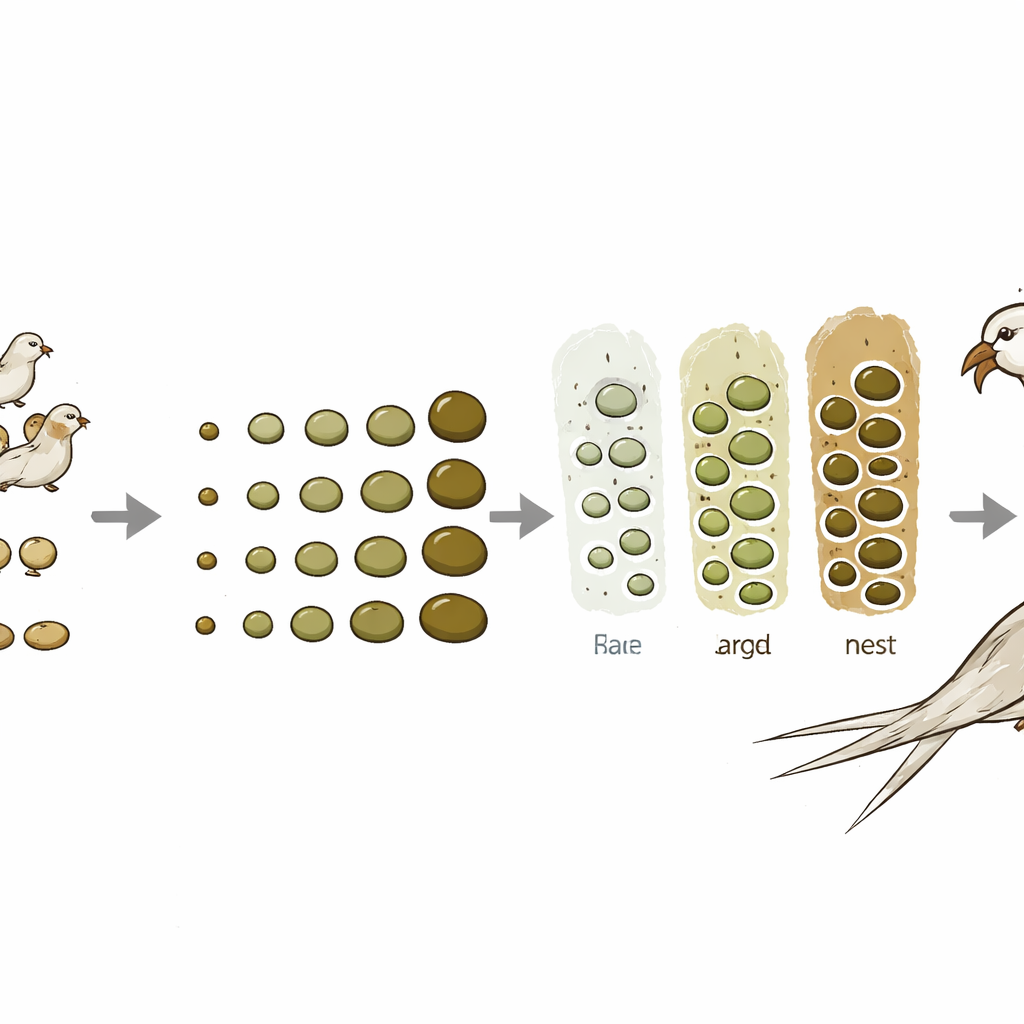
To measure how much energy chick droppings might contain, the researchers collected 224 fecal sacs from nine swift nests in urban colonies around Tel Aviv, Israel. Importantly, they waited until all chicks had fledged, so they disturbed no birds and simply gathered what remained in the nest boxes. In the lab, each sac was gently dried and weighed. The team then used a bomb calorimeter—a device that burns material in a controlled chamber and measures the heat released—to calculate the total chemical energy in each dried sample. By pairing each sac’s mass with its measured energy, they could ask how energy scaled with size and whether some nests regularly produced richer droppings than others.
How Much Energy Is in a Sac?
On average, each fecal sac contained about 1.94 kilojoules of energy, roughly equivalent to half a small dietary calorie. Some sacs were much poorer, while a few were several times richer. Heavier sacs tended to contain more energy, as expected if more dry material simply holds more fuel. Yet mass was only part of the story. When the team compared nests, they found that sacs from the same nest were more similar to each other than to sacs from other nests. About one quarter of the total variation in energy could be traced to nest identity, hinting that differences in food delivered to chicks, their age and digestion, or how quickly parents usually remove droppings may shape how much energy ends up in the sacs that stay behind.
What the Study Can and Cannot Claim
Although these measurements show that swift chick droppings contain recoverable energy, they do not by themselves prove that parents actually gain a net benefit by eating them. The samples were collected only after chicks had left, so the researchers could not link any particular sac to the age of a chick, how often such sacs were ingested instead of discarded, or how efficiently adults could digest what they consumed. Conditions in the nest after deposition—such as drying and microbial breakdown—might also have altered the mass and energy content. As a result, the study reveals the size of the potential energy pool but not how much of it is actually used.
Why This Matters for Understanding Bird Families
In everyday terms, this work shows that chick droppings are not just waste: they still carry a measurable amount of chemical energy that, in principle, could be recycled by hard‑working parents. For a bird species that lives close to the edge in its energy budget, even small nutritional bonuses might be worthwhile, but that remains to be tested. Future studies that watch nests in real time and track when and how often droppings are eaten, how rich those droppings are at different chick ages, and how this behavior ties into adult condition and breeding success will be needed. For now, this study provides the missing first step: a careful measurement of what is available to be recycled, opening the way to understanding whether this unusual habit is simply convenient housekeeping or a subtle energy‑saving strategy.
Citation: Hahn, A., Kosicki, J.Z. & Yosef, R. Faecal sac energy in common swifts (Apus apus) as a function of mass and nest identity. Sci Rep 16, 9034 (2026). https://doi.org/10.1038/s41598-026-40366-0
Keywords: common swifts, coprophagy, avian energetics, nest sanitation, parental care