Clear Sky Science · en
Experimental study of the mechanical behavior of oriented bimrocks under diametral compression test using DIC
Why mixed-up rocks matter to everyday life
Many hillsides, tunnels, and foundations are not carved in clean, solid rock. Instead, they pass through jumbled ground made of hard rock chunks floating in a weaker “mortar-like” material. These block‑in‑matrix rocks, or bimrocks, can fail in surprising ways, making it difficult and expensive to build safe infrastructure. This study asks a practical question with big consequences for engineering: how do the amount and alignment of hard rock blocks inside such mixtures change the way they crack under tension, and can a common laboratory test really measure their strength?
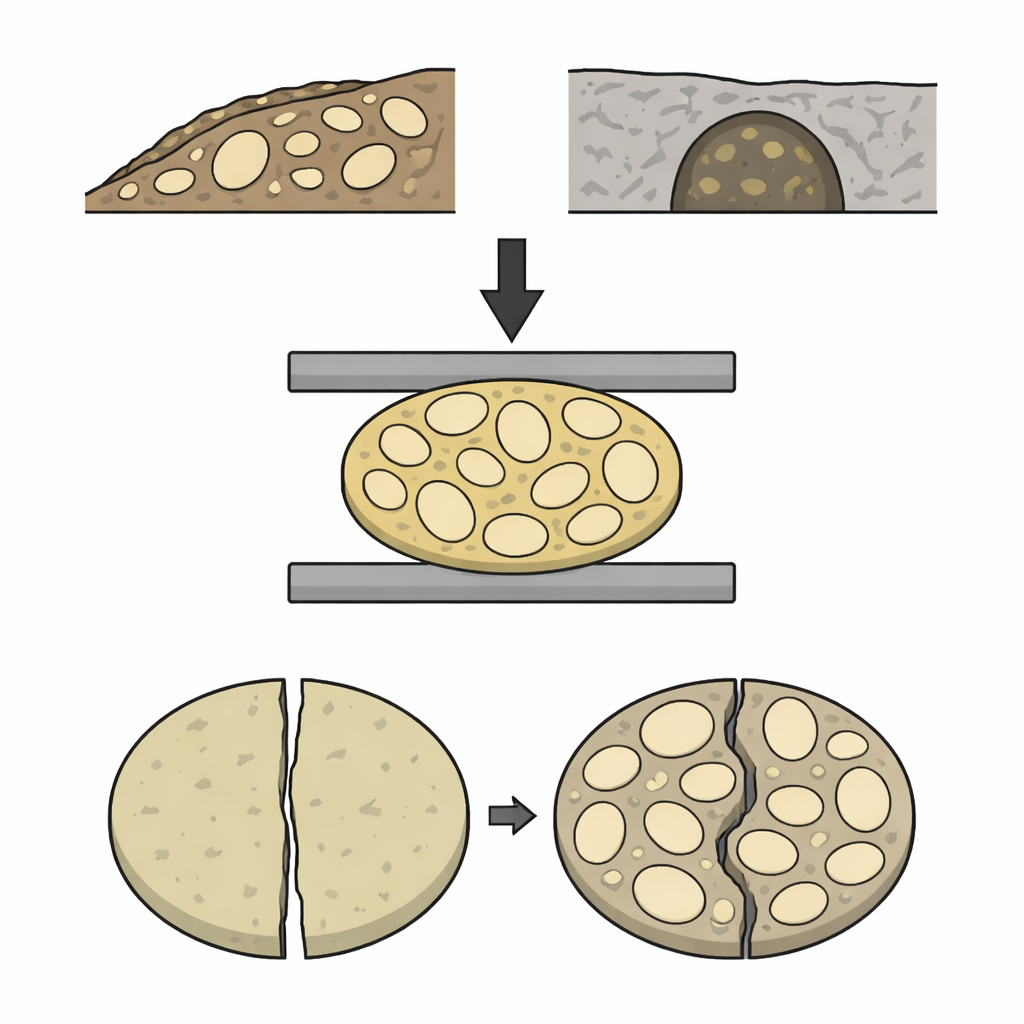
Rocks made of pieces
Bimrocks are found worldwide in landslides, tectonic zones, and ancient debris flows. They look like a rocky pudding: strong stone blocks of many sizes embedded in a much weaker, fine-grained matrix. Engineers often simplify this complexity by ignoring the blocks and designing as if only the soft matrix were present. While this seems cautious, it can be misleading, because the blocks deflect cracks and can either strengthen or weaken the ground depending on how they are arranged. One key feature is block orientation: whether the long axes of the blocks lie mostly up‑and‑down, side‑to‑side, or somewhere in between, a “fabric” that reflects how the material formed in nature.
Crushing rock discs to reveal hidden strength
To probe how block content and orientation affect tensile behavior, the authors made synthetic bimrocks in the laboratory. They cast oval “rock” blocks from a strong plaster‑cement mix and embedded them randomly within a weaker, powder‑rich matrix, carefully controlling the percentage of block volume (from 0 to 50 percent) and aligning all block long axes at specified angles relative to the loading direction. From these mixtures, they cut disc‑shaped specimens and loaded them across the diameter in a standard “Brazilian” test, where compression at the edges produces tension inside the disc. This method is widely used to estimate the tensile strength of rocks because it is simple to perform.
Watching cracks form in real time
Instead of relying only on force readings and broken specimens, the team used digital image correlation, an optical technique that tracks tiny surface movements between thousands of image pixels. By speckling the disc surfaces and filming the tests, they reconstructed full maps of strain—how much each part stretched—throughout loading. These maps showed where local strain built up, where cracks first appeared, and how they threaded through or around the embedded blocks. The researchers then analyzed 87 tests statistically, using response surface methods and analysis of variance to separate the influence of block proportion and orientation and to capture their combined, nonlinear effects on the peak load the discs could carry.
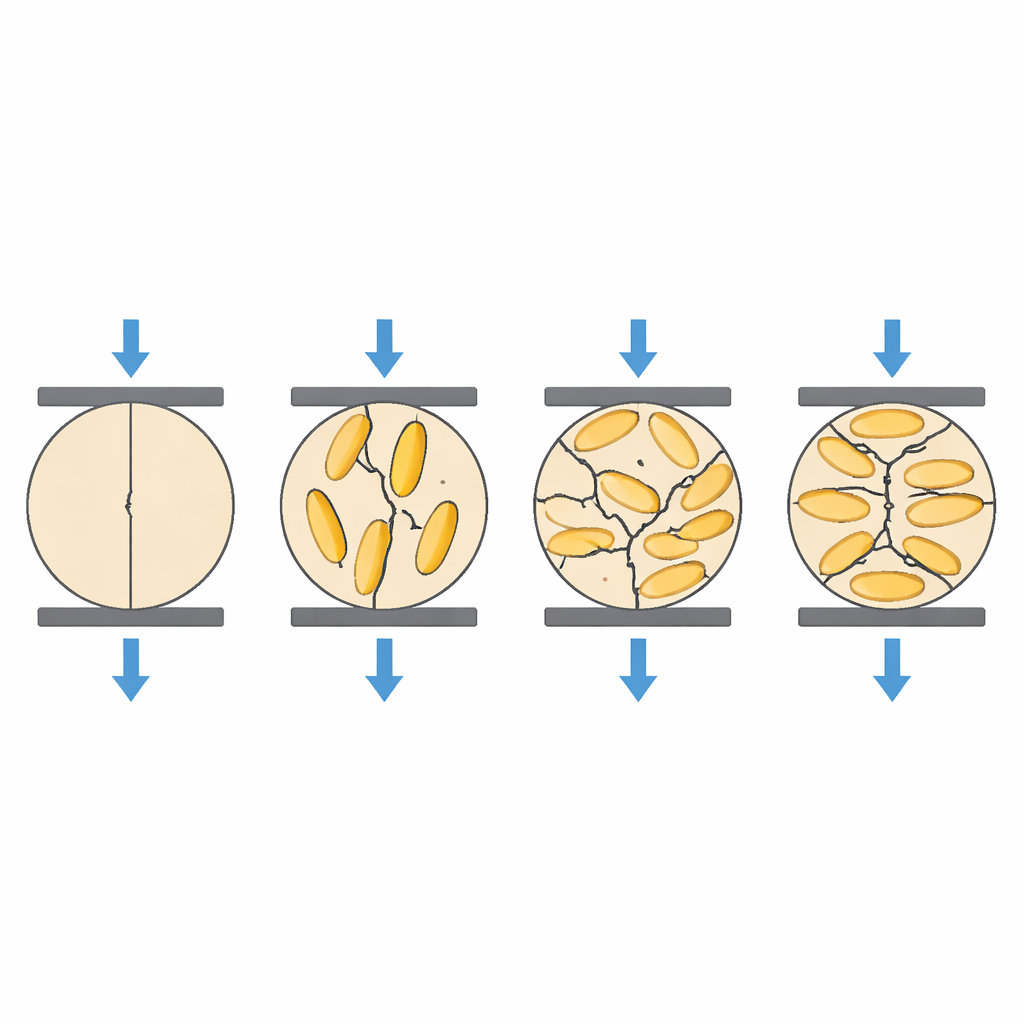
How block content and direction reshape cracking
The experiments revealed that even a small amount of blocks drastically alters behavior. When no blocks were present, the disc behaved as textbooks predict: strain concentrated at the center and a single, straight crack split the disc along the loaded diameter. As soon as 12.5 percent of the volume was occupied by blocks, the peak load dropped sharply and cracks began to favor the interfaces between blocks and matrix, the weakest zones in the mixture. At higher block contents, the drop in strength slowed, but crack paths became much more tortuous. Instead of starting at the center, they often initiated at block edges or near the loading points and zigzagged around multiple blocks. Block orientation further controlled strength: discs with blocks aligned parallel to the loading direction were weakest, while those with blocks rotated toward horizontal resisted higher loads, especially when many blocks were present. This reflects how the long block‑matrix boundaries line up—or fail to line up—with the main tensile stresses.
When a standard test stops telling the truth
The strain maps from digital image correlation provide a warning for engineers. The usual interpretation of the Brazilian test assumes a single central crack caused by a fairly uniform internal tension. In the experiments, that assumption only held for the pure matrix material. As block content increased, cracks started away from the center, and at 50 percent blocks several cracks formed and grew at once, turning the test from a simple material measurement into a complex structural failure. Under these conditions, the number reported as “tensile strength” no longer represents a basic property of the bimrock, but rather the particular block pattern in each specimen.
What this means for tunnels, slopes, and design
For lay readers, the bottom line is that mixed rocks containing many hard pieces do not fail like uniform materials, and a widely used lab test can give misleadingly simple answers. This study shows that the amount of blocks and, crucially, their preferred direction control how cracks start and travel. At high block contents, the Brazilian test becomes invalid for measuring true tensile strength; even at lower contents, results depend strongly on the size and alignment of large blocks. The authors recommend that designers working in such complex ground use these insights to interpret test results cautiously, map block orientation in the field, and, where conditions are highly heterogeneous, consider alternative direct tension tests when safety depends on accurate strength estimates.
Citation: Rostamlo-Jooshin, R., Bahaaddini, M. & Khosravi, M.H. Experimental study of the mechanical behavior of oriented bimrocks under diametral compression test using DIC. Sci Rep 16, 9544 (2026). https://doi.org/10.1038/s41598-026-40334-8
Keywords: bimrock, tensile strength, Brazilian test, digital image correlation, geotechnical engineering