Clear Sky Science · en
Enhanced sliding mode control for parallel-integrated boost converters in hybrid solar-wind systems
Cleaner power from sun and wind
As more homes and communities turn to solar panels and wind turbines, a hidden challenge lurks in the electronics that tie everything together: turning two unruly, fluctuating energy sources into the steady, household‑friendly power we expect from a wall socket. This paper presents a new way to control that conversion hardware so it can squeeze more usable power from the same sun and wind, while delivering smoother, cleaner electricity to plugs, appliances, and future electric vehicles.
Why combining sun and wind is tricky
Solar and wind power make a natural team: sunny days can be calm, windy days can be cloudy, and together they can provide energy more of the time than either one alone. But both sources are unpredictable. Passing clouds, gusts, and lulls cause the incoming power to rise and fall from moment to moment. Traditional systems often handle this by stacking several conversion stages in series, each with its own control scheme. That works, but adds cost, complexity, and energy losses. When different sources are merged into a single, tightly coupled converter, the electronics must juggle changing inputs, share current fairly between parallel paths, and keep the output voltage rock‑steady—all at once.
A smarter one‑stage power bridge
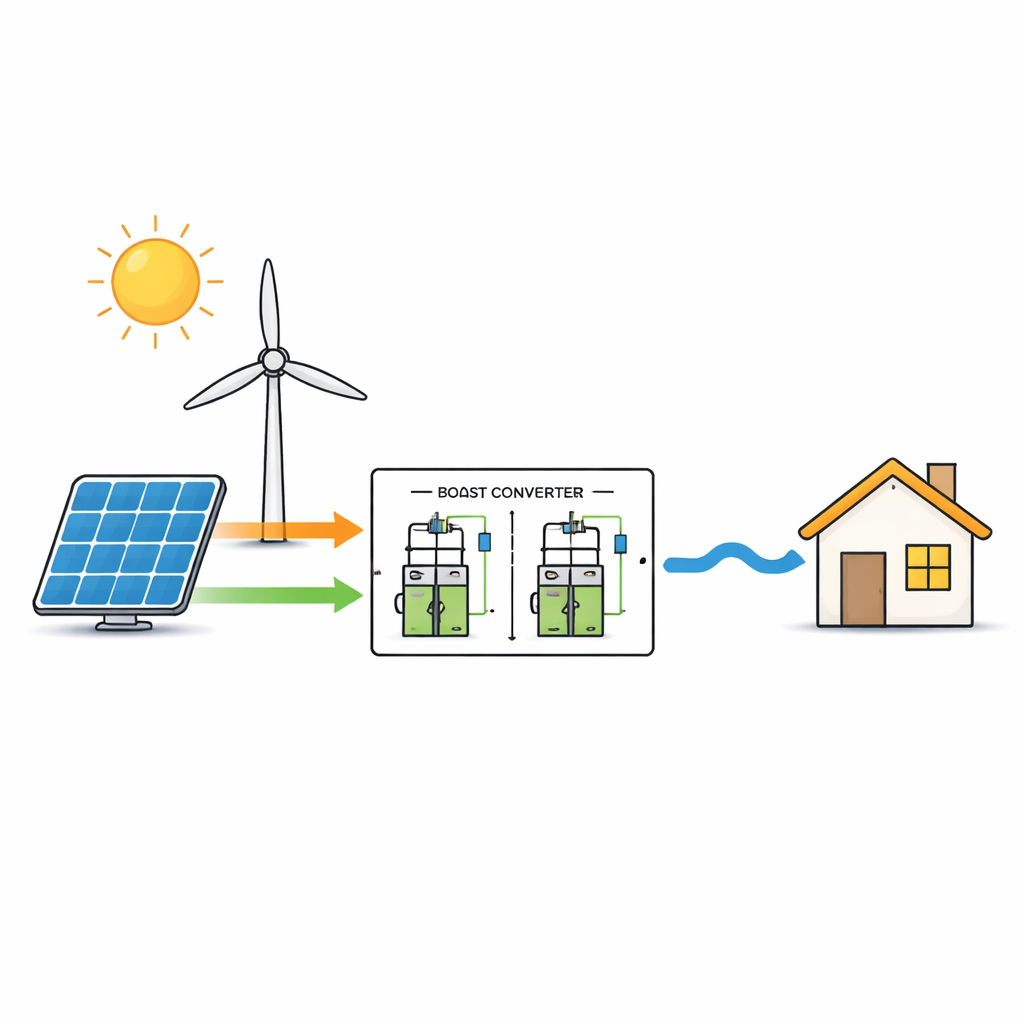
The authors focus on a device called a parallel‑integrated boost converter, which can take low‑voltage power from a solar array and wind generator, raise its voltage, and produce an alternating output suitable for household use, all in a single stage. Two identical converter “legs” work in an interleaved fashion—like two people taking turns pushing a swing—so that power delivery is smoother and electrical stress is shared. A simple battery and standard solar and wind front‑ends manage basic energy storage and power capture, while a maximum power point tracker keeps the solar panels operating near their sweet spot. The heart of the work is not the hardware itself, but the way the switches inside this converter are driven in real time.
Taming jitter in fast digital control
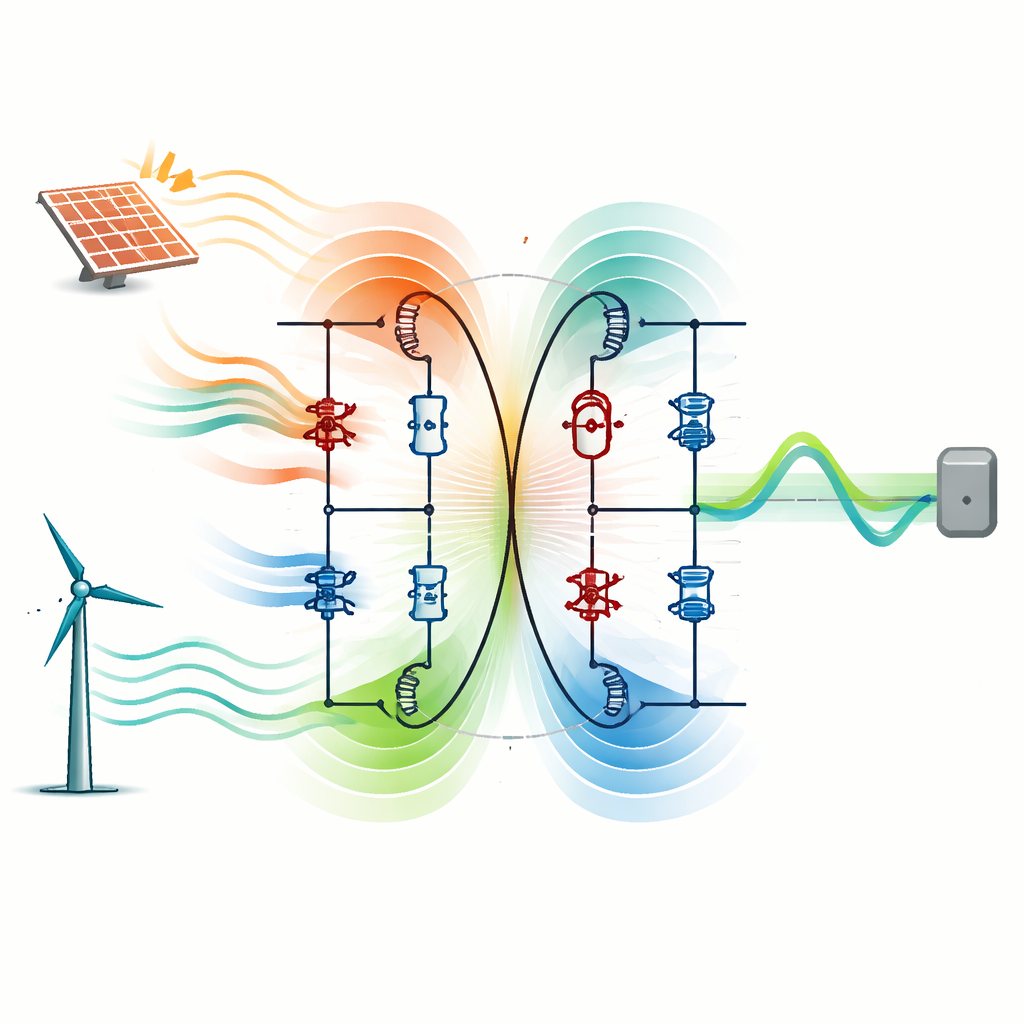
One appealing way to command power electronics is a technique called sliding mode control, which rapidly flips switches to keep the output where it should be despite disturbances. Classic versions are robust but suffer from “chattering”: very high‑frequency on–off jitter that wastes power, heats components, and can interfere with nearby electronics. The authors propose an enhanced sliding mode control that softens the switching decisions near the target operating point. Instead of a harsh, all‑or‑nothing action, the new scheme wraps the decision region in a thin “edge layer” where the control signal changes smoothly. This preserves the quick, self‑correcting behavior of the original method, but with less electrical noise and more predictable switching frequency. Crucially, it is tuned specifically for the twin‑leg converter so that both legs share current evenly and circulating currents are minimized.
How much better is the new approach?
To test their idea, the researchers compared three ways of driving the converter: a common sinusoidal pulse‑width scheme used in many inverters, a conventional sliding controller, and their enhanced version. Computer simulations subjected all three to sudden jumps in load, source fluctuations, and component mismatches. While the basic sinusoidal method produced acceptable waveforms, its output voltage was the lowest and it showed noticeable distortion. Conventional sliding control boosted the voltage higher but at the cost of more harmonics—unwanted frequency components that can stress equipment and grids. The enhanced sliding controller managed to deliver the highest output voltage while cutting voltage distortion to about one‑third of the other methods and reducing current distortion even further. It also kept performance almost unchanged when the input voltage or key components were deliberately varied, a sign of strong robustness. A small laboratory prototype, running at safe low voltages, confirmed that the same control rules work in real hardware and produced similarly low distortion.
What this means for everyday energy use
For non‑specialists, the take‑home message is that better “traffic rules” for electrons can make renewable systems more reliable and efficient without changing the panels or turbines themselves. By redesigning how a single converter stage reacts to the constantly shifting mix of sun, wind, and household demand, the proposed control method delivers more usable power, cleaner waveforms, and gentler stress on components. That, in turn, can lower losses, extend equipment life, and simplify future links to smart grids, batteries, and electric‑vehicle charging—helping homes and communities get more out of every ray of sunlight and every gust of wind.
Citation: Arunyuvaraj, K., M, V.P. & Aravind, P. Enhanced sliding mode control for parallel-integrated boost converters in hybrid solar-wind systems. Sci Rep 16, 9039 (2026). https://doi.org/10.1038/s41598-026-40333-9
Keywords: hybrid solar-wind, power electronics, inverter control, renewable energy systems, sliding mode control