Clear Sky Science · en
Millimeter-wave technology for multi-person fall detection validated through wearable sensors and real-life scenarios
Why Watching for Falls Matters
As people live longer, more of us are caring for parents and grandparents who want to stay safe and independent. One of the biggest threats to that safety is a simple fall, which can lead to broken bones, loss of confidence, and even death. Nurses and caregivers cannot watch every corner of a building all the time, and many older adults dislike wearing gadgets or being filmed by cameras. This study explores a different approach: using invisible radio waves, similar to those in some car sensors, to quietly watch over large indoor spaces and spot when someone has fallen.
A New Kind of Invisible Lifeguard
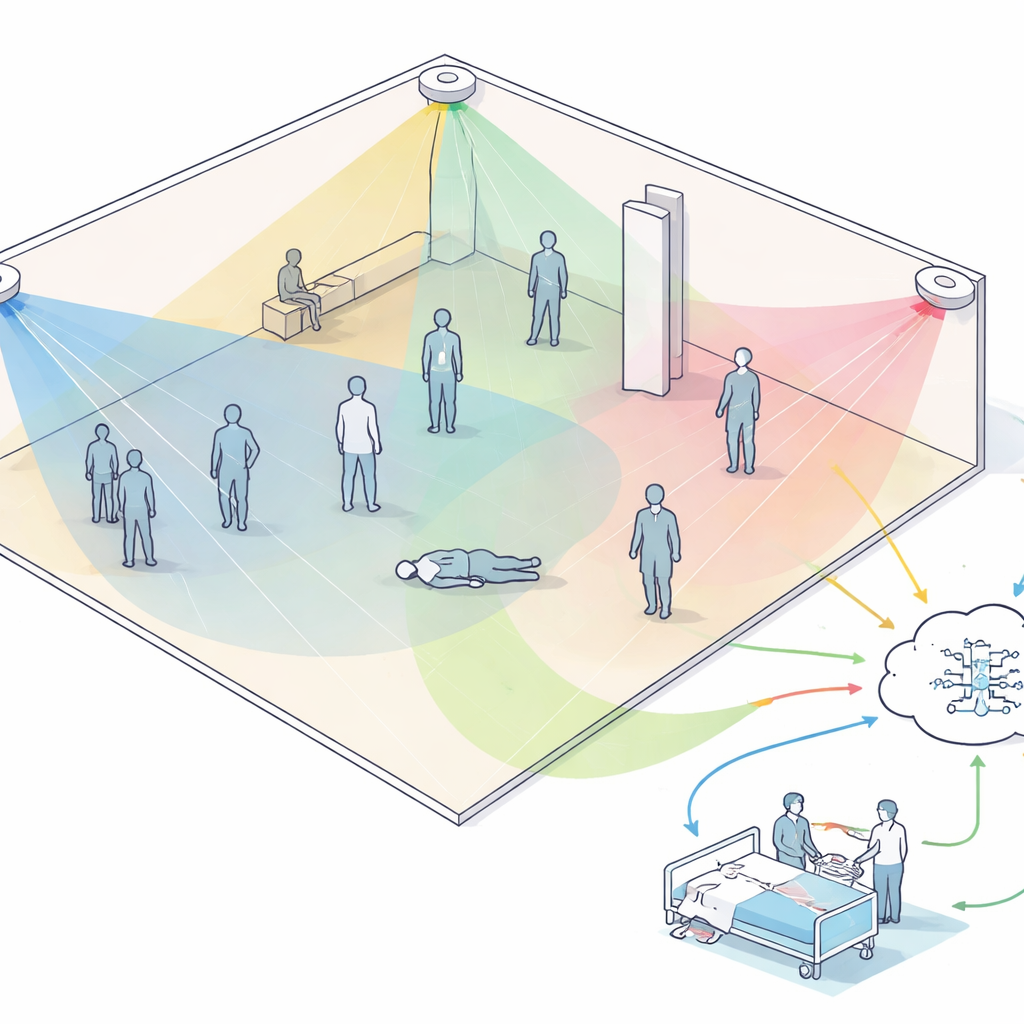
The researchers tested a system based on millimeter-wave radar, a technology that sends out very short radio waves and listens to their reflections to sense motion and position. Unlike cameras, it does not capture faces or clothing, so privacy is better protected. Unlike wearable devices, it does not rely on people remembering to put something on. The team wanted to know whether such radar could reliably detect falls for several people at once in a realistic, cluttered indoor area similar in size to a section of a hospital or long-term care center.
Turning Reflections into Human Motion
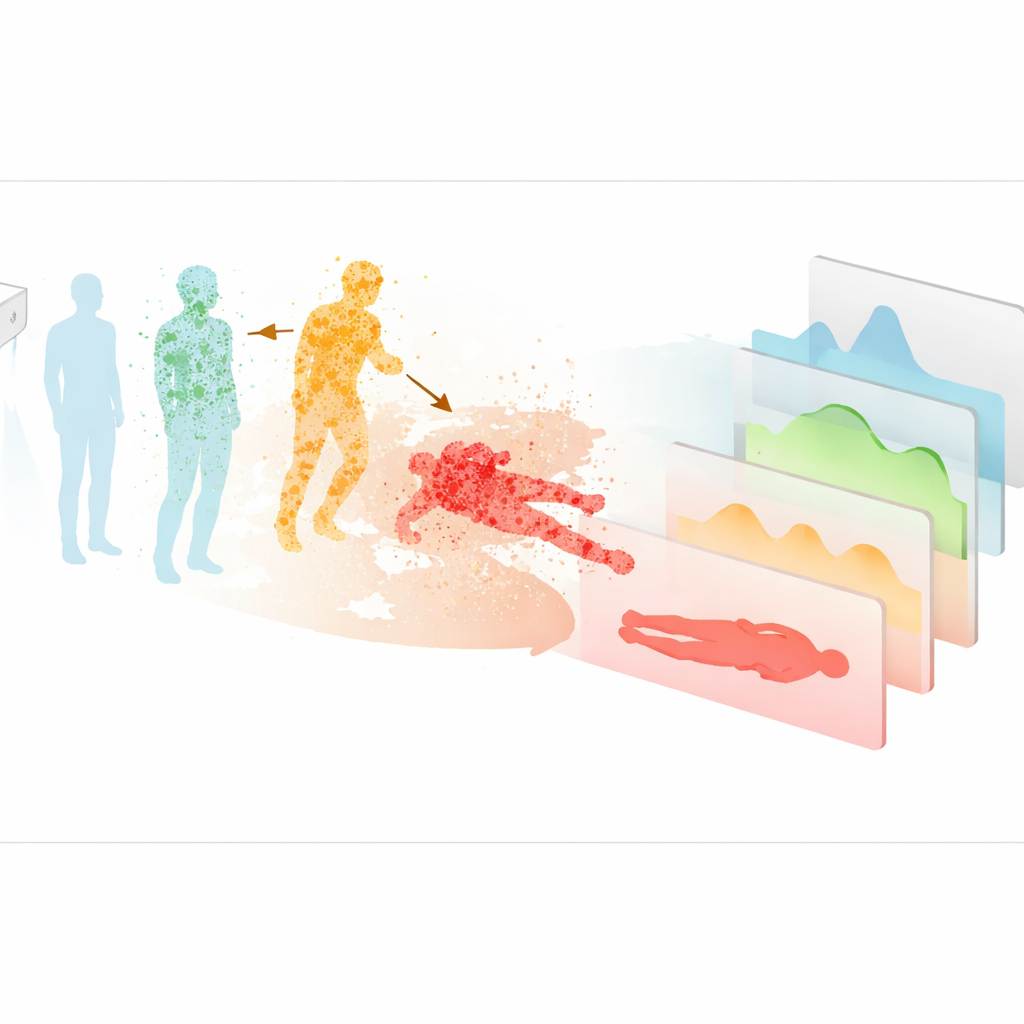
In their setup, four small radar units were mounted at the corners of a 12-by-12 meter room with a structural column in the middle, representing a typical obstacle. When the radar waves bounced off people, the system translated those echoes into a cloud of dots outlining each person’s body in three dimensions. Software then tracked the center of each cloud over time, essentially following each person’s body height and movement. From this, the system calculated how quickly someone was moving up or down and how that motion changed from moment to moment, looking for the characteristic pattern of a sudden drop followed by lying low and still on the floor.
Testing in Realistic Group Situations
Ten healthy volunteers were asked to move around the test area and perform many rounds of simulated “soft” falls under ten different group scenarios, ranging from one person to ten people in the room. They also carried a small motion sensor on the chest and were filmed by a camera, which together served as the ground truth for when falls actually occurred. The researchers tried several ways of arranging one to four radars and found that four units in the corners gave the best overall coverage and fall-detection performance, with typical position errors of only a few centimeters.
What the System Got Right—and Where It Struggled
Across all multi-person trials, the radar system correctly identified simulated falls with an overall accuracy of 97.9%, even with the central column partly blocking the view. Performance remained very high for small groups and stayed strong but slipped slightly as more people were added. When ten people were present, the system was more likely to miss a fall, mainly because people blocked one another from the radar’s view. The team also challenged the system with everyday movements that can resemble a fall—such as sitting quickly, squatting, tying shoes, or picking something up. Here, the first version of the algorithm confused many of these actions with real falls. After refining the decision rules to pay closer attention to fall speed and the final lying posture, accuracy for these everyday tasks improved to 86.5%, though there is still room to grow.
What This Could Mean for Everyday Care
The findings show that a carefully designed millimeter-wave radar network can watch over a large room and reliably flag when someone ends up on the floor, without asking them to wear anything or putting cameras in private spaces. The system is not yet fast or precise enough to trigger split-second injury-prevention devices, but it is well suited for rapid post-fall alerts, helping staff respond within a few seconds rather than discovering a person only after a long, harmful wait. With further work to handle more complex room layouts and to better distinguish normal daily movements from real emergencies, this type of invisible sensing could become a quiet safety net in hospitals, nursing homes, and perhaps one day in ordinary homes.
Citation: Chen, HH., Lin, JD., Lin, SH. et al. Millimeter-wave technology for multi-person fall detection validated through wearable sensors and real-life scenarios. Sci Rep 16, 8859 (2026). https://doi.org/10.1038/s41598-026-40330-y
Keywords: fall detection, millimeter-wave radar, elderly care, non-contact monitoring, indoor safety