Clear Sky Science · en
Unusual solar radiation and its impact on the Japanese rice market during the 1830s famine
When Dimming Sunlight Shook a Nation’s Dinner Table
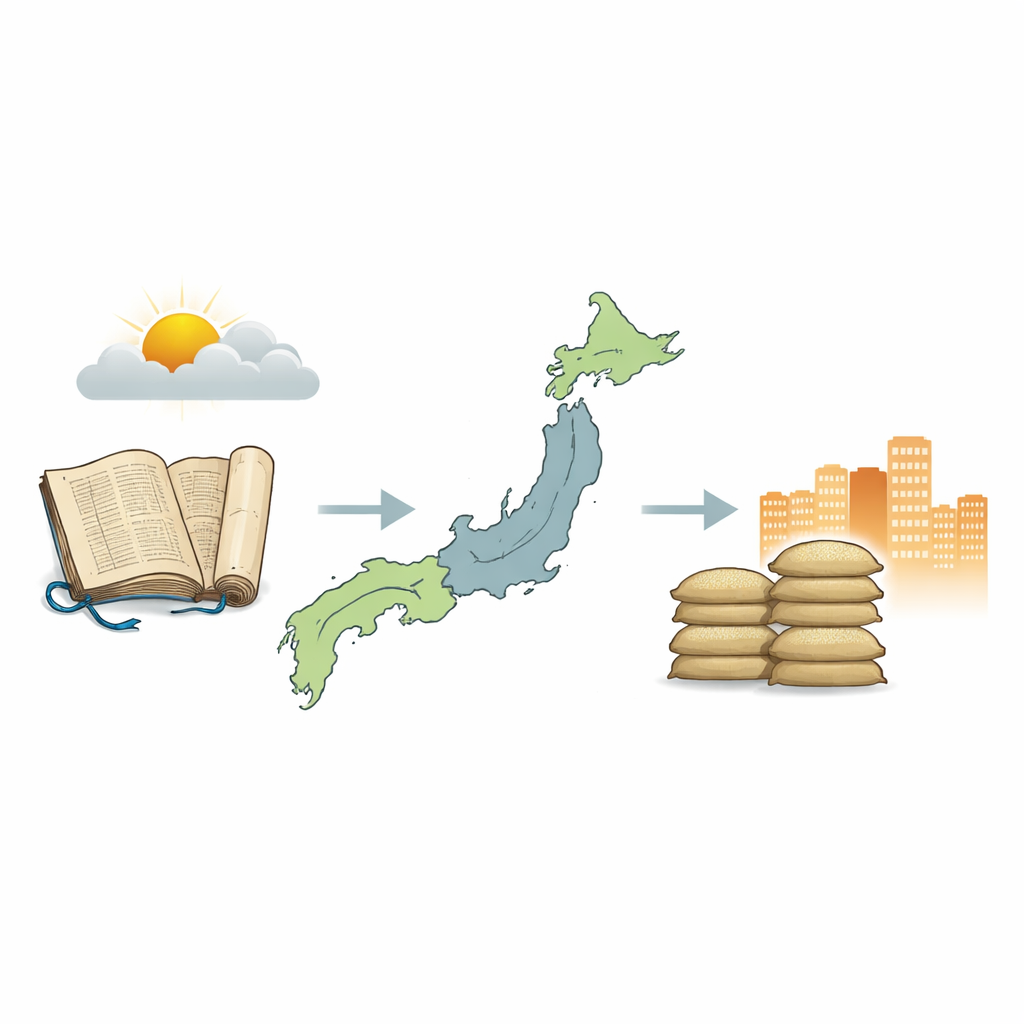
Nearly two centuries ago, long before satellites and weather stations, people in Japan carefully noted each day’s weather in their diaries. Those personal jottings, combined with old market ledgers, have now allowed researchers to uncover how a stretch of unusually weak summer sunlight helped drive one of Japan’s worst famines—and sent rice prices soaring to several times their usual level. This study shows in vivid detail how shifts in the sky can ripple through fields, markets, and households, offering lessons for today’s climate‑strained world.
Turning Old Diaries into Climate Clues
The authors focused on the 1830s Tenpō Famine, a crisis that caused widespread hunger and death across Japan but hit some regions harder than others. To understand why, they assembled daily weather descriptions from 18 historical diaries scattered from northern Honshu to southern Kyushu, covering 1821–1850. They then paired these accounts with modern measurements from the Japan Meteorological Agency, which relate different kinds of days—fine, cloudy, or rainy—to the amount of sunlight actually reaching the ground. By treating phrases like “clear skies,” “cloudy with breaks,” or “steady rain” as coded measurements, they could estimate how much solar radiation fell on different parts of Japan, month by month, during the decades around the famine.
Mapping a Summer of Gloom
Using this method, the team reconstructed monthly average sunlight across Japan and compared each year to the longer 30‑year norm. Their maps show that the summer of 1836 stands out: in central Japan—from the Kanto region around Edo (Tokyo) through the Kansai region and into northern Kyushu—sunlight in July and August dropped by about 10 percent below normal. This dimming persisted from late spring through early autumn in those central areas, even as northern Tohoku and far‑southern Kyushu saw more typical levels of sunlight. A statistical technique called principal component analysis revealed a clear national pattern: when this main “mode” of variation was strongly negative, central Japan in particular experienced widespread lack of sunshine during the key growing months for rice.
From Dark Skies to High Rice Prices
Rice was the cornerstone of early modern Japan’s society and economy—food, tax, and financial asset all at once. Because reliable harvest data are scarce, historians often turn to rice prices to gauge supply and hardship. In this study, the authors used newly compiled monthly price records from Osaka, the country’s central rice market, covering 1833–1839 and several major rice brands shipped in from western Japan. These records show that starting in the summer of 1836, rice prices abruptly jumped from typical levels of 50–70 monme (a contemporary unit of silver) to around 200, and remained high into the summer of 1837. When the researchers compared these price spikes with their sunlight estimates, the pattern lined up: prices began climbing soon after the gloomy summer of 1836 and only eased once sunlight and expectations for the harvest improved.
How Farmers, Merchants, and Officials Reacted
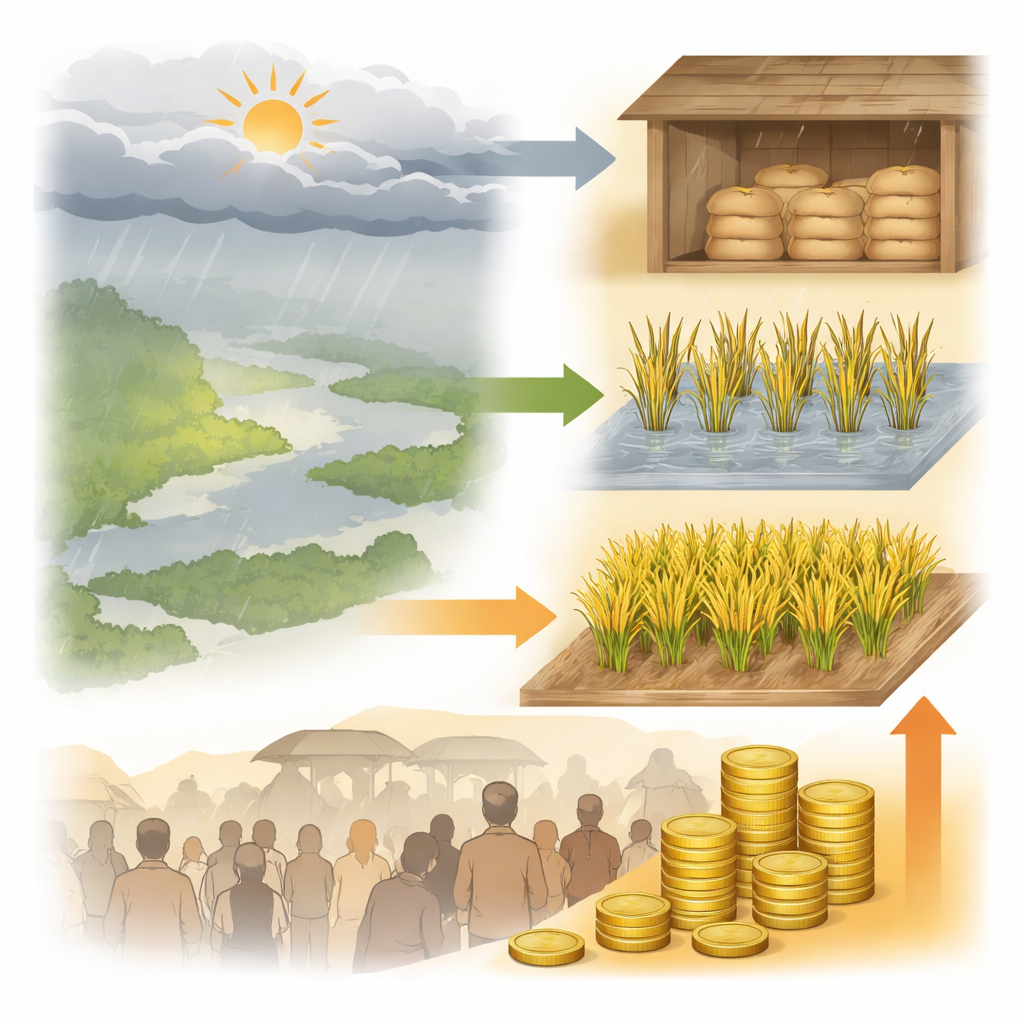
The study also sheds light on how people interpreted and acted on these weather signals in real time. Merchants in Osaka traded rice based not only on the current harvest but also on their expectations of the upcoming one, informed by reports of persistent rain and chill across the country. A surviving proclamation from the Osaka town magistrate in September 1836 warns traders not to push prices up based on gloomy expectations alone, revealing that authorities were keenly aware that unusual weather was feeding market anxiety. Yet government attempts to calm prices by releasing stored rice or ordering more grain into the city proved short‑lived. As the poor harvest became undeniable, scarcity overpowered policy, and prices continued to climb. When sunlight recovered during the 1837 growing season, prices finally began to fall that autumn, suggesting that both the sky and human expectations moved the market together.
Lessons for Climate and Markets Today
By tracking both climate and prices month by month, rather than year by year, the researchers show that the Tenpō Famine was not a simple story of one bad harvest. Instead, a sequence of unusually dim and cool summers, regional differences in weather, and fast‑moving market expectations combined to amplify hardship. The work also hints that distant volcanic eruptions, which can spread sunlight‑blocking aerosols worldwide, may have played an indirect role in shaping cloudiness and temperature patterns at the time, though more data are needed to be sure. Overall, the study demonstrates that even modest shifts in sunlight—on the order of 10 percent—can significantly destabilize food supplies and prices in a society deeply dependent on a single staple crop. That historical experience underscores how tightly linked climate, agriculture, and markets remain, and why fine‑grained climate information is vital for navigating today’s climate risks.
Citation: Ichino, M., Masuda, K., Mikami, T. et al. Unusual solar radiation and its impact on the Japanese rice market during the 1830s famine. Sci Rep 16, 9733 (2026). https://doi.org/10.1038/s41598-026-40316-w
Keywords: historical climate, rice markets, famines, solar radiation, Japan 1830s