Clear Sky Science · en
Energy evolution mechanisms and hazard prevention in deep granite under cyclic loading: a case study from Sanshandao gold mine
Why Deep Rock Matters to Safety Underground
As the easiest gold deposits are mined out, companies must chase ore kilometers below the surface, where the rock is squeezed by enormous forces. Under these extreme conditions, tunnels can suddenly crack, shed blocks of rock, or even violently burst, putting miners at serious risk. This study explores how hard granite deep underground stores and releases energy as mines are excavated over time, and how smarter, energy-absorbing supports can turn potentially violent failures into manageable, controlled movements.
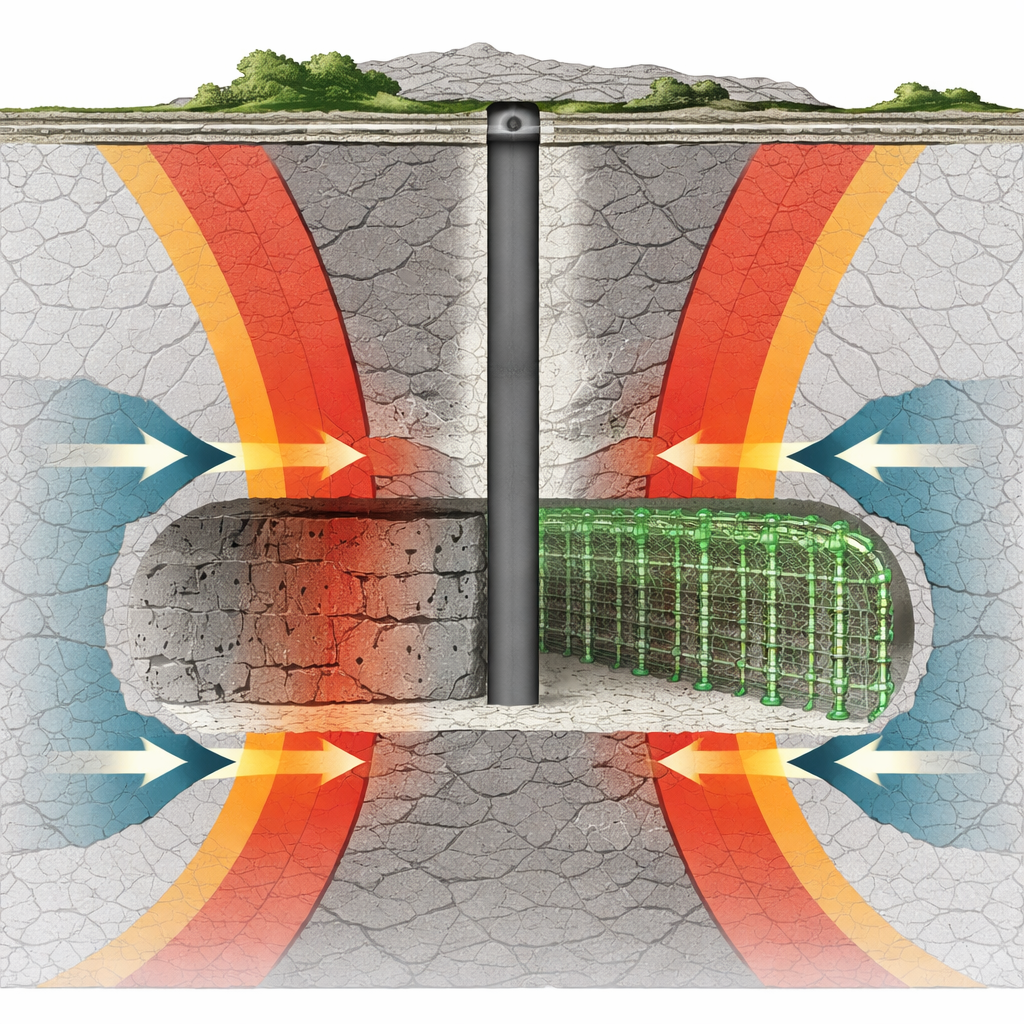
Hidden Forces in a Deep Gold Mine
The research focuses on the Sanshandao Gold Mine in China, where tunnels lie more than a kilometer below the surface. The authors first measured the natural stress in the surrounding rock by drilling boreholes and carefully releasing the in‑situ pressure. They found that the rock is squeezed more from the sides than from above, with horizontal forces much stronger than the vertical load from the weight of overlying rock. These stresses grow roughly linearly with depth, creating a horizontally dominated stress field that shapes how tunnels deform and fail as mining advances.
Recreating Deep Earth Conditions in the Lab
To understand how this stressed rock behaves as mining repeatedly loads and unloads it, the team cut granite blocks from the mine and tested them in a custom three‑direction loading machine. This device can independently control pressure in three directions, mimicking the true underground stress state rather than a simplified one. They simulated conditions equivalent to depths from 500 to 2000 meters and repeatedly pushed and relaxed the samples along one axis while holding the other two directions constant, tracking how the granite strained, cracked, and ultimately failed over multiple loading cycles.
How Rock Stores and Burns Off Energy
The experiments show that granite under repeated loading does not simply spring back like an elastic band. Instead, permanent deformation accumulates mainly along the strongest compression and expansion directions, growing roughly exponentially with each cycle, while the intermediate direction changes more gently. From an energy viewpoint, part of the work done on the rock is stored as recoverable elastic energy, and part is irreversibly lost to processes such as micro‑cracking and friction as grains slide past one another. Early in loading, the granite mostly stores energy elastically; as stresses rise toward its yield point, more of the input energy is diverted into damage, with cracks forming and linking up. Near and beyond peak strength, much of the extra energy is consumed by further damage rather than being suddenly released, revealing a “damage‑induced energy conversion” mechanism that can either dampen or drive failure depending on how the rock is supported.
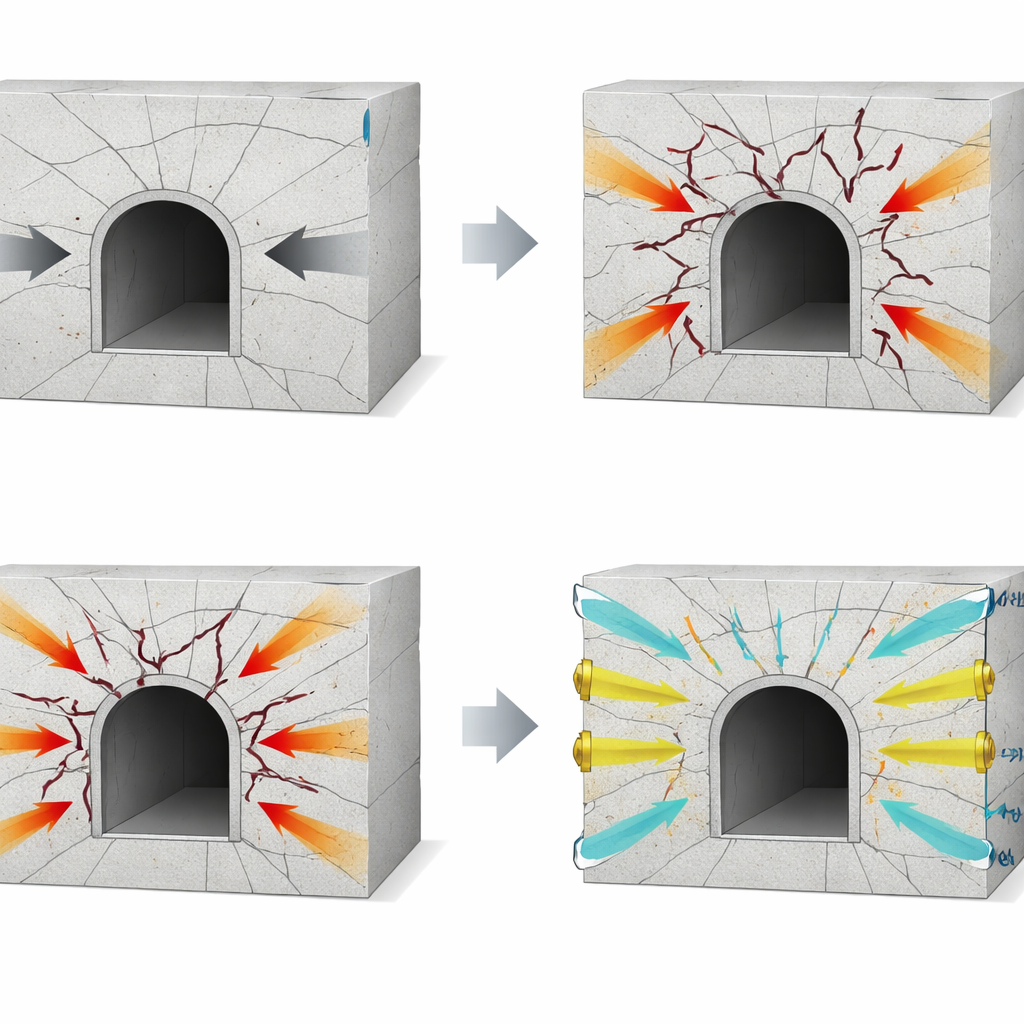
Turning Energy Insights into Better Supports
Building on these findings, the authors propose designing tunnel supports around energy rather than just strength. They estimate how much extra energy accumulates in the damaged zone of rock around a tunnel when it is excavated under deep stress. Support systems—especially rock bolts—are then chosen so that their total energy‑absorption capacity exceeds this value with a safety margin. At Sanshandao, they optimized friction‑based “split‑set” bolts by adjusting their size and length and by injecting a water‑activated chemical grout inside the tubes, which expands and hardens to press the bolts more firmly against the rock. Field pull‑out tests showed that these upgraded bolts could absorb much more energy before failing than standard designs.
Safer Deep Tunnels Through Smarter Energy Control
When the improved energy‑absorbing support system was installed in a haulage roadway 1050 meters underground, monitoring over 12 days showed that both bolt loads and vibration levels dropped and stabilized, and problems such as wall spalling and localized collapses were significantly reduced. In simple terms, the granite around the tunnel still stores energy under deep stress, but the strengthened, more ductile supports now soak up and dissipate a large share of that energy through controlled yielding instead of allowing it to drive sudden, violent rock failure. This energy‑based design approach offers a practical path to safer, more reliable deep mining wherever engineers must carve openings in hard, highly stressed rock.
Citation: Yin, Y., Ye, H., Peng, C. et al. Energy evolution mechanisms and hazard prevention in deep granite under cyclic loading: a case study from Sanshandao gold mine. Sci Rep 16, 8775 (2026). https://doi.org/10.1038/s41598-026-40308-w
Keywords: deep mining, rockburst prevention, granite tunneling, energy absorbing supports, cyclic loading