Clear Sky Science · en
Dynamic multi-objective aviation maintenance scheduling: an algorithmic framework
Why keeping planes in the air is so hard
Every commercial flight you take depends on a hidden world of maintenance planners who decide which aircraft go into the hangar, which parts get inspected, and which technicians do the work. These choices must protect safety, avoid costly delays, and make good use of skilled staff, all while new problems pop up unexpectedly. This paper presents a new way to help airlines juggle all of these demands at once, using smart algorithms that constantly update the maintenance plan as real-world conditions change.
Many goals, moving targets
Airline maintenance is far from a simple checklist. Tasks arrive at unpredictable times as inspections uncover issues, sensors flag possible faults, or parts wear out faster than expected. How long each job will actually take is uncertain, depending on hidden damage, parts on hand, and technician availability. At the same time, planners must balance at least five goals: keep costs down, minimize safety risk, use technicians efficiently, build schedules that can absorb surprises, and adapt quickly when new tasks appear. Traditional planning tools often focus on a single objective, like cost, and assume that job lists and task durations are known in advance. The authors argue this is unrealistic for modern aviation and propose a richer model that treats all five goals as equally important targets rather than rigid rules.
A new planning engine for the hangar
The core of the study is a dynamic optimization framework that treats maintenance planning as a living process instead of a one-time calculation. Incoming tasks and changing technician rosters feed into a mathematical model that represents each job’s urgency, skill needs, and safety impact, along with uncertainty about how long it will take. On top of this model, the authors deploy a family of advanced search procedures inspired by ideas from evolution, swarms, and neighborhood exploration. Rather than spitting out a single “best” plan, the system generates a collection of high-quality alternatives that trade off cost, safety, utilization, robustness, and adaptability in different ways. Place 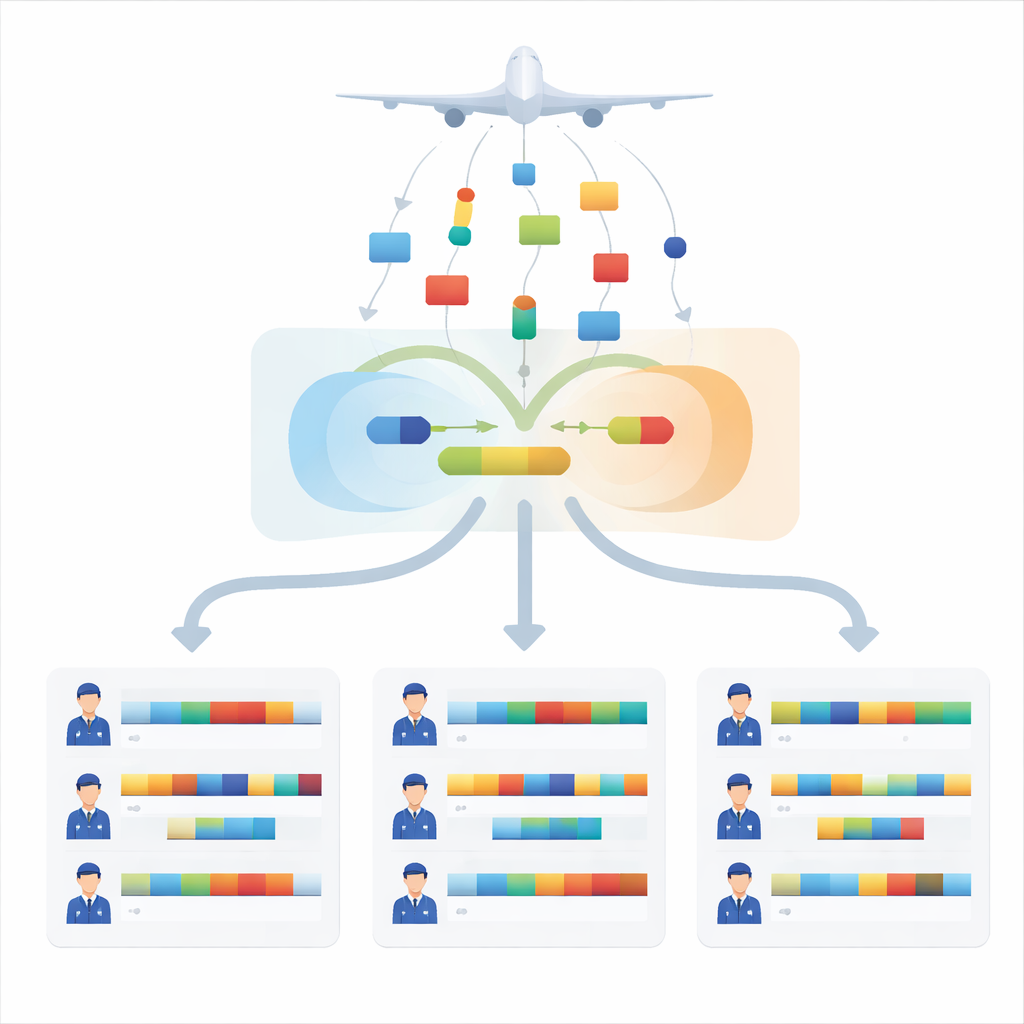
Smart search instead of perfect answers
Because the problem is so complex—full of yes-or-no assignment choices, uncertain job durations, and conflicting goals—trying to find an exact mathematical optimum would take far too long to be useful in practice. The authors instead rely on meta-heuristic algorithms, which use guided trial-and-error to explore many possible schedules quickly. They carefully justify this choice, showing that even a simplified version of the problem is extremely hard for exact solvers, and that airlines need answers within seconds, not hours. Among nine different methods tested, a technique called Adaptive Tabu Search achieved the lowest average cost, while several population-based methods produced richer sets of alternative plans. The framework also includes “warm-start” strategies that reuse good existing plans when new tasks arrive, so the system can replan efficiently in real time.
Testing in a virtual airline world
To see how well their approach works, the authors built a large suite of simulated maintenance scenarios. These range from small, predictable task sets to large, chaotic environments with frequent new jobs and highly uncertain durations. Across 810 experimental runs, the advanced algorithms consistently beat simple rules like first-come, first-served, cutting modeled costs by around 15–25 percent. The study also examines how performance changes as problems grow larger or more uncertain, how stable results are across repeated runs, and how much computing time and memory each method needs. In synthetic case studies mimicking regional, medium-haul, and long-haul airlines, the framework suggests potential double-digit reductions in maintenance spending, higher technician utilization, and shorter aircraft downtime—though the authors stress that these economic gains still need to be confirmed with real airline data. Place 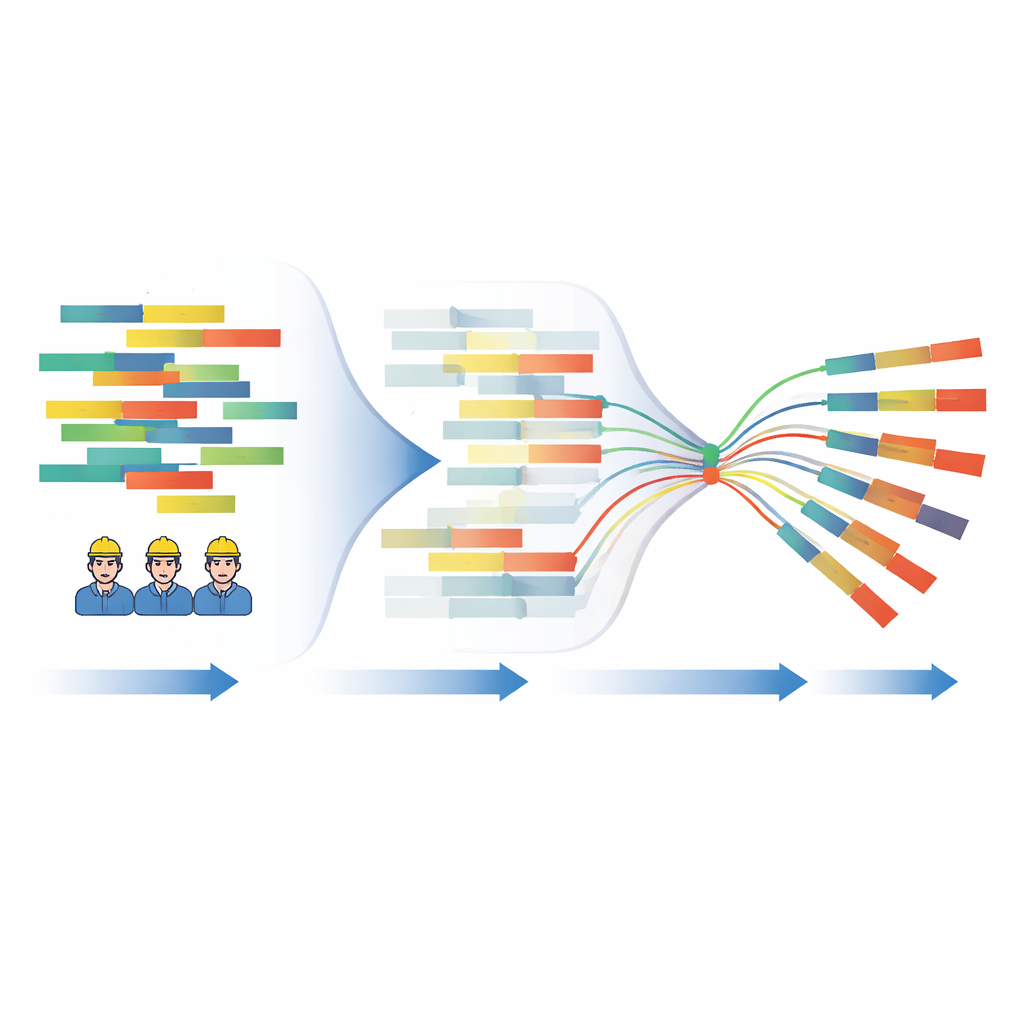
What this means for future flights
For a non-specialist, the key message is that smarter, continuously updating maintenance plans could make flying safer, cheaper, and more reliable at the same time. Instead of locking into a single rigid schedule, airlines could choose among several plans that each strike a different balance between cost and safety, and then adjust on the fly as new problems arise. While this study relies on simulated data, it lays a mathematical and computational foundation for next-generation maintenance systems, and its ideas could extend beyond aviation to hospitals, power plants, and emergency services—anywhere critical work must be scheduled under pressure, uncertainty, and competing priorities.
Citation: Qi, L., Lv, C., Zhang, T. et al. Dynamic multi-objective aviation maintenance scheduling: an algorithmic framework. Sci Rep 16, 9461 (2026). https://doi.org/10.1038/s41598-026-40304-0
Keywords: aviation maintenance, scheduling algorithms, multi-objective optimization, operational research, airline operations