Clear Sky Science · en
Microbial synthesis of silver nanoparticles using bacterial supernatants from Brazilian stingless bees with antimicrobial activity
Why Bee Microbes Matter for Future Medicines
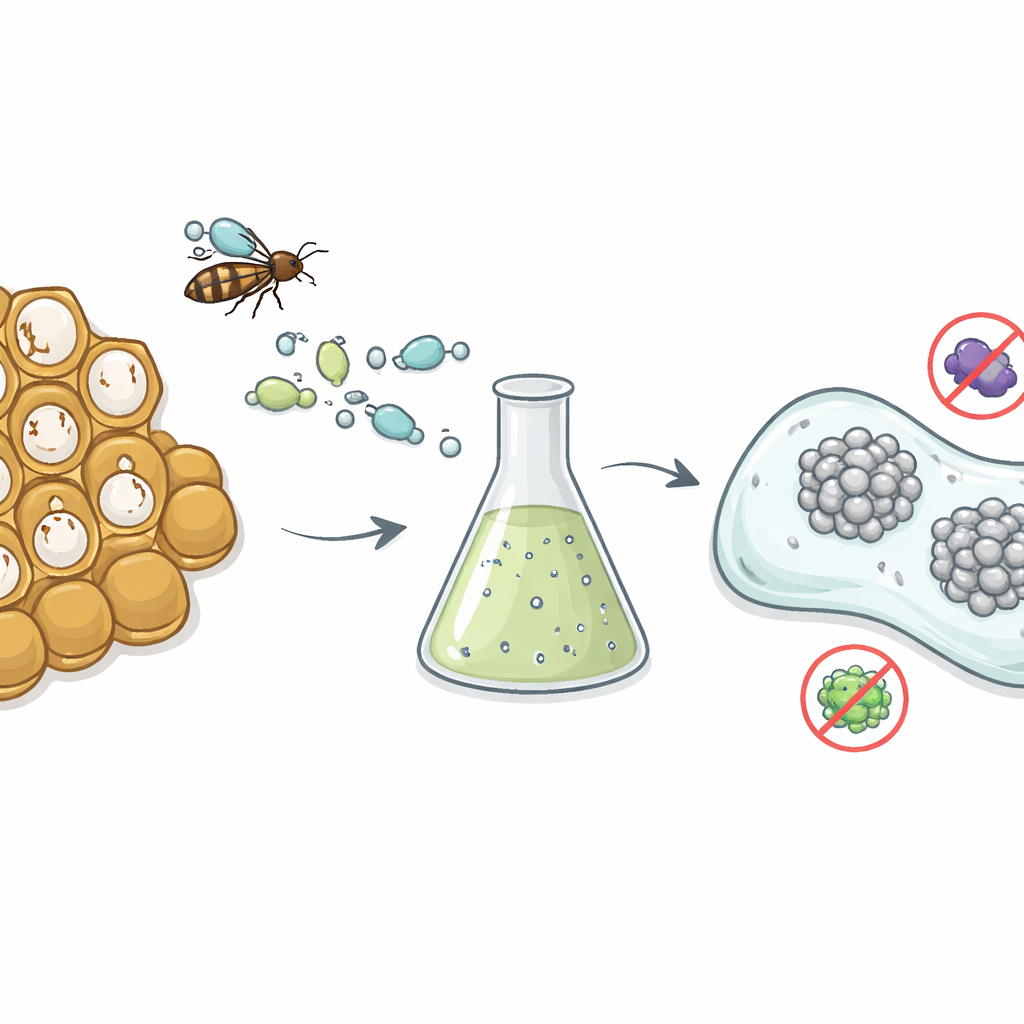
Hospitals around the world are seeing more infections that laugh off our best antibiotics. When common drugs fail, even routine surgeries or minor wounds can become dangerous. This study explores an unusual ally in the fight against these tough microbes: bacteria that live in the food of Brazilian stingless bee larvae. By harnessing chemistry hidden in these bee-associated bacteria, the researchers created tiny silver particles that can kill drug-resistant germs while showing low toxicity in early safety tests.
Tiny Silver Fighters Against Tough Germs
The team focused on silver nanoparticles—particles so small that thousands could fit across a human hair. Silver has long been known to stop bacterial growth, but making nanoparticles usually requires harsh chemicals or high energy. Here, the authors used a “green” route. They collected liquid supernatants (the clear broth containing secreted molecules) from two bacterial strains found in stingless bee larval food, identified as Providencia rettgeri and Proteus mirabilis. These liquids are rich in natural antioxidants, molecules that can donate electrons. Those same properties allow them to convert dissolved silver ions into solid metallic particles and keep them from clumping together.
Speeding Up Nature’s Chemistry
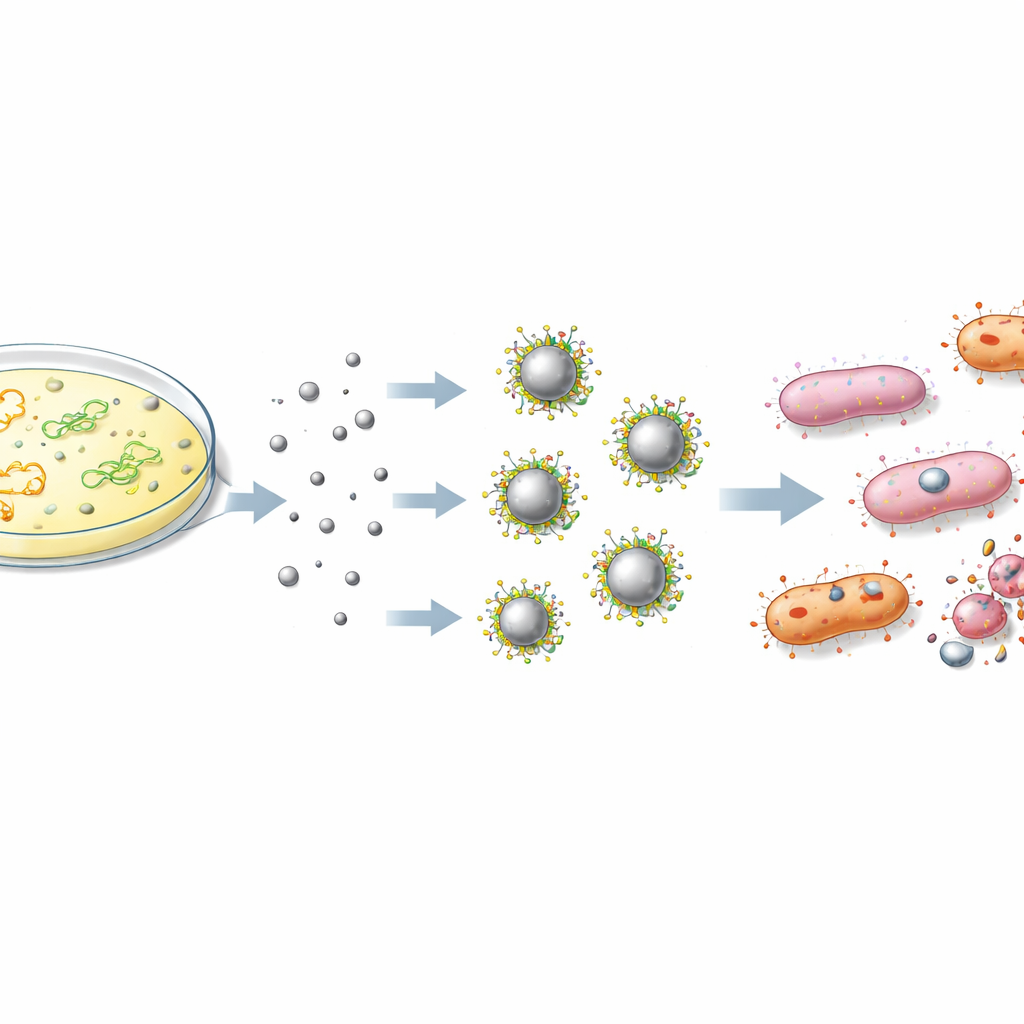
To turn silver salts into nanoparticles, the researchers mixed the bee-bacteria supernatants with a silver solution. They tested two methods: letting the mixture sit at room temperature, and briefly exposing it to microwave energy. The microwave treatment sped up the reaction and produced more uniform, stable particles. Detailed measurements using light scattering and electron microscopes showed that the resulting silver nanoparticles were mostly spherical, with sizes in the range of a few to a few dozen billionths of a meter. The study focused on two key formulations, called AgNPs-1B and AgNPs-54B, which differed slightly in size and how evenly dispersed they were in liquid, but both clearly showed successful nanoscale silver formation.
How the New Particles Battle Resistant Bacteria
Next, the team tested whether these bee-derived nanoparticles could tackle problem microbes. They exposed multidrug-resistant strains of Escherichia coli and Staphylococcus aureus—the types of bacteria often responsible for stubborn hospital infections—to the silver particles. In petri dish tests, the nanoparticles created clear zones where bacteria could not grow, while the original bacterial liquids and silver salt alone did not. When the researchers determined the minimum amount needed to stop growth, both nanoparticle types proved active at relatively low concentrations, and one formulation was especially effective against the Gram-positive S. aureus. The results suggest the nanoparticles act through multiple physical and chemical assaults on the bacteria, making it harder for the microbes to evolve resistance.
Testing Safety in Flies, Nerve Cells, and Films
Potent antimicrobials are only useful if they are reasonably safe. To probe this, the scientists fed the nanoparticles to fruit flies (Drosophila melanogaster), a classic animal model in toxicology. Over 17 days, survival in treated flies did not differ from untreated controls, suggesting low whole-organism toxicity at the tested doses. They also exposed human neuron-like cells grown in dishes to the particles. One formulation slightly reduced cell viability at the highest dose tested, while the other showed no measurable harm. Finally, the silver nanoparticles were embedded into soft alginate films—a gel-like material already used in wound dressings. These composite membranes could suppress growth of both E. coli and S. aureus, especially right beneath the film, indicating strong contact-based protection suitable for coatings or bandages.
What This Means for Everyday Health
For a non-specialist, the key message is that the researchers turned an overlooked natural niche—bacteria from stingless bee larval food—into a factory for eco-friendly, medically useful nanomaterials. The resulting silver nanoparticles reliably killed drug-resistant bacteria, kept their activity when built into soft films, and showed low toxicity in early fly and cell tests. While much work remains before such materials reach clinics, this bee-inspired approach points toward future bandages, surfaces, or devices that can quietly prevent infections without relying on traditional antibiotics, helping us stay a step ahead in the race against resistant germs.
Citation: Santos, A.C.C., Corrêa, J.L., Cerqueira, R.C. et al. Microbial synthesis of silver nanoparticles using bacterial supernatants from Brazilian stingless bees with antimicrobial activity. Sci Rep 16, 8512 (2026). https://doi.org/10.1038/s41598-026-40296-x
Keywords: silver nanoparticles, antibiotic resistance, stingless bees, green nanotechnology, antimicrobial materials