Clear Sky Science · en
Effects of strong parametric excitation on cantilever beam: non-perturbative approach
Why shaking beams matter in everyday life
From airplane wings and turbine blades to skyscraper floors and robotic arms, many structures behave like cantilever beams: fixed at one end, free at the other. When their supports or operating conditions change rhythmically—because of wind gusts, machine vibrations, or shifting loads—these beams can suddenly switch from gentle swaying to wild, chaotic motion. This study explores how such "shaken" beams behave when pushed hard, and introduces a clever way to predict when their vibrations stay safe and when they might spiral out of control.
A simple model for a very busy beam
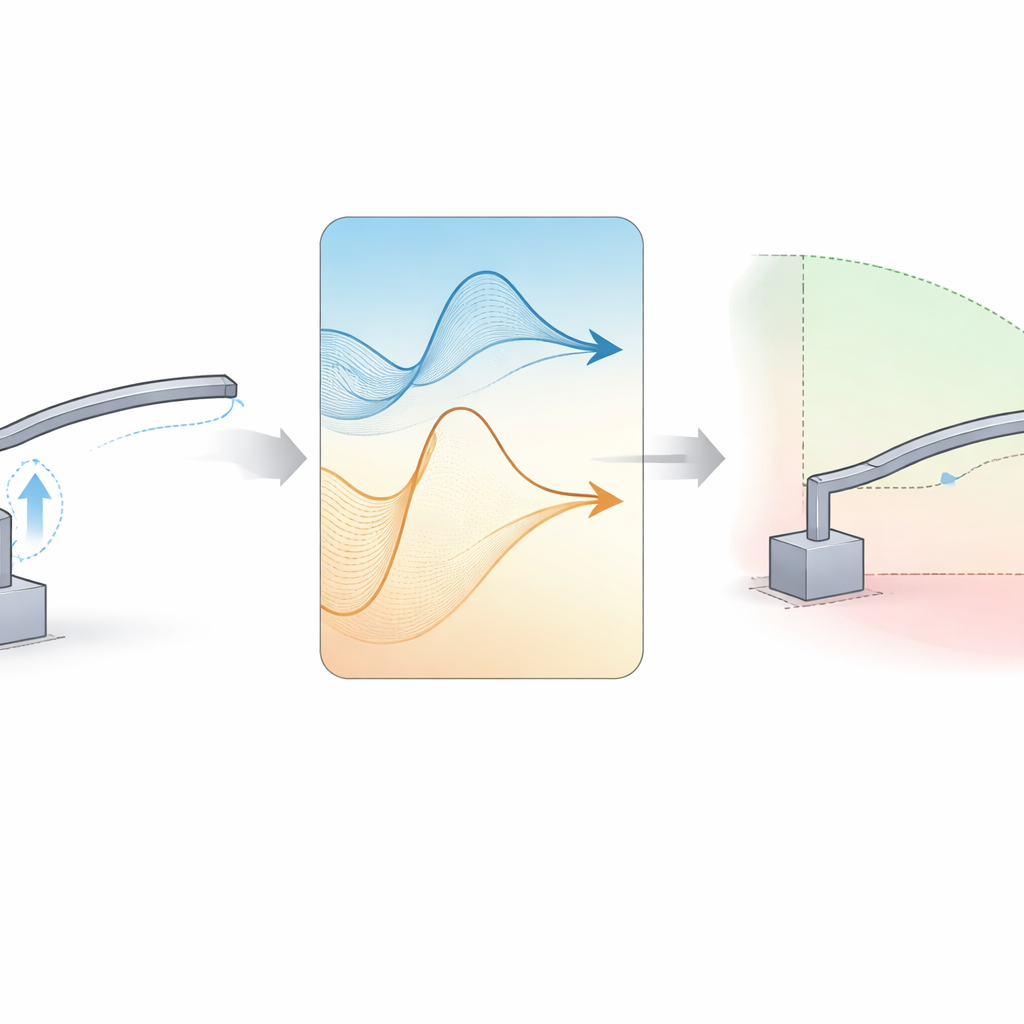
The authors focus on a single cantilever beam coated with piezoelectric patches and mounted on a moving base that shakes it periodically. Instead of tracking every point along the beam, they condense its behavior into one main bending mode, described by a single time-varying displacement. The resulting equation of motion is packed with real-world effects: ordinary friction-like damping, aerodynamic drag that grows with speed, geometric bending that stiffens the beam at large deflections, inertial terms that reflect how the beam’s own shape and mass distribution feed back on its motion, and a specially designed nonlinear control term meant to tame large oscillations. Together, these ingredients reproduce how real beams transition from small, nearly sinusoidal vibrations to large, potentially dangerous motion when their environment is periodically disturbed.
Turning a messy problem into a simpler picture
Instead of using traditional perturbation methods that assume only small deviations, the researchers adopt a non-perturbative approach rooted in He’s frequency formula. The key idea is to replace the complicated nonlinear equation with a carefully chosen linear one that behaves almost identically over the motion of interest. They construct "equivalent" frequency and damping parameters by averaging how the nonlinear terms act over a cycle of motion. This yields a streamlined linear oscillator that still carries all the important physical parameters of the original beam. By comparing the simplified model’s predictions with full numerical simulations, they find excellent agreement, showing that the non-perturbative method can capture the beam’s essential dynamics without relying on smallness assumptions.
Mapping the safe and unsafe vibration zones
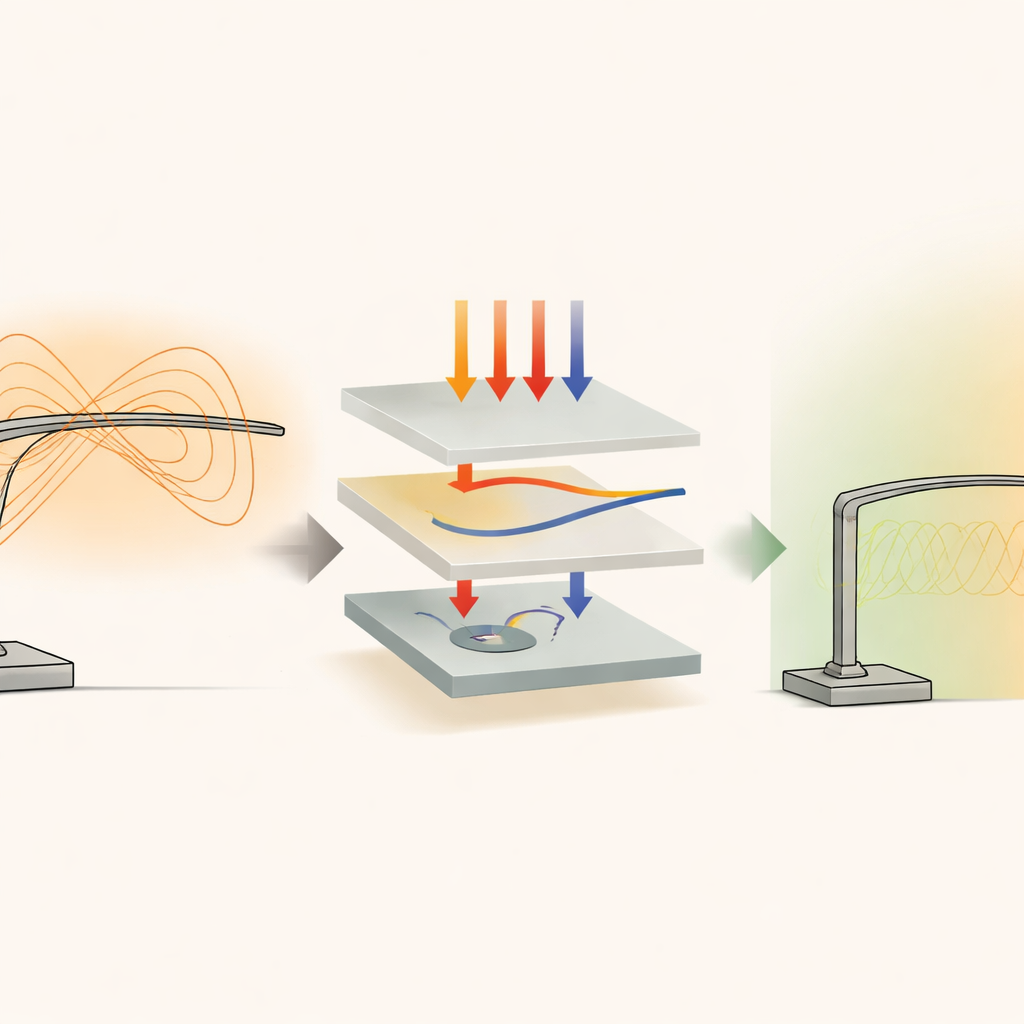
With the simplified model in hand, the authors systematically explore how different physical knobs—such as natural frequency, ordinary damping, aerodynamic drag, geometric stiffness, and the strength and frequency of the parametric excitation—shape the beam’s stability. They draw stability diagrams that separate regions of bounded, regular oscillations from regions where motion grows unbounded or becomes erratic. Higher natural frequencies generally favor stability, while strong periodic forcing can push the system into unstable or chaotic regimes. Ordinary viscous damping tends to calm the motion, whereas certain nonlinear inertial and drag effects can either stabilize or destabilize the beam depending on amplitude and parameter values. The nonlinear control term, which grows strongly with vibration speed, plays an important role in limiting large oscillations near resonance.
Watching the beam’s motion evolve in time
To make these abstract stability boundaries tangible, the team examines detailed time histories of the beam’s tip motion. By varying one parameter at a time, they show how the beam’s oscillations can decay quickly, linger, grow, or change character. Increased damping leads to faster decay of vibrations, while stronger parametric forcing drives larger deflections and can pull the system into complex nonlinear behavior. Changes in geometric and inertial parameters alter how the vibration frequency shifts with amplitude, revealing features such as hysteresis and jumps between different steady states—classic fingerprints of nonlinear resonance. These time-domain views connect the mathematics back to what engineers would actually observe in experiments or real structures.
From gentle swings to chaos and back again
Finally, the authors probe the onset of chaos using bifurcation diagrams and the largest Lyapunov exponent, a standard measure of how sensitively a system responds to tiny changes in initial conditions. As the excitation strength or damping parameters are varied, the beam’s motion moves through a rich sequence: steady periodic oscillations give way to complex, chaotic patterns, then occasionally return to orderly periodic behavior in narrow "windows" before chaos reappears. Some parameters, especially increased linear damping or certain forms of nonlinear dissipation, can permanently suppress chaos, keeping the beam’s response predictable. Others, like strong parametric forcing, tend to enlarge the chaotic regions.
What this means for real-world structures
In plain terms, the study shows that even simple-looking beams can behave unpredictably when their properties or supports are periodically modulated, and that small changes in design or control can make the difference between safe motion and dangerous chaos. By converting a highly nonlinear problem into an accurate, easier-to-analyze linear surrogate, the non-perturbative method offers engineers a practical tool to foresee where stability breaks down, how to shift resonance away from operating conditions, and how to tune damping and control terms to keep vibrations in check. This framework can help guide safer designs in fields ranging from civil engineering and aerospace to precision machinery, wherever flexible components must endure rhythmic loading without failing.
Citation: Moatimid, G.M., Amer, T.S. & Elagamy, K. Effects of strong parametric excitation on cantilever beam: non-perturbative approach. Sci Rep 16, 8956 (2026). https://doi.org/10.1038/s41598-026-40295-y
Keywords: cantilever beam vibrations, parametric excitation, nonlinear dynamics, chaos and stability, non-perturbative analysis