Clear Sky Science · en
Temperature–pressure characteristics of CO2 phase-transition blasting and the failure mechanism of fracturing tubes
Breaking Rock Without Traditional Explosives
Mining and tunneling often rely on powerful explosives that bring noise, heat, and safety risks. This study explores a different approach: using compressed carbon dioxide (CO2) that suddenly changes from liquid to gas to crack rock. By carefully controlling how CO2 heats up, expands, and escapes from a steel tube, engineers can fracture rock while avoiding open flames and explosive chemicals. Understanding this process could make underground work safer, quieter, and more precise.
How a CO2 Blast Is Set Up
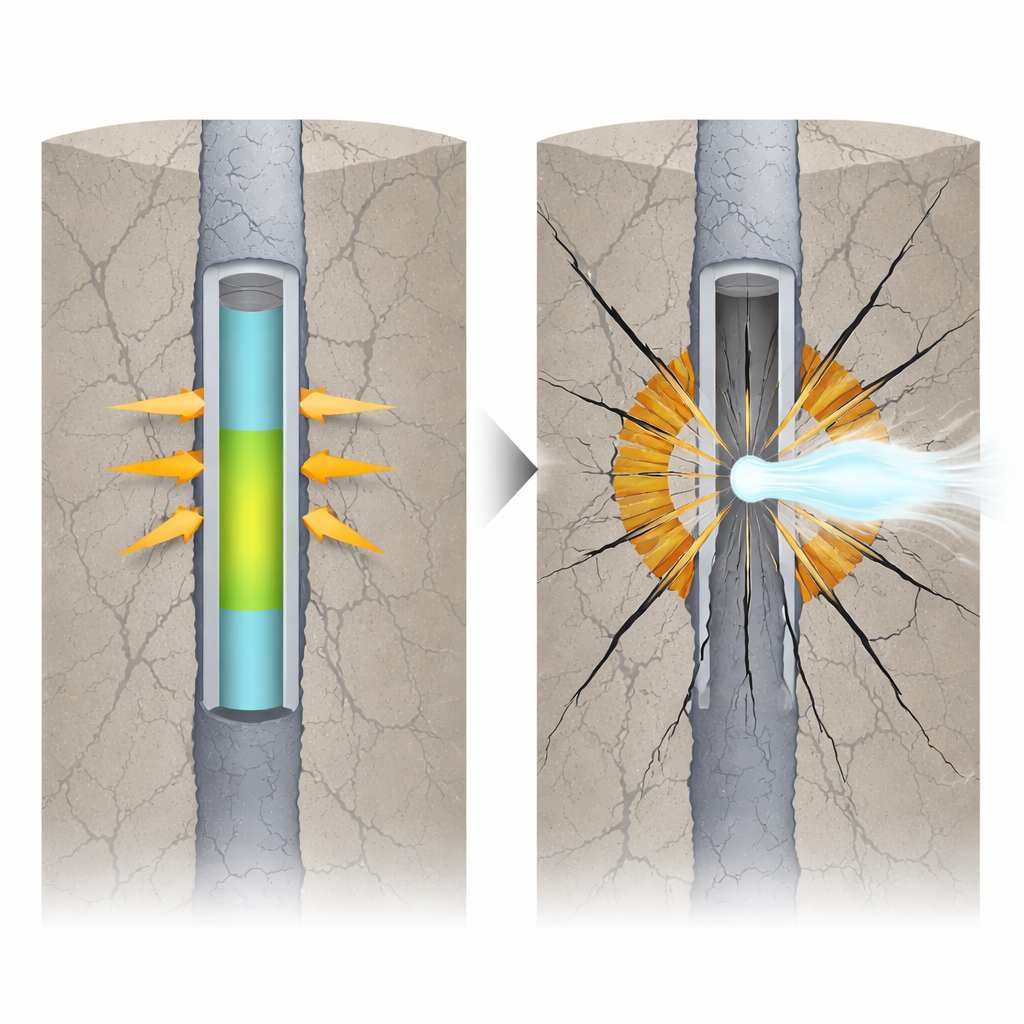
In CO2 phase-transition blasting, a strong steel tube is placed in a borehole drilled into rock or coal. Liquid CO2 is pumped into the tube and cooled so that it stays in a dense, pressurized state. A built-in heating element is later triggered by an electric signal. When heated, the liquid CO2 rapidly turns into a highly compressed gas-like state and its volume tries to expand hundreds of times. This causes the pressure inside the tube to soar until a designed weak point finally gives way, allowing the CO2 to rush out and push against the nearby rock surface. Because the energy comes from a physical phase change rather than chemical burning, the method produces lower vibration and no flame or toxic fumes.
What Happens Inside the Tube
The authors closely track how temperature and pressure change inside the tube during three key stages: filling, heating, and release. During filling, CO2 cycles between gas and liquid while the pressure steadily climbs and the tube wall carries the load without permanent damage. During heating, special chemical pellets act like a compact heater, pushing the CO2 into a supercritical state in a few thousandths of a second. Pressure rises sharply, but the tube is made of high-strength alloy steel with thicker ends, so it stays within safe limits. The study shows that the tube’s peak stress remains far below the metal’s failure strength, meaning the tube body can be reused many times as long as its weakest component is properly controlled.
Designed Weak Points That Control the Blast
The real “fuse” in the system is the part that is meant to fail: either a thin rupture disc at the bottom of a reusable tube or a grooved seam along the side of a disposable tube. Using computer simulations, the researchers show that the bottom disc mainly fails by shearing along a ring where the loaded center meets the clamped edge. The pressure needed to break this disc increases almost linearly with the metal’s strength and thickness and decreases with the size of the loaded area. This simple relationship allows engineers to select disc material and geometry to dial in a desired release pressure and, therefore, the blast energy.
One-Time Tubes and the Role of Grooves
For single-use side-release tubes, the weak spot is created by machining a long V-shaped groove along the tube wall. As CO2 pressure builds, stress concentrates at the groove until the metal tears open along its length, venting gas sideways into the borehole. Because the shape of this groove is more complex, the break pressure cannot be written with a simple formula. Instead, the team uses a statistical design method to explore many combinations of groove depth, length, and width. Their analysis reveals that depth has the strongest effect on when the tube tears, followed by length, while width matters least. By adjusting these parameters, designers can fine-tune how easily the tube opens and how much energy is delivered to the rock.
From Gas Jet to Cracked Rock
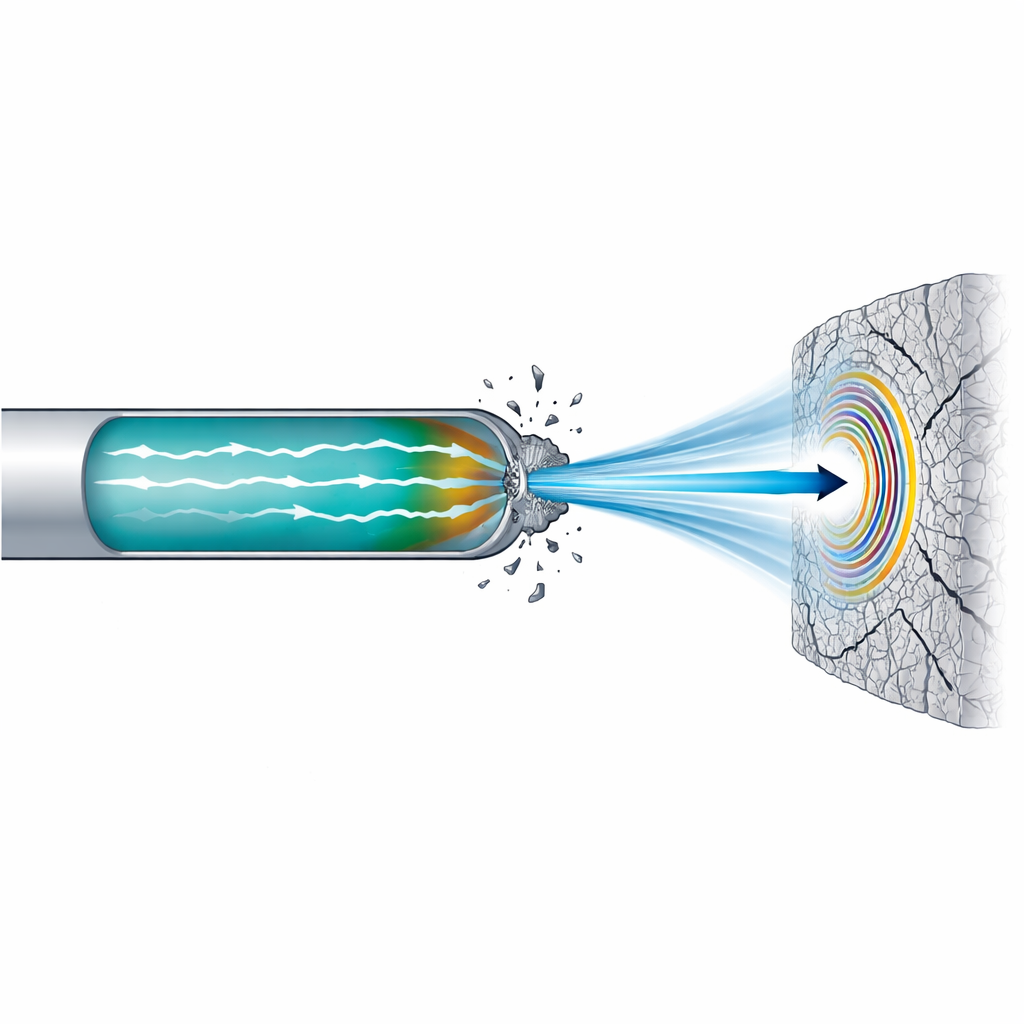
Once the tube opens, the CO2 rushes out as a high-speed jet. It travels through the narrow gap between the tube and the borehole wall, gradually losing strength but still striking the rock with a sharp impact. This impact generates stress waves that radiate through the rock, seeding small cracks around the borehole. The lingering pressurized gas then seeps into these cracks, pushing them open and extending them farther. The study describes how pressure at the wall is amplified when the jet hits and how it then decays into a more slowly acting pressure field, combining a fast “hammer blow” with sustained pushing to break the rock effectively.
Why This Matters for Safer Rock Breaking
Overall, the work shows that CO2 phase-transition blasting is driven by a carefully scripted journey of the fluid: from gas to liquid, to a dense supercritical state, and back to gas. The way temperature and pressure change inside the tube, and how the tube is engineered to fail, control how much energy reaches the rock and how fractures grow. By providing formulas, simulations, and design rules for both reusable and disposable tubes, the study offers a roadmap for making this non-explosive method more predictable and efficient. For workers and communities near mines and tunnels, that could mean safer operations with less vibration, less noise, and reduced reliance on conventional explosives.
Citation: Chen, Z., Yuan, Y., Li, B. et al. Temperature–pressure characteristics of CO2 phase-transition blasting and the failure mechanism of fracturing tubes. Sci Rep 16, 9526 (2026). https://doi.org/10.1038/s41598-026-40279-y
Keywords: CO2 blasting, rock fracturing, non-explosive demolition, gas jets, mining safety