Clear Sky Science · en
Adsorption kinetics and isotherm studies for removal of copper phthalocyanine dye from aqueous medium using biodegradable adsorbent
Turning Waste into a Water Cleaner
Colorful dyes give our clothes and textiles their bright shades, but once these dyes wash into rivers they can harm aquatic life and may pose health risks to people. This study explores a deceptively simple idea: can we turn everyday plant leaves and stone dust—materials that are usually thrown away—into tiny beads that pull stubborn blue dye out of polluted water? The researchers show that such biodegradable beads can clean water efficiently, can be reused several times, and could help make wastewater treatment cheaper and more sustainable.
Why Blue Dyes Are a Hidden Threat
Modern industries use large quantities of synthetic dyes that are designed to be tough: they resist fading from light, heat, and microbes. This very durability becomes a problem when dye-laden wastewater is released into streams and lakes. The copper phthalocyanine dye studied here, known for its intense turquoise color, is typical of such persistent chemicals. Even small amounts can tint large bodies of water, blocking sunlight and disrupting photosynthesis in aquatic plants. Some dyes or their breakdown products can also be toxic or cancer-causing, so there is a pressing need for simple methods that remove them before they reach the environment.
Building Cleaning Beads from Leaves and Stone
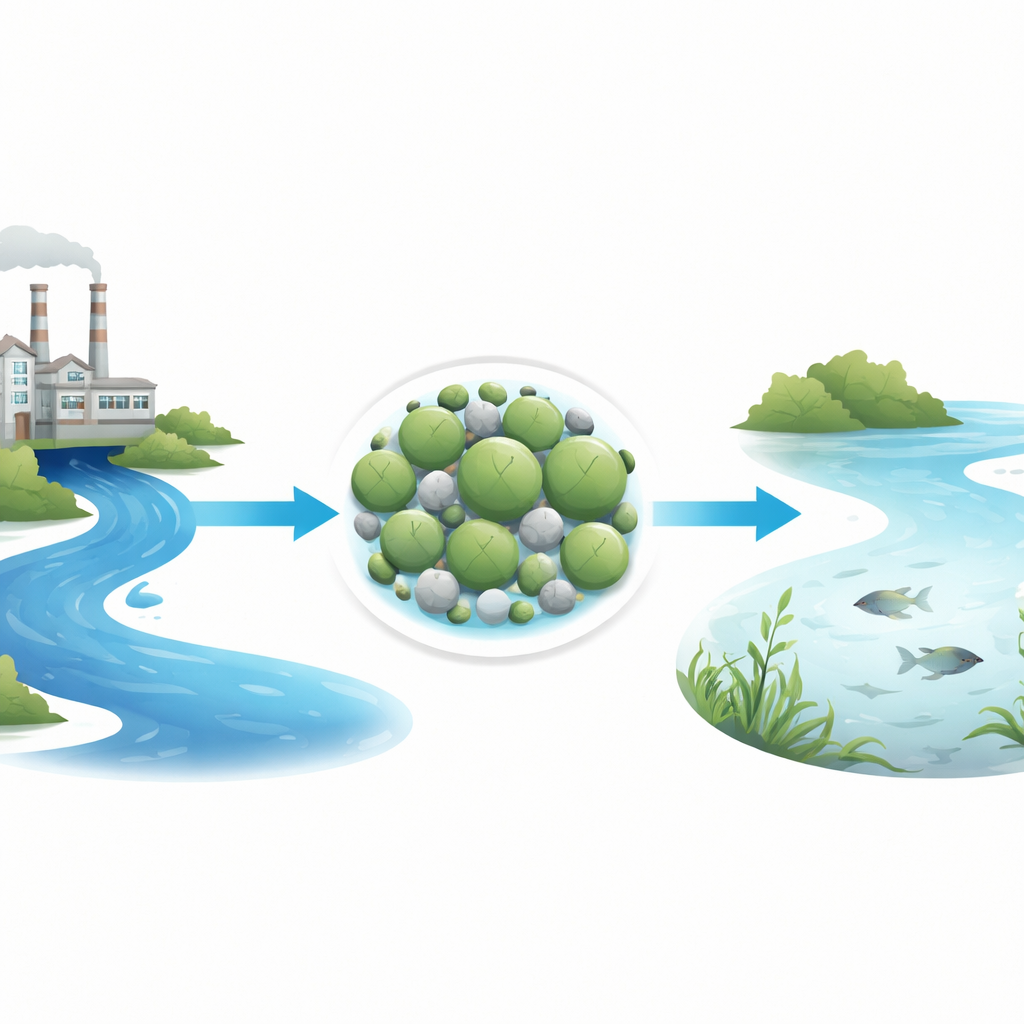
The team set out to create a low-cost “sponge” for dyes using waste materials. They combined powdered leaves from the Syzygium cumini tree (a common fruit tree) with fine granite dust from the marble and stone industry. Both are widely available wastes. These ingredients were mixed into a solution of sodium alginate, a natural gum derived from seaweed that forms soft gels in the presence of calcium ions. Dropping this mixture into a calcium solution produced firm, millimeter-scale beads. Each bead is a tiny composite of plant fibers and mineral particles locked inside an alginate skeleton, offering many nooks, crannies, and chemical groups where dye molecules can stick.
How Well Do the Beads Work?
The researchers carefully tested how different factors influenced the beads’ ability to pull the turquoise dye from water. By varying how much adsorbent they used, how long it stayed in contact with the dye solution, and the acidity (pH) of the water, they identified conditions that maximized dye removal. Microscopy showed that the bead surfaces are rough and full of pores, ideal for trapping dye. Other measurements confirmed that the plant fibers and granite were successfully integrated into a semi-crystalline network. Under optimal conditions, the beads removed a high percentage of dye, especially at a mildly acidic pH around 6, where their surface groups are most effective at grabbing the negatively charged dye molecules.
Peeking into the Dye-Trapping Process
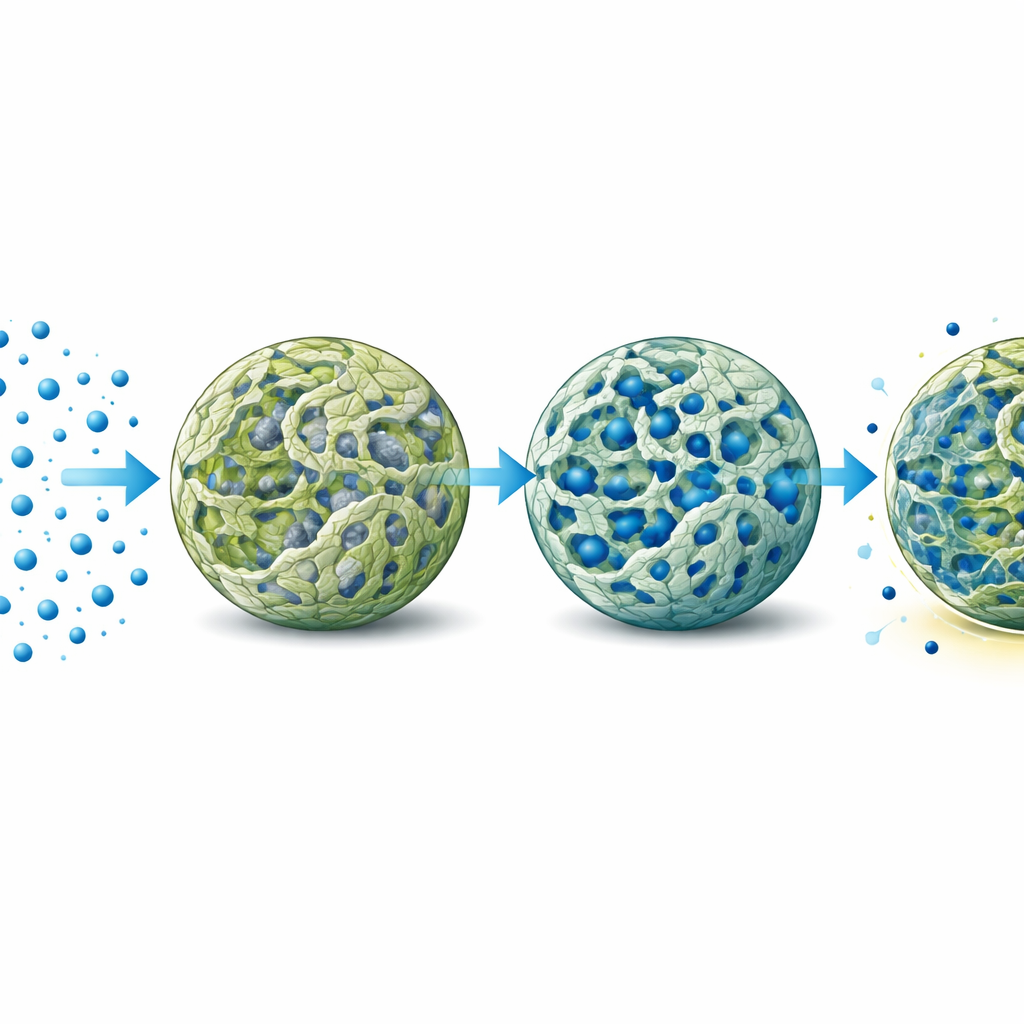
To understand what happens beyond simple before-and-after tests, the team fitted their experimental data to a suite of mathematical models commonly used in water treatment research. These models revealed that dye molecules tend to form a single, orderly layer on the bead surface rather than stacking up in many layers. The rate at which dye disappeared from the water matched a pattern associated with “chemisorption,” where relatively strong, specific interactions—such as hydrogen bonding and attractions between charged groups—dominate. Thermodynamic calculations showed that the process releases heat and occurs spontaneously, meaning the beads naturally favor holding onto the dye once contact is made.
Beads That Can Be Used Again
For any practical treatment system, materials should be reusable rather than disposable. The authors therefore tested how well the dye-loaded beads could be cleaned and used again. By washing them with a mild alkaline solution, they were able to release much of the trapped dye back into a separate liquid, effectively regenerating the beads. Over five cycles of adsorption and desorption, the beads retained a substantial part of their cleaning power, suggesting that they could be used repeatedly in real-world wastewater treatment setups.
From Lab Beads to Cleaner Rivers
Overall, the study shows that small, biodegradable beads made from discarded leaves, stone dust, and a seaweed-derived gel can efficiently strip a stubborn blue dye from water in a predictable, energy-favorable way, and can be regenerated several times. For a lay reader, the key message is that common wastes can be engineered into smart materials that help safeguard rivers and lakes from industrial dyes. If scaled up and integrated into treatment plants, such biosorbent beads could offer a low-cost, eco-friendly tool for cleaning colored wastewater while contributing to a more circular use of natural resources.
Citation: Sajid, Z., Afraz, M., Mehmood, S. et al. Adsorption kinetics and isotherm studies for removal of copper phthalocyanine dye from aqueous medium using biodegradable adsorbent. Sci Rep 16, 9270 (2026). https://doi.org/10.1038/s41598-026-40276-1
Keywords: dye removal, wastewater treatment, biodegradable adsorbent, industrial pollution, water purification