Clear Sky Science · en
Improvement of SNR in laser-induced breakdown spectroscopy using microwave and multifiber synergy
Sharper Chemical Eyes for Real-World Materials
From tracking pollutants in air and water to checking the composition of recycled metals, it is increasingly important to know exactly which elements are hiding inside everyday materials. One promising tool, laser-induced breakdown spectroscopy (LIBS), can read the chemical “fingerprints” of a material in a split second—but its signals are often faint and noisy. This study shows how combining two clever tricks—microwave energy and a bundle of optical fibers—can make those signals thousands of times clearer, potentially turning LIBS into a far more sensitive and practical analyzer for industry, the environment, and even nuclear safety.
How a Laser Turns Matter into Light
LIBS works by firing a brief, intense laser pulse at a surface, vaporizing a tiny patch and turning it into an ultra-hot, glowing cloud of gas called plasma. As the plasma cools, atoms and ions emit light at colors that reveal which elements are present. In principle, this gives a fast, almost contact-free way to analyze solids, liquids, or even distant objects. In practice, however, the plasma is tiny, unstable, and lives for only billionths of a second. Much of the light never reaches the detector, and what does arrive can be buried in background noise. These limits make it hard to see trace ingredients at low concentrations—the very signals that matter for detecting contaminants or subtle differences in alloy composition.
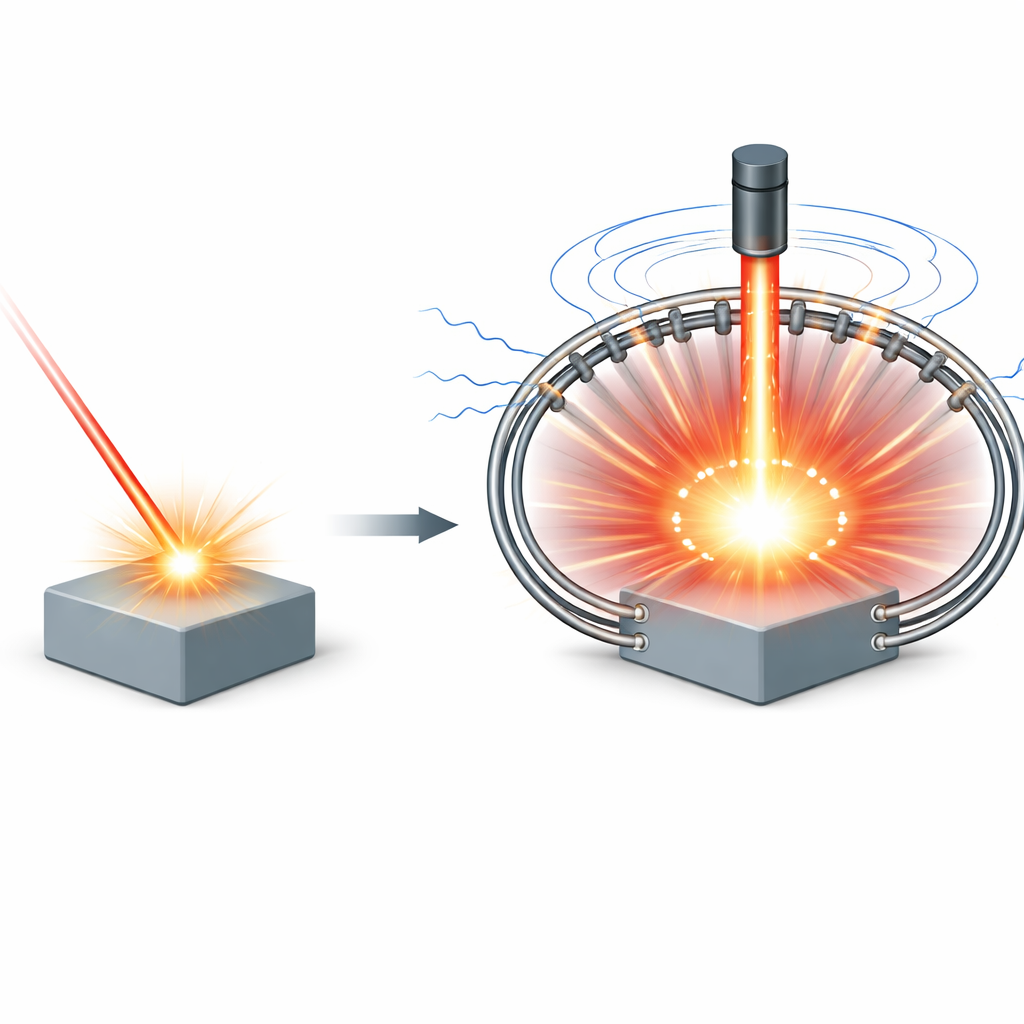
Making the Plasma Bigger and Brighter
The first part of the solution is to feed extra energy into the plasma using microwaves, similar to the frequency used in household ovens but carefully pulsed and focused. When the laser-created plasma is exposed to these microwaves, it swells more than twenty-fold in volume and survives for over a thousand times longer than in standard LIBS. During this extended lifetime, electrons and ions are repeatedly re-energized, causing the plasma to keep glowing instead of fading almost instantly. The result is a dramatic increase—up to hundreds of times—in the brightness of the elemental emission lines that carry the chemical information.
Gathering More Light with Many Tiny Windows
Yet even a bright, long-lived plasma is wasted if only a small fraction of its light is collected. Conventional LIBS often uses a single optical fiber to bring light to a spectrometer, sampling only a narrow slice of the glowing region. In this study, the author replaces that single “window” with a small bundle of six fibers arranged around a central delivery fiber. The central fiber brings the laser pulse to the sample, while the surrounding fibers act as multiple collection channels, each grabbing light from a different part of the expanded plasma. Custom-built lenses then merge these beams into one, feeding the spectrometer with far more photons than a lone fiber could provide.
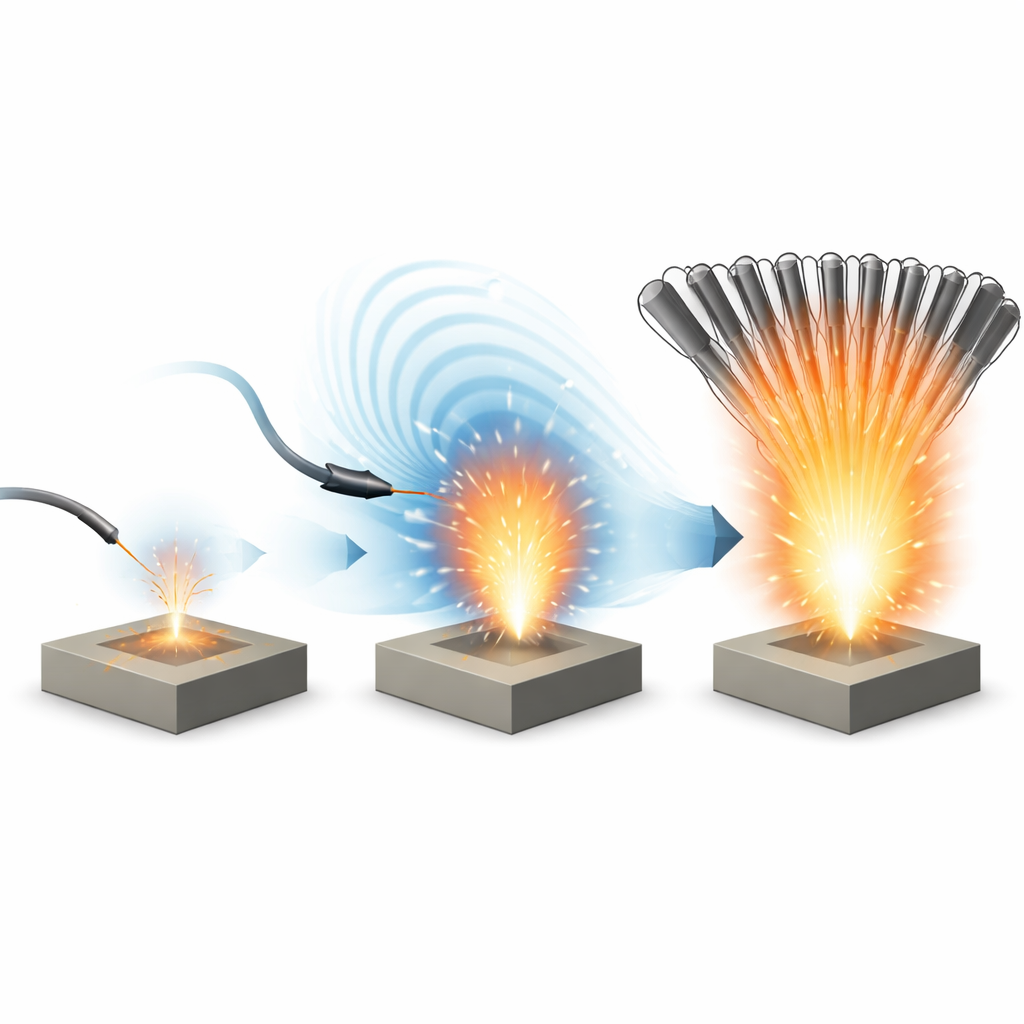
Stronger Signals and Clearer Chemical Fingerprints
When these two ideas—microwave boosting and multifiber collection—are combined, their effects multiply rather than simply add. Tests on common aluminum alloys show that the multifiber bundle alone increases the collected light several-fold, and microwaves alone brighten emissions by roughly hundreds of times. Together, they generate about 1500 to 2000 times more useful signal than standard single-fiber LIBS, while improving the signal-to-noise ratio by two to three orders of magnitude. That improvement directly lowers the smallest detectable amounts of elements like aluminum and iron, meaning the system can distinguish smaller impurity levels and produce cleaner calibration curves for quantitative analysis.
Why This Matters Beyond the Lab
For non-specialists, the bottom line is that this work turns an already versatile laser technique into a much sharper and more reliable chemical “eye.” By keeping the glowing cloud alive with microwaves and surrounding it with many light-collecting fibers, the system captures far more information with the same modest laser energy and a relatively simple spectrometer. That makes it easier to detect trace metals in recycled alloys, track contaminants in industrial processes, or monitor nuclear-related materials from a safer distance. In essence, the study shows that smart engineering of both the energy fed into the plasma and the light gathered from it can unlock far better performance from LIBS without needing bulkier or more powerful equipment.
Citation: Ikeda, Y. Improvement of SNR in laser-induced breakdown spectroscopy using microwave and multifiber synergy. Sci Rep 16, 8672 (2026). https://doi.org/10.1038/s41598-026-40272-5
Keywords: laser-induced breakdown spectroscopy, microwave-enhanced plasma, optical fiber bundle, trace metal detection, materials analysis