Clear Sky Science · en
Reference percentiles for children and adolescents for the digital motor performance test (DigiMot): results from the COMO-study
Why testing kids’ fitness from home matters
Parents, teachers, and doctors increasingly worry that modern childhood—full of screens and sitting—may be eroding kids’ strength, coordination, and overall health. Yet bringing thousands of children into gyms or labs for testing is costly and often impossible, as the COVID‑19 pandemic made clear. This study introduces and benchmarks a new way to measure children’s physical fitness entirely via video call, showing how simple home-based tests can help track development and flag problems early.
A simple home workout as a scientific test
Researchers in Germany designed the Digital Motor Performance Test, or DigiMot, to turn a short home workout into a standardized fitness check. Children aged 7 to 15 joined a Zoom session, laid out a non‑slip exercise mat sent to their homes, and were guided by trained test leaders. They performed four easy-to-understand tasks: jumping sideways between two marked areas for 15 seconds (coordination), doing as many push‑ups as possible in 40 seconds (upper‑body strength), doing sit‑ups for 40 seconds (core strength), and bending forward to touch the floor in a stand‑and‑reach test (flexibility). Many sessions were video‑recorded so a second evaluator could double‑check unclear performances, helping to keep scoring fair and consistent. 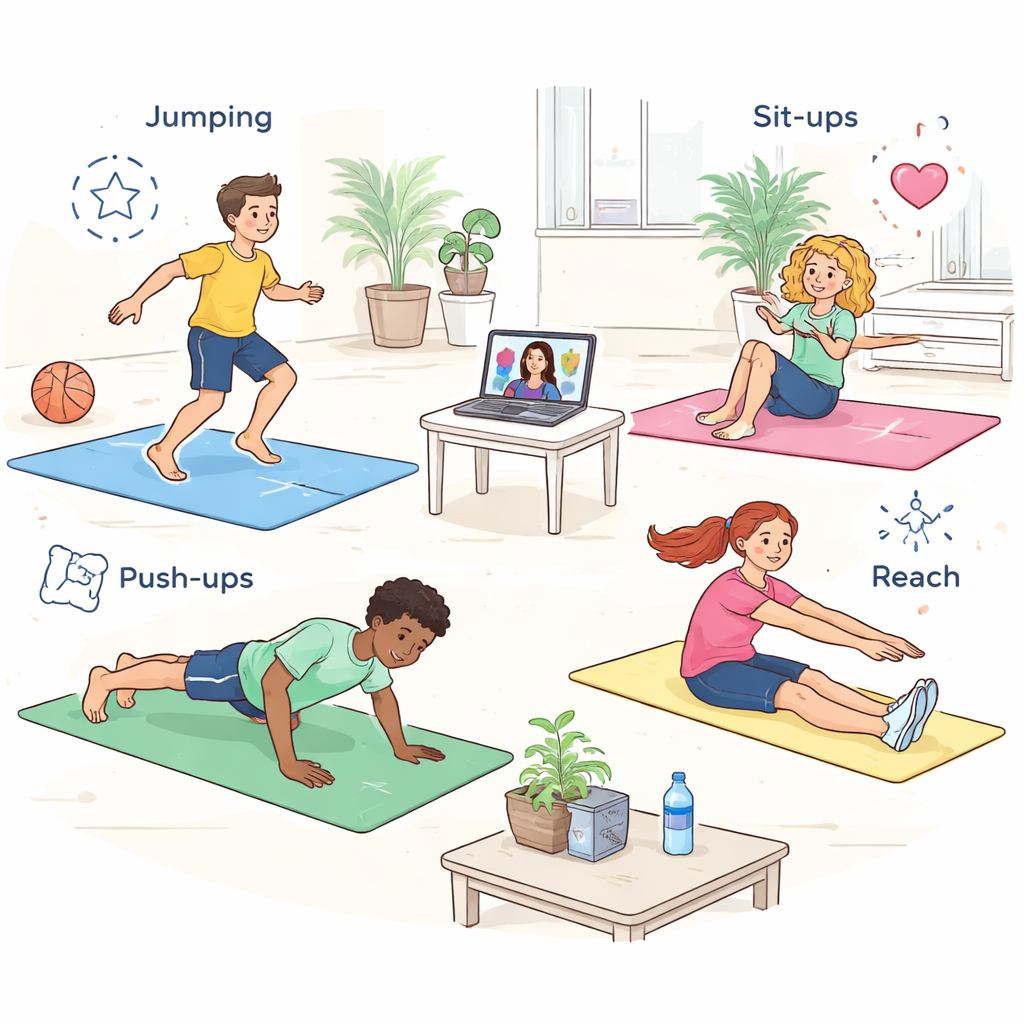
Turning raw effort into meaningful benchmarks
On their own, raw scores such as “10 push‑ups” or “20 jumps” do not say much. To make results interpretable, the team used data from 1,149 children in the large national COMO-study to build “reference percentiles” by age and sex. These percentiles work much like height charts in a child’s health record: they show, for example, whether a 10‑year‑old girl’s jump count places her around the middle of her peers or closer to the bottom or top. Sophisticated statistical models were applied so that the curves describing performance across ages were smooth and realistic, and so that boys and girls could be compared fairly. For the reach test, which was scored simply as “reached the floor” or “not,” the authors summarized the percentage of children in each group who succeeded.
How boys and girls differ as they grow
The results sketch a clear, age‑related picture of children’s fitness under real‑world home conditions. For the sideways jumping task, both boys and girls improved steadily with age, with girls slightly ahead in childhood but boys overtaking them in early teen years as their performance continued to climb. Strength tasks told a different story. Boys increased the number of sit‑ups and push‑ups they could do almost every year, while girls’ sit‑up scores leveled off around age 10 and their push‑up scores actually declined with age. This surprising drop in girls’ push‑up performance is unlikely to be purely biological; the authors suggest that factors like lower confidence, less familiarity with strength exercises, or reduced motivation during remote testing may play a role. In flexibility, girls clearly led the way: on average, more than three‑quarters of girls in every age group could reach the floor in the stand‑and‑reach test, compared with about half of boys. 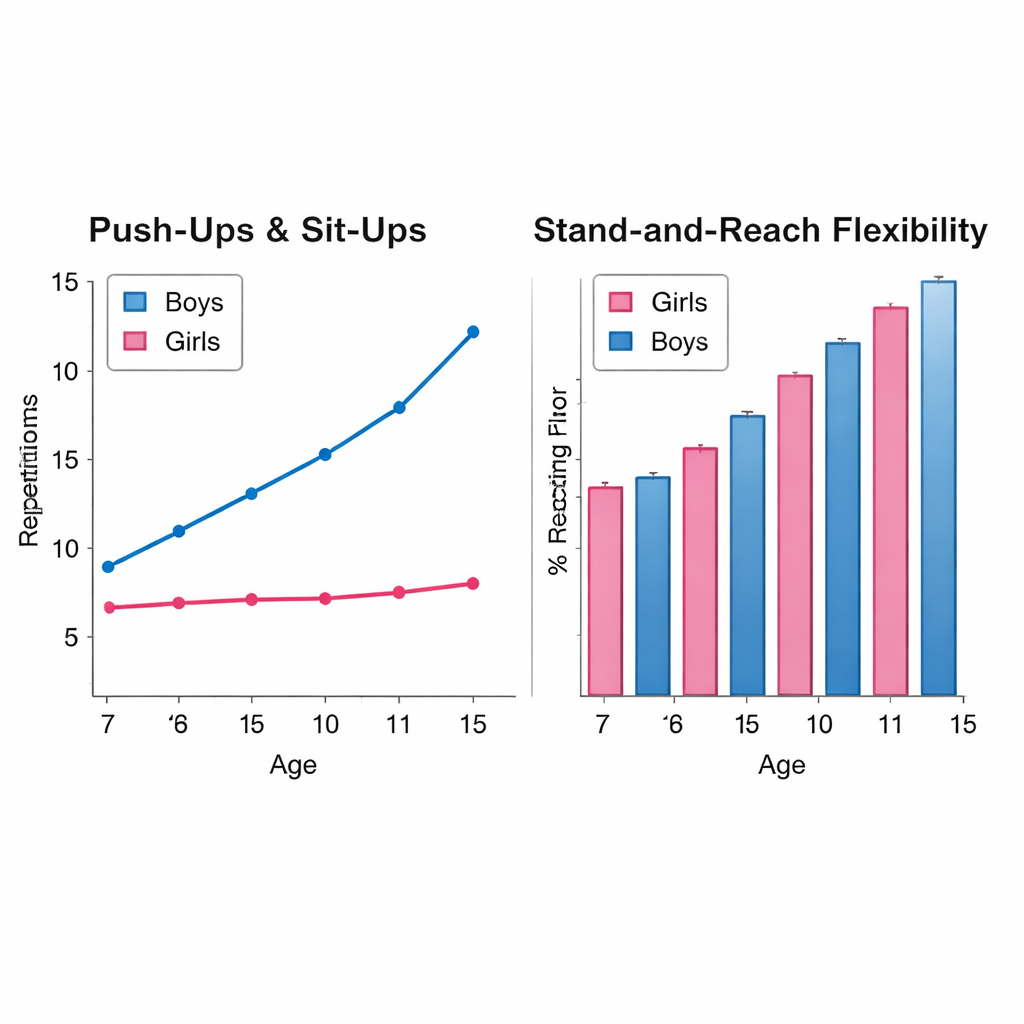
What remote tests can and cannot tell us
Comparisons with earlier, in‑person German fitness studies showed that children generally performed slightly worse in the remote DigiMot sessions, especially for push‑ups and sit‑ups. The authors argue that this gap likely reflects practical challenges—varying room sizes, imperfect camera angles, and the absence of a lively gym atmosphere that can push children to try harder—rather than a true decline in ability. They also caution that fewer older teenagers took part, and that the extreme ends of the percentile curves (very low or very high performers) are less precise. Still, the overall patterns match longstanding research: fitness tends to improve with age, boys usually gain more muscular strength in adolescence, and girls typically excel in flexibility.
What this means for families, schools, and health policy
For non‑experts, the takeaway is straightforward: it is now possible to monitor large numbers of children’s fitness levels reliably without bringing them into a gym. Teachers and health professionals could use DigiMot to identify kids who fall well below average and may benefit from extra support or tailored physical education. Because the tests can be done from almost any living room, they also offer a way to reach children who are far from sports facilities, have health or mobility issues, or feel more comfortable exercising at home. While DigiMot cannot by itself say whether a child’s difficulties stem from normal development or from inactivity, it provides a standardized early‑warning system that can trigger follow‑up assessments and family‑centered activity programs.
Citation: Klein, T., Worth, A., Niessner, C. et al. Reference percentiles for children and adolescents for the digital motor performance test (DigiMot): results from the COMO-study. Sci Rep 16, 6714 (2026). https://doi.org/10.1038/s41598-026-40270-7
Keywords: remote fitness testing, children and adolescents, physical fitness percentiles, digital health tools, motor development