Clear Sky Science · en
LUMIN: an automated graphical analysis toolbox for high-throughput calcium imaging of in vitro neuronal cultures
Why watching brain cells matters
Our brains work through rapid electrical signals, but actually measuring this activity inside living cells is hard. A popular workaround is to watch tiny flashes of light from special dyes that glow when calcium levels rise inside neurons—an indirect but powerful readout of brain activity. As labs increasingly grow human nerve cells from stem cells to model diseases and test drugs, they are collecting huge amounts of these “calcium movies.” The problem is that turning thousands of flickering cells into clear, reliable measurements usually requires complex, custom code. This paper introduces LUMIN, an easy-to-use software toolbox that lets biologists analyze large calcium imaging experiments on an ordinary laptop, helping to translate raw movies of living brain cells into insight about health, disease, and potential treatments. 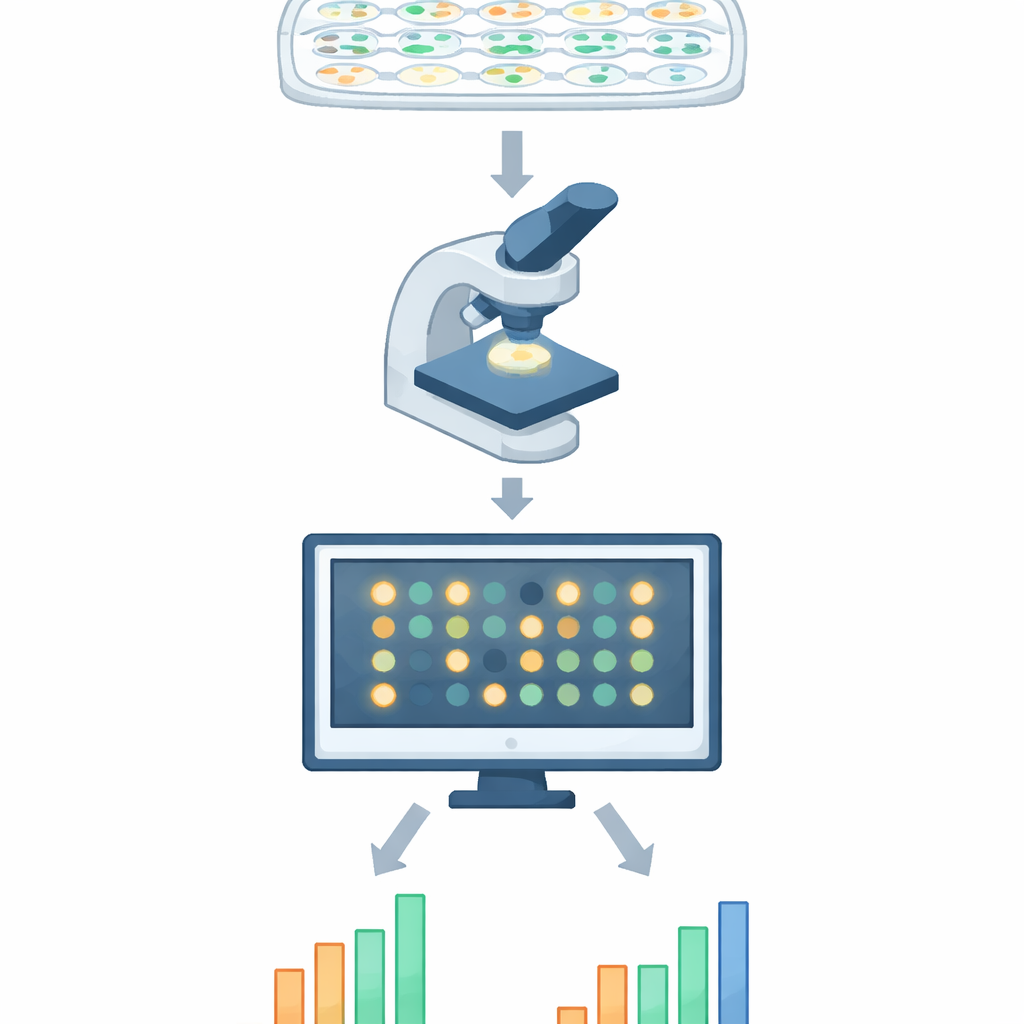
From glowing cells to big data
The authors start from a simple question: how can a typical biology lab, without specialist programmers, make sense of calcium imaging from large plates of human stem cell–derived neurons? These cultures are increasingly used to study conditions like Parkinson’s disease or epilepsy and to screen drug candidates, but existing analysis tools are mostly built for recordings inside live animals. Those tools often correct for brain motion and perform other heavy calculations that are unnecessary for flat cell cultures, slowing analysis and complicating use. LUMIN is designed specifically for cells grown in dishes. It wraps the full workflow—finding individual cells in each movie, measuring their calcium signals over time, and turning those traces into quantitative descriptions of activity—inside a graphical interface, so users click through steps instead of writing code.
How the toolbox sees and measures each cell
LUMIN’s workflow begins once time-lapse images have been acquired on a microscope. A “segmentation and signal extraction” pipeline first converts each stack of images into a single map that highlights the brightest signal across time, then identifies individual cells using modern image recognition tools originally trained for biological pictures. Optionally, a nuclear stain can be added so the software can match each bright cell body to a nucleus, improving accuracy. After some light filtering based on cell size and brightness, the program extracts the average fluorescence from each cell in every frame, producing a separate calcium trace for thousands of cells. This process scales linearly with the amount of data, so even tens of thousands of cells across dozens of recordings can be processed within about half an hour on a standard laptop.
Two ways to read neuronal “voices”
Once the raw traces are extracted, LUMIN offers two main analysis paths, tailored to different kinds of experiments. In cultures that fire quick, spike-like bursts of activity, the “transient activity” module smooths the data, normalizes each cell’s baseline, and then detects peaks that stand out from the background noise. It measures properties such as how tall, wide, and frequent these spikes are and uses standard clustering methods to group cells into distinct activity types. In quieter cultures where drugs cause a slow, sustained rise in calcium instead of sharp spikes, the “baseline shift” module uses a different strategy. It compares each cell’s signal after stimulation to its own pre-stimulus period, sums the total increase (area under the curve), and labels cells as responders or non-responders based on how far they deviate from control samples. 
Putting LUMIN to the test in human neurons
To show that the toolbox works in realistic settings, the team applied LUMIN to human midbrain neurons grown from embryonic stem cells. In one set of experiments, they recorded spontaneous firing and then added well-known drugs that either boost or silence neuronal activity. LUMIN quickly quantified how many cells were active, how often they spiked, and how spike shapes changed under each drug, confirming expected effects such as strong silencing by tetrodotoxin and increased firing with compounds that promote excitation. In a second set of experiments, they examined cultures that were mostly quiet until stimulated with a chemical mimicking the excitatory messenger glutamate. Using the baseline shift module, they showed that this stimulus caused broad, sustained calcium increases in most neurons and used follow-up staining to confirm that the responding cells were primarily neurons, including dopamine-producing ones important in Parkinson’s disease.
What this means for future brain research
In essence, LUMIN turns complex calcium imaging data into accessible, standardized measurements of how human-derived neurons behave in a dish. By combining modern image recognition, flexible analysis for both fast spikes and slow shifts, and a friendly graphical interface, it allows scientists without advanced coding skills to profile thousands of cells and compare how they respond to different compounds or disease-related changes. While it does not yet include more advanced features like network-level connectivity maps or fully publication-ready figures, the toolbox fills a key gap: it makes high-throughput functional readouts from human stem cell–based models practical in everyday lab settings, potentially speeding up discoveries in neuroscience and drug development.
Citation: Hänninen, E., Mueller, A.K., Bagge, J.V. et al. LUMIN: an automated graphical analysis toolbox for high-throughput calcium imaging of in vitro neuronal cultures. Sci Rep 16, 9496 (2026). https://doi.org/10.1038/s41598-026-40269-0
Keywords: calcium imaging, neuronal activity, stem cell models, high-throughput analysis, neuropharmacology