Clear Sky Science · en
SEM morphological analysis of the deformation on disposable scalpels used in dentistry
Why the sharpness of a tiny blade matters
When you have dental surgery—such as a difficult tooth extraction or implant placement—the dentist relies on a tiny disposable scalpel to open the gums cleanly and precisely. We tend to assume that each new blade stays razor‑sharp throughout a procedure, but this study shows that as the cut gets longer, the blade itself actually bends and blunts in measurable ways. Understanding how and when that damage happens matters not only for dentists, but also for anyone interested in how surgical tools affect pain, healing, and safety.
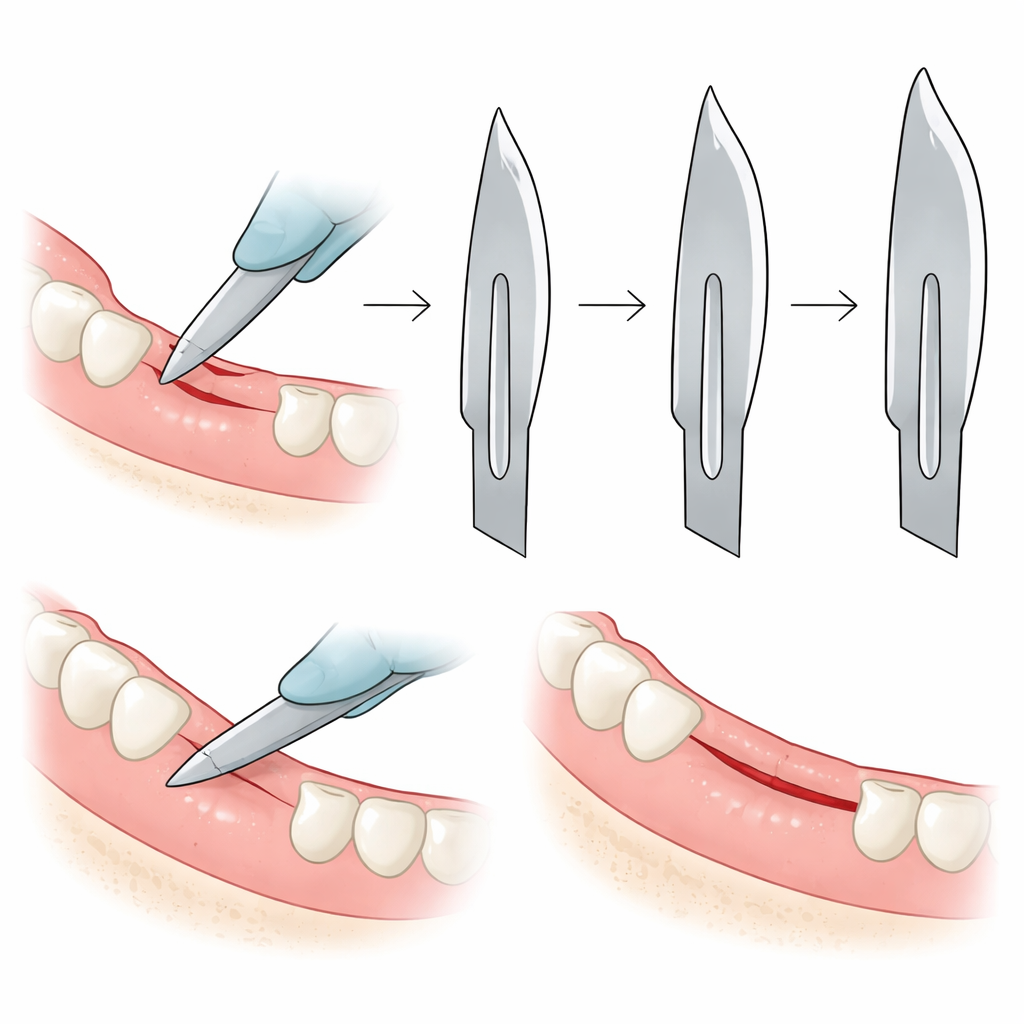
Small tools in a tight space
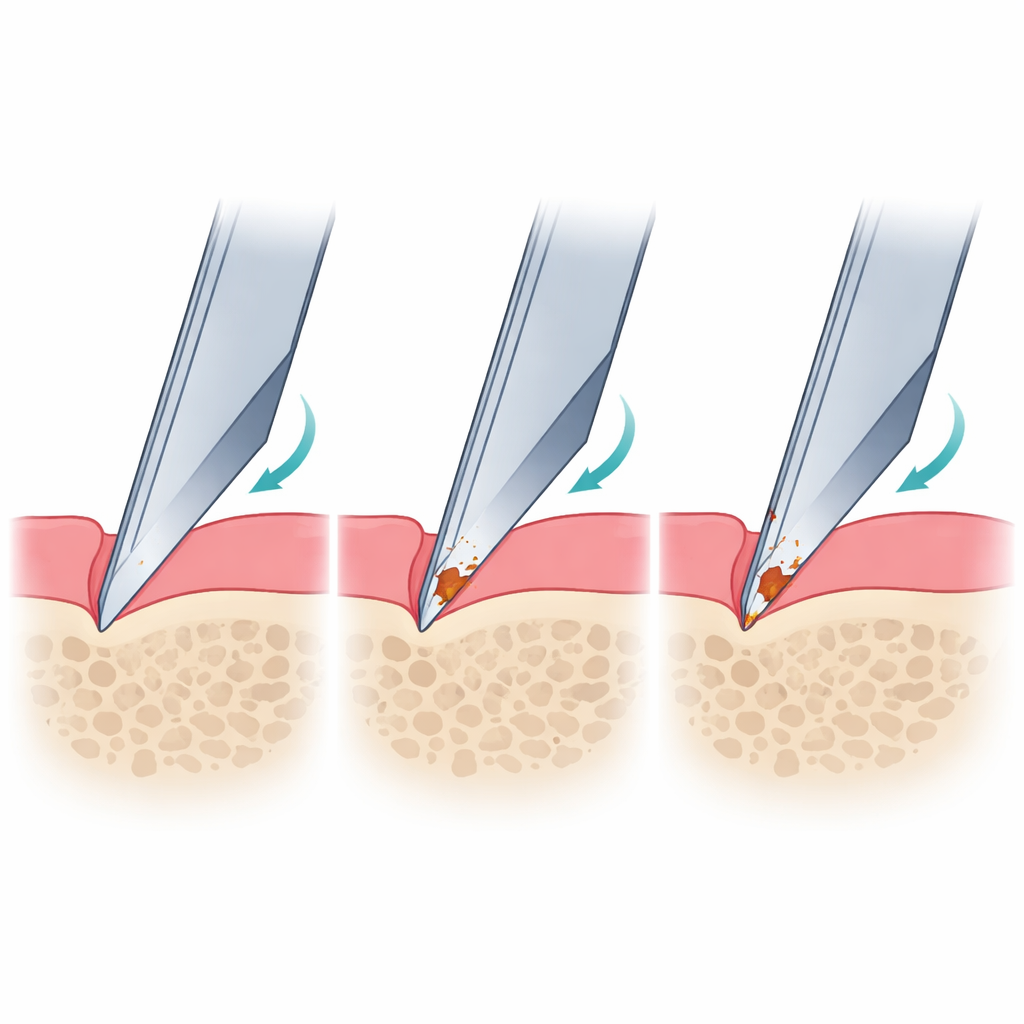
Inside the mouth, there is very little room to work. Dentists commonly use two blade shapes, known as no. 11 and no. 15, because they fit well around teeth and bone. In many procedures, especially when placing implants or treating gum disease, the dentist raises a “full‑thickness flap.” That means the blade must cut through the gum and its thin covering layer while being pressed firmly against the hard jawbone below. This firm contact is necessary for a neat, controlled opening, but it also places a great deal of mechanical stress on the delicate cutting edge.
Putting scalpels to the test in real patients
The researchers followed 96 adult patients undergoing routine oral surgery that required full‑thickness flaps in the upper or lower jaw. Each patient was operated on with a brand‑new disposable stainless‑steel blade—either shape no. 11 or no. 15—from one of two manufacturers. The blades were used for different incision lengths, grouped from very short (up to 2 centimeters) to relatively long (between 6 and 8 centimeters). After the surgery, every blade was carefully cleaned, sterilized for safety, and then examined under a powerful scanning electron microscope, which can reveal surface changes far too small to see with the naked eye.
What the microscope revealed
The microscopic images showed that almost every blade—94 out of 96—had been damaged by normal use. Even very short cuts caused visible changes in more than 9 out of 10 blades, and once the incision was longer than 2 centimeters, every single blade showed deformation. The longer the cut, the more extensive the damage: the bent or flattened area along the cutting edge grew both in length and in how far it stuck out or caved in from the original profile. The two blade shapes behaved differently. The more pointed no. 11 tended to develop broader, chunkier distortions, especially at its tip where forces concentrate. The more curved no. 15 spread the load over a slightly longer section, so its damage extended farther along the edge but was narrower at any single point. Importantly, blades with the same shape from the two brands performed essentially the same, suggesting that, under these conditions, shape matters more than manufacturer.
What this means for surgery and patients
From the operating dentist’s point of view, these microscopic changes are not just theoretical. The surgeon in this study reported a noticeable loss of cutting ease once an incision exceeded about 6 centimeters. As the blade bends and loses its fine edge, it no longer slides cleanly through tissue; the dentist must push harder, raising the risk of ragged cuts, extra trauma to the flap, and potentially more pain and swelling afterward. Because full‑thickness flaps require the blade to scrape along bone, the study suggests that this kind of surgery is particularly demanding on disposable scalpels, regardless of brand or coating.
Take‑home message for everyday readers
This work shows that even high‑quality, single‑use dental scalpel blades do not stay perfect for long: nearly all of them deform during the very procedures they are meant to perform, and the damage grows steadily with incision length. For patients, this highlights why careful technique—and sometimes simply changing blades during longer operations—may help ensure cleaner cuts and better healing. For dentists and device designers, the findings point toward developing blade shapes and materials that better withstand contact with bone. In short, keeping that tiny edge truly sharp is more complex, and more important for comfort and recovery, than it might appear.
Citation: Cumbo, E., Messina, P., Gallina, G. et al. SEM morphological analysis of the deformation on disposable scalpels used in dentistry. Sci Rep 16, 8787 (2026). https://doi.org/10.1038/s41598-026-40261-8
Keywords: dental surgery, scalpel blades, blade sharpness, oral flap procedures, surgical instruments