Clear Sky Science · en
Effect of movement goal on countermovement jump performance in athletes across different sports
Why How You Ask Athletes to Jump Matters
Coaches and trainers rely on simple jump tests to track how strong, powerful, and ready their athletes are. But this study shows that even a small change in the words used before a jump—asking someone to jump “as high as possible” versus “as fast as possible”—can meaningfully change how the body moves and the results that are recorded. For anyone interested in sport performance, injury monitoring, or fair testing, understanding this subtle but powerful effect is essential.
Two Simple Jump Goals, Many Hidden Changes
The researchers focused on the countermovement jump, a standard test where athletes quickly dip down and then spring upward. They recruited 56 highly trained and elite competitors from track and field, football (soccer), and futsal, all used to performing this kind of jump. Each athlete completed jumps under two clear verbal goals: one set aiming to jump as high as possible, and another aiming to jump as fast as possible. A small motion sensor worn near the lower back tracked how far and how quickly the athletes moved, allowing the team to calculate jump height, time spent pushing off the ground, and how much power the legs produced.
What Changes When You Chase Height or Speed
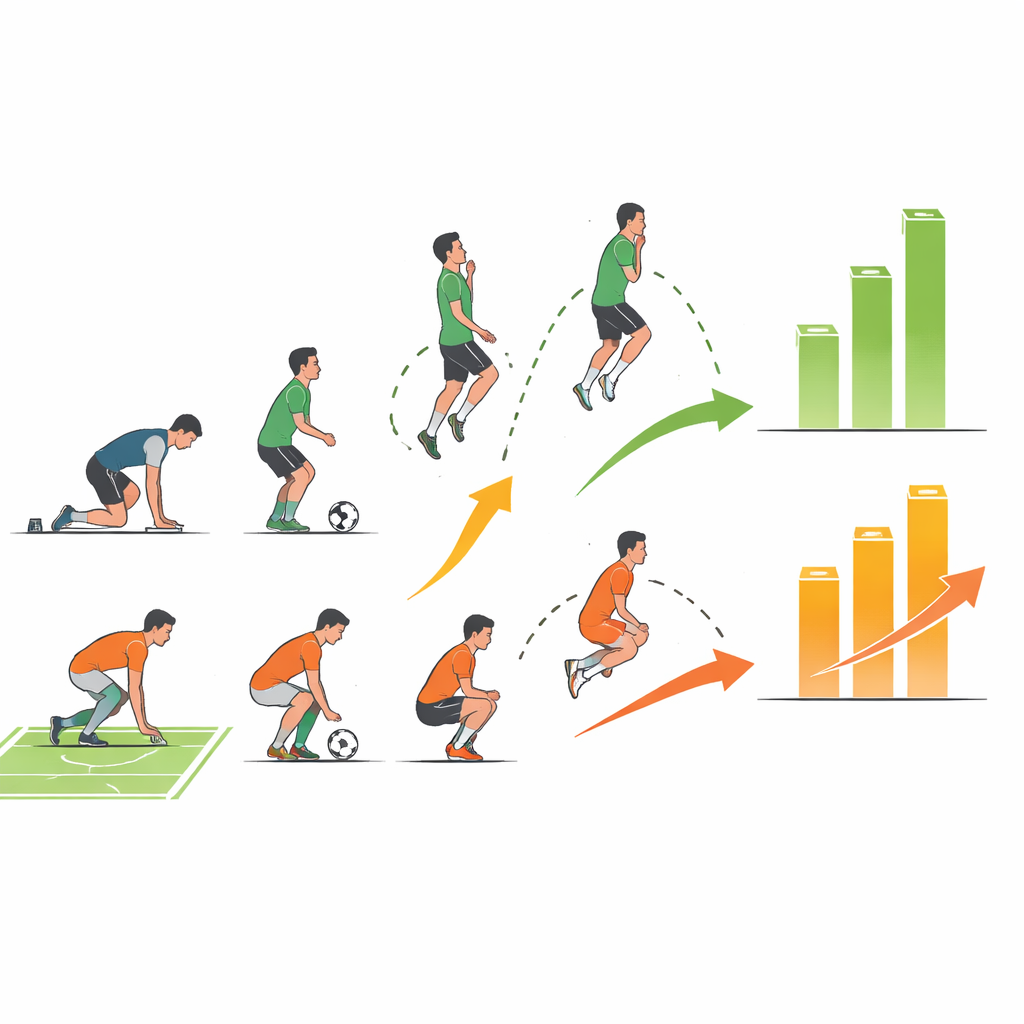
Despite the goals sounding similar, the body responded very differently. When athletes focused on jumping fast, they produced more power relative to their body weight and showed a higher “reactive strength” score, a measure that combines how high and how quickly they jumped. However, these fast jumps were not as high: athletes did not sink as deep before take-off, spent less time pushing against the ground, and reached a lower peak in the air. In contrast, when they aimed for maximum height, they dipped deeper, took longer to push off, and reached higher jumps, but with slightly lower overall power and reactivity. In other words, a height goal favored a big, longer movement, while a speed goal favored a quicker, punchier one.
Different Sports, Different Jump Habits
The type of sport also shaped how athletes responded. Track and field sprinters and jumpers generally showed the most explosive profiles, with better reactive strength and more power than football players, and often better than futsal players, no matter which goal they followed. This likely reflects their regular exposure to training that emphasizes vertical jumping and rapid force production. Futsal players, whose sport demands frequent short sprints and quick changes of direction, showed jump characteristics that in some ways resembled track and field athletes more than footballers. Interestingly, only one key part of the motion—how fast athletes dropped down before pushing off—showed a combined influence of both sport and goal. Track and field and football players sped up their downward movement when chasing height, while futsal players kept a similar pattern regardless of the instruction, suggesting differences in how easily each group reshapes its movement strategy.

Why Clear Instructions Protect Testing and Training
Because the wording of the jump goal altered every major variable the researchers tracked, this work carries an important warning. If coaches change their instructions from one session to another, or use different cues across teams, they may think an athlete is getting stronger or weaker when, in fact, only the movement goal has changed. Consistent, clearly defined phrases—such as always using either “as high as possible” or “as fast as possible”—are crucial for fair comparisons over time and between athletes. The study also hints that learning to intentionally shift between these goals could itself be trained, helping athletes fine-tune how they produce power for different sporting demands.
What This Means for Athletes and Coaches
For a layperson, the bottom line is straightforward: the same jump test can tell different stories depending on what you ask the athlete to do. A “high” jump goal leads to taller, slower jumps, while a “fast” goal creates shorter, sharper ones with more power packed into less time. These differences are further shaped by the athlete’s sport background. To use jump tests as reliable tools—not just rough impressions—coaches should standardize their instructions and choose them to match what they care about most: raw height or rapid, explosive execution.
Citation: Pompa, D., Carson, H.J., Romagnoli, R. et al. Effect of movement goal on countermovement jump performance in athletes across different sports. Sci Rep 16, 9748 (2026). https://doi.org/10.1038/s41598-026-40260-9
Keywords: countermovement jump, athlete testing, verbal instructions, explosive power, sport performance