Clear Sky Science · en
Molecular evolution and diversity of the norovirus RNA-dependent RNA polymerase
Why stomach bugs keep surprising us
Norovirus is the infamous “stomach flu” virus that can shut down cruise ships, schools, and hospitals within days. It spreads easily, makes hundreds of millions of people sick each year, and constantly spawns new variants. This study looks under the hood of that evolution, focusing on a single viral enzyme—an internal “copy machine” called the RNA polymerase—to ask how it changes over time and how stable it really is. Understanding this hidden engine of change could help explain why some norovirus strains dominate globally and guide the design of future antiviral drugs.
The virus’s inner copy machine
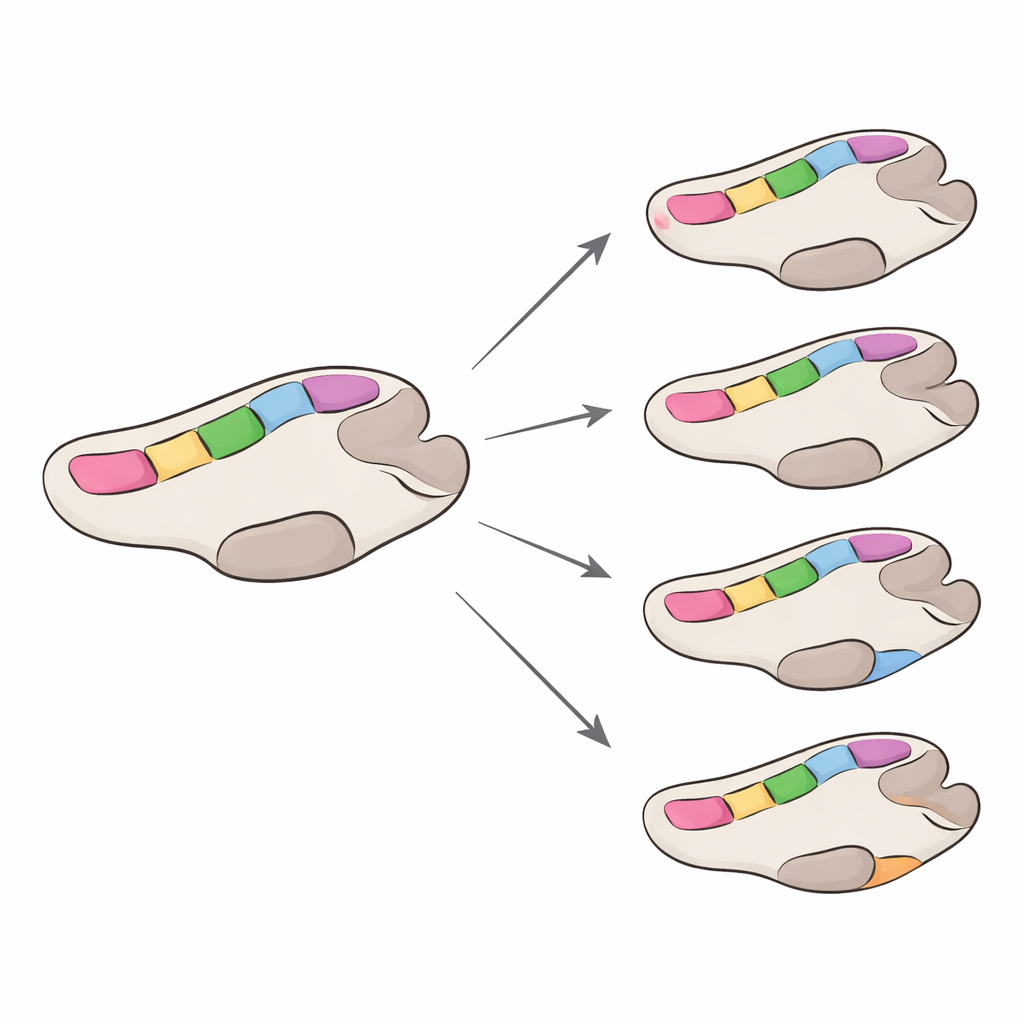
Norovirus carries its genetic material as RNA and relies on an enzyme called RNA-dependent RNA polymerase to copy that RNA inside infected cells. This enzyme, about 510 building blocks long, looks like a curled hand with fingers, palm, and thumb, forming a channel where RNA and new building blocks pass through. Within this structure sit seven tiny “hotspots” that are almost identical across strains; these regions perform the core chemistry of copying the genome. Because the polymerase is essential for the virus to reproduce, even small disruptions in these hotspots can be disastrous for the virus, so evolution tends to preserve them extremely carefully.
Hundreds of strains, a few key families
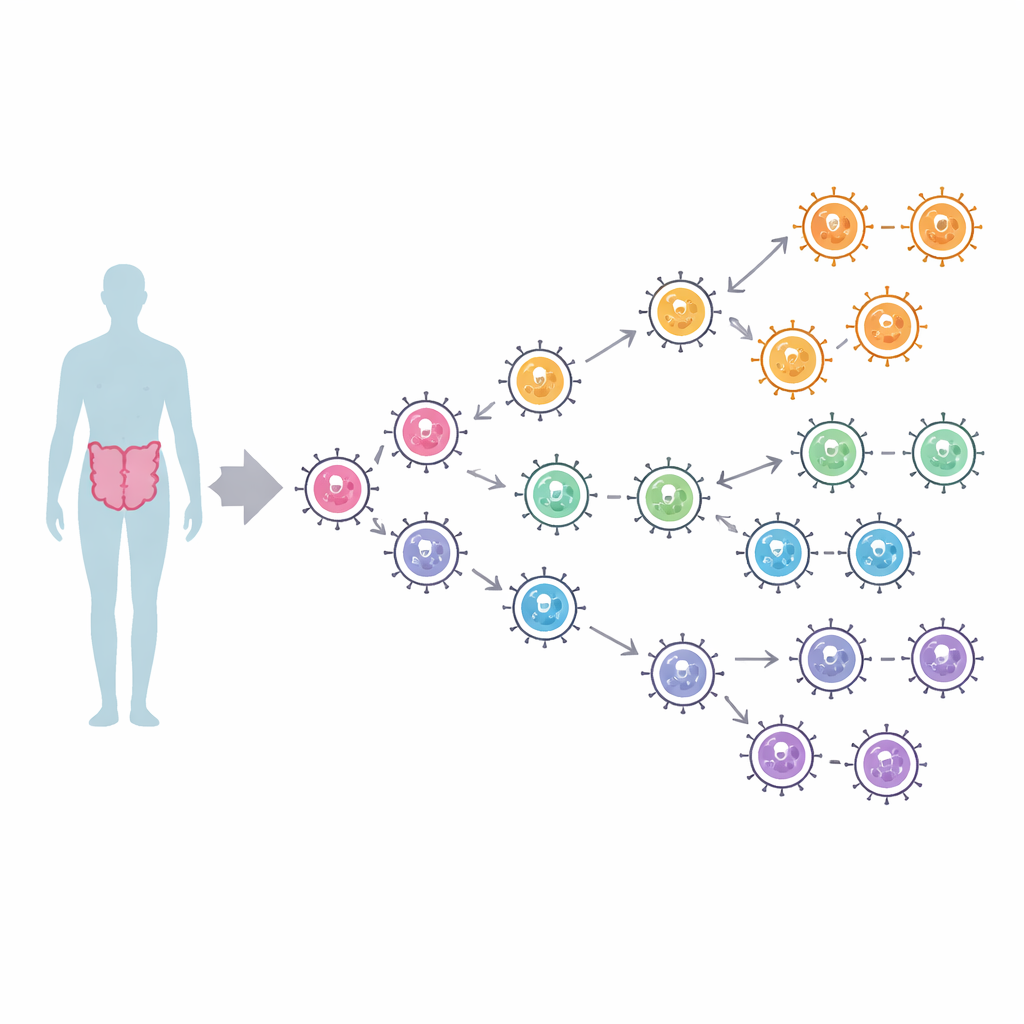
The researchers gathered 1,094 complete polymerase sequences from two major human norovirus groups, called GI and GII, collected worldwide between 1972 and 2024. Using computational family trees that incorporate both sampling dates and locations, they traced how these enzymes branched over nearly four centuries. GI polymerases fell into three main lineages that likely split starting around the 1600s, while GII polymerases formed four lineages, including a distinct branch for a type known as P16. Modern infections are dominated by two GII polymerase types, P16 and P31, both historically linked to the long-time pandemic capsid genotype GII.4. Yet, despite global spread, the trees showed little geographic clustering—strains from different continents mix together—suggesting that norovirus moves rapidly around the world without staying confined to particular regions.
Slow, steady change with well-protected cores
By comparing the amino acid building blocks at each position in the polymerase, the team catalogued thousands of changes across types. They found far fewer changes in GI than in GII, partly reflecting fewer available sequences, but a clear pattern emerged: the seven conserved hotspots and the nearby RNA-binding site were almost untouched. When substitutions did occur there, they were usually mild swaps between chemically similar building blocks, hinting that the enzyme tolerates only very gentle tweaks in these crucial zones. Most of the frequent changes clustered in the “fingers” and other outer regions of the enzyme, away from the central chemistry. Some positions even showed reversible back-and-forth changes across different polymerase types, a sign of convergent evolution where unrelated strains stumble onto similar solutions.
Different speeds for different viral families
The team then estimated how fast the polymerase evolves, focusing on changes that alter amino acids, which are more likely to affect function. Overall, GII polymerases changed about four times faster than GI polymerases, though both were slower than norovirus’s outer shell protein, known for rapidly shifting to evade immunity. Within each group, some polymerase types evolved a bit faster than others, but differences were modest. Importantly, most positions in the enzyme were under strong “purifying” pressure—mutations that disrupted function were weeded out—while only a handful of sites showed signs of being favored by natural selection. When these positively selected sites were mapped onto three-dimensional models of the enzyme, they almost always sat outside the most conserved hotspots, though a few lay close enough to potentially fine-tune how the polymerase binds RNA or moves during copying.
What this means for future outbreaks and treatments
Together, these findings paint norovirus polymerase as a surprisingly stable core wrapped in more flexible regions that allow gradual adaptation. GII polymerases, especially those associated with historically pandemic strains, are evolving somewhat faster, which may help those viruses keep pace with changing hosts and competing variants. Yet the deep conservation of key functional regions over centuries suggests that this enzyme is a promising fixed target for antiviral drugs: disrupt the core copying machinery, and the virus has little room to escape without crippling itself. For non-specialists, the takeaway is that while the outer faces of norovirus may continue to shift, making new outbreaks inevitable, the inner engine that powers those changes is both tightly constrained and scientifically tractable—offering a stable bull’s-eye for future therapies.
Citation: Flint, A., Jawad, M. & Nasheri, N. Molecular evolution and diversity of the norovirus RNA-dependent RNA polymerase. Sci Rep 16, 9042 (2026). https://doi.org/10.1038/s41598-026-40248-5
Keywords: norovirus, viral evolution, RNA polymerase, antiviral targets, molecular epidemiology