Clear Sky Science · en
Thermal–electrical multiphysics modeling of ZnO/mesoporous carbon nanocomposite anodes for lithium-ion batteries
Why Better Battery Materials Matter
Lithium-ion batteries power our phones, laptops, cars, and increasingly, the electric grid. But to store more energy safely in a compact space, today’s batteries need new electrode materials that can hold more charge without overheating or wearing out too quickly. This paper explores a promising candidate—an anode made from zinc oxide particles supported inside a sponge-like carbon framework—and uses advanced computer modeling to see how well it can carry charge and shed heat compared with a conventional zinc oxide layer.
A Smarter Anode Design
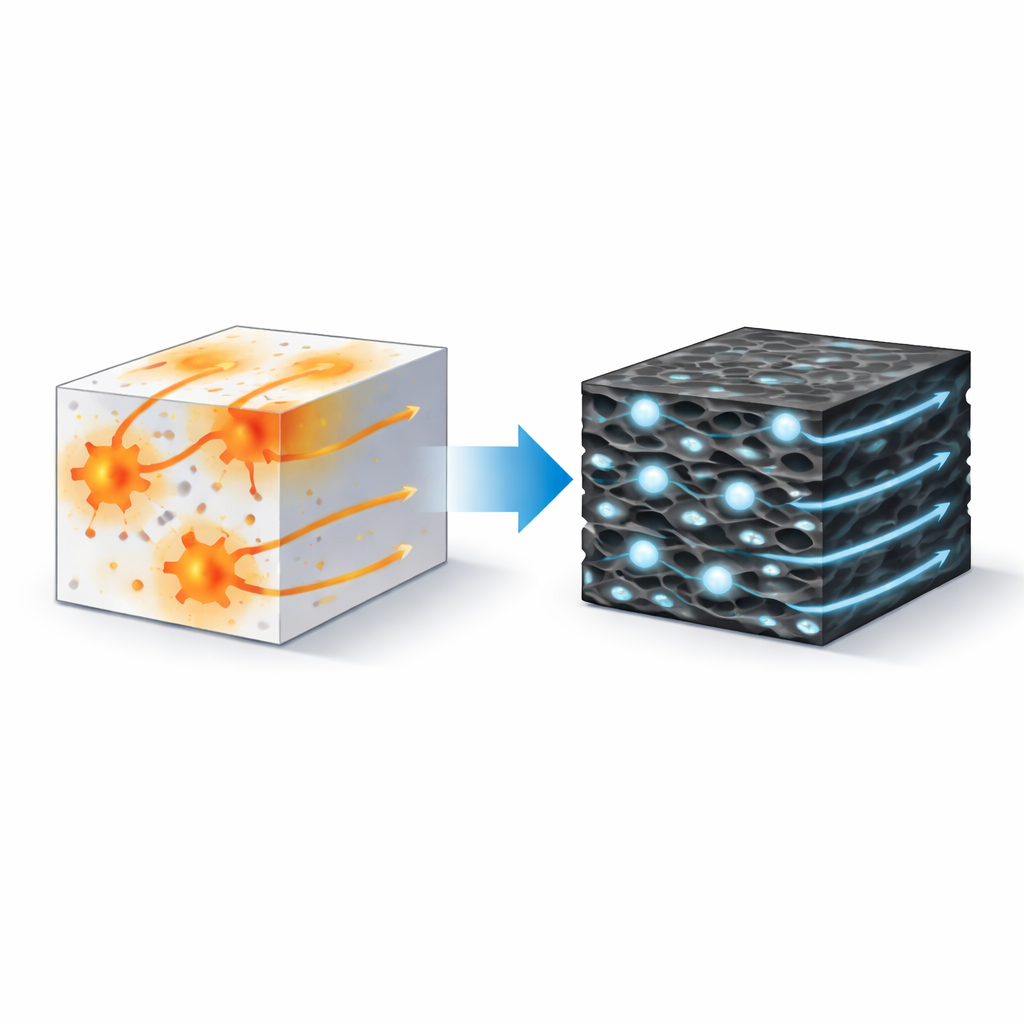
The study focuses on a hybrid material where tiny zinc oxide (ZnO) particles are embedded in a mesoporous carbon matrix—a solid carbon “sponge” full of interconnected pores. Zinc oxide can in principle store far more lithium than the graphite used in most commercial anodes, but on its own it conducts electricity poorly and tends to heat up and crack during charging. The carbon scaffold is designed to fix these weaknesses: it is highly conductive, has a large internal surface area, and can cushion the expansion and contraction of the zinc oxide particles. The question the authors ask is not just whether this material works electrochemically, but how well it manages both heat and electricity deep inside a thick electrode, where real-world problems often start.
Modeling the Inside of a Thick Electrode
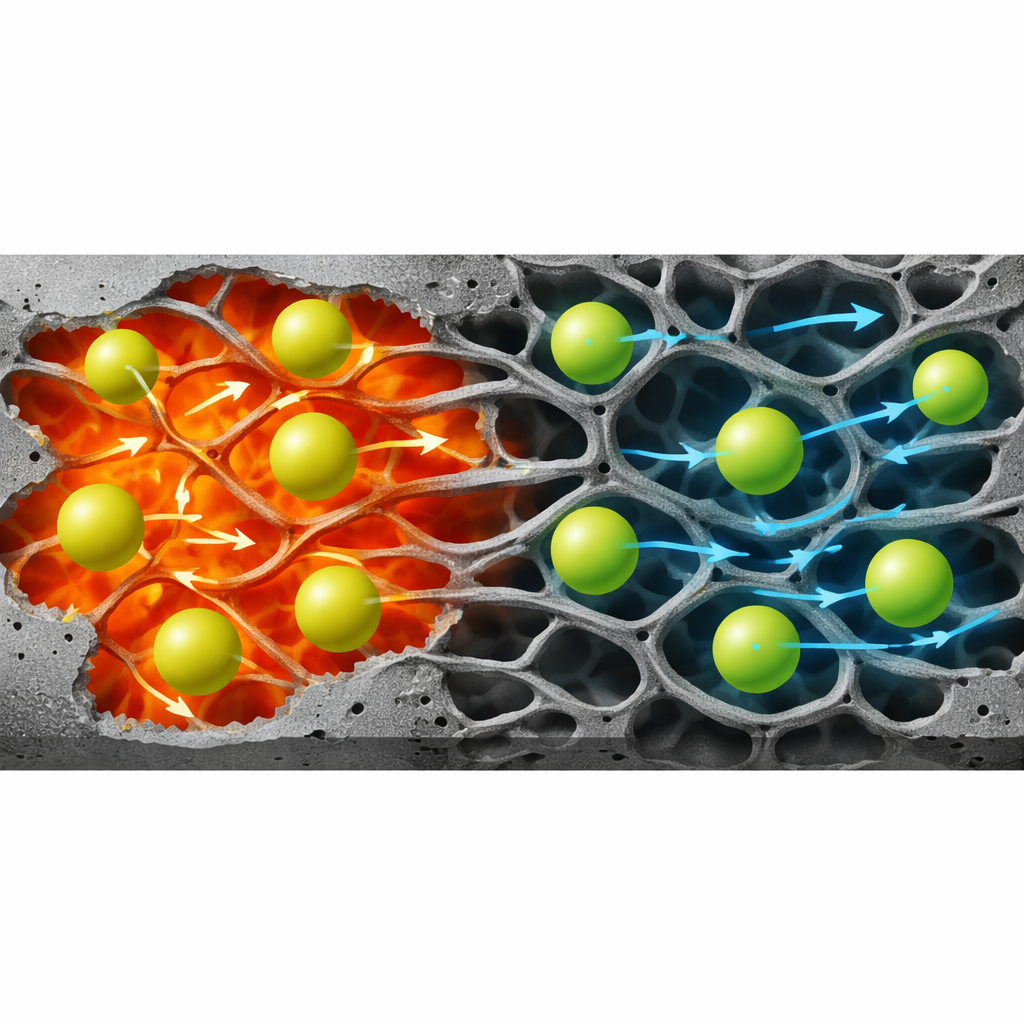
Instead of treating the anode as a uniform block, the researchers build a detailed two-dimensional computer model that explicitly places hundreds of individual ZnO particles inside the carbon sponge. Using a commercial simulation package, they couple two types of physics: heat flow and electrical conduction. The model tracks how heat is generated by electrical resistance and by the chemical reaction that stores lithium in ZnO, and how this heat spreads through the carbon and oxide. At the same time, it calculates how easily electrons move through the mixed network of poor-conducting ZnO and highly conducting carbon, including small resistances where the two materials touch. Material properties and geometry are chosen to match a real ZnO/mesoporous carbon anode previously made and measured in the lab, and the model is checked against experimental data such as voltage curves and impedance spectra.
Cooler, More Even, and Ready for Fast Charging
When the team simulates a 150-micrometer-thick anode charged at a moderate 1C rate, the difference between pure ZnO and the hybrid material is striking. In a pure ZnO layer, heat builds up and the peak temperature reaches about 48.5 °C. In the composite, the peak is cut to about 42.8 °C—an 11.8% drop—because the carbon scaffold quickly spreads heat away from hot spots. Electrically, the composite shows a smaller internal voltage loss (0.09 V instead of 0.14 V) and a more uniform current distribution, meaning the entire electrode participates more evenly in storing charge. When the authors crank up the charging speed and vary the electrode thickness, the advantages of the hybrid design grow. At ten times the normal charging rate, pure ZnO runs toward dangerously high temperatures and large voltage penalties, while the ZnO/carbon anode stays cooler and maintains more manageable voltage losses even in very thick layers.
Implications for Bigger, Safer Batteries
These results matter because next-generation batteries aim for thicker electrodes to pack in more energy, a strategy that can easily create thermal and electrical bottlenecks. The simulations show that the mesoporous carbon skeleton turns thickness from a liability into an asset: even at 300 micrometers, the composite keeps temperature and voltage gradients under control, while pure ZnO would likely be unsafe or unusable. The model also reveals that the composite suffers less from “polarization”—extra voltage needed to keep current flowing—thanks to the carbon’s continuous pathways for electrons and its ability to moderate local heating at ZnO surfaces.
What This Means for Future Devices
For non-specialists, the main takeaway is that simply choosing a material with high theoretical capacity is not enough; how that material is arranged and how it handles heat are just as important. By weaving zinc oxide into a porous, conductive carbon framework and then testing this design with a detailed multiphysics model, the authors show a realistic route to anodes that can store more energy, charge faster, and run cooler. Their approach offers both a specific materials recipe—ZnO in a mesoporous carbon scaffold—and a general simulation method that can be reused to vet other complex battery materials before they are built, helping accelerate the development of safer, higher-efficiency lithium-ion batteries.
Citation: Abushuhel, M., Priya, G.P., Al-Hasnaawei, S. et al. Thermal–electrical multiphysics modeling of ZnO/mesoporous carbon nanocomposite anodes for lithium-ion batteries. Sci Rep 16, 9189 (2026). https://doi.org/10.1038/s41598-026-40242-x
Keywords: lithium-ion batteries, anode materials, zinc oxide carbon composite, thermal management, multiphysics modeling