Clear Sky Science · en
The impact of global value chain participation on CO2 emissions: new evidence based on the nonlinear PSTR model
Why Trade Chains Matter for the Climate
When you buy a smartphone, a car, or even a T-shirt, its parts likely crossed several borders before reaching you. This web of cross-border production, known as global value chains, now accounts for most of world trade. That means the way we organize production internationally is tightly bound up with climate change. This study asks a deceptively simple question: as countries plug deeper into these global production chains, do their carbon emissions automatically rise, or can they fall under the right conditions?
Following the Path from Trade to Emissions
Instead of assuming that more participation in global value chains always pushes emissions up or down in a straight line, the authors examine how the impact changes once countries reach certain turning points. Using data for 63 countries from 2000 to 2018, they track carbon dioxide emitted per unit of economic output alongside a measure of how strongly each country is tied into global value chains. A flexible statistical approach lets the effect of trade integration change smoothly as economies grow, industrialize, and upgrade their technology, mirroring how real-world transitions rarely happen overnight.
Three Ways Trade Changes Pollution
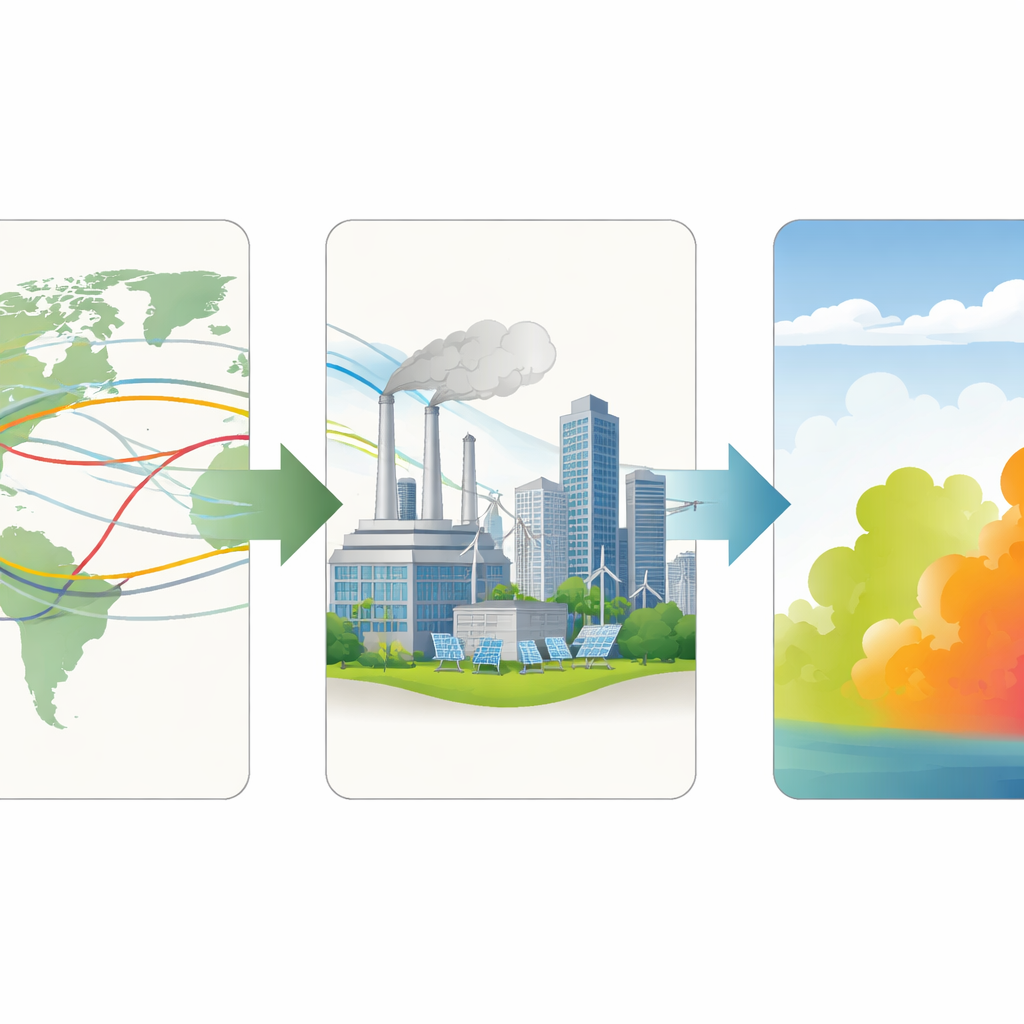
The study shows that global value chain participation influences emissions through three main routes. First is the scale route: as exports grow and factories run harder, energy use and carbon output tend to rise. Second is the structural route: the mix of activities in an economy—heavy industry versus services, for example—shapes how polluting a given level of output will be. Third is the technology route: access to better machines, processes, and know-how can make each unit of production cleaner. Crucially, each route has its own tipping point beyond which the effect of trade integration shifts.
When More Trade Helps—and When It Hurts
For the scale route, the authors find that when exports are still a modest share of a country’s economy, joining global value chains does not significantly change carbon emissions per unit of output. But once export intensity crosses a middle-range threshold, extra integration clearly pushes emissions upward as sheer production volume dominates any efficiency gains. Along the structural route, global value chain participation helps lower emissions in economies where industry makes up a relatively small share of output and services are more prominent. As the industrial share rises beyond a critical level, however, those gains fade and eventually disappear, because countries are specializing in more carbon-heavy production stages.
Technology Helps, but Not Enough on Its Own
The technology route offers some good news, but with limits. In countries with weaker overall productivity, deeper integration into global value chains clearly raises emissions, reflecting a focus on energy-hungry, low-value activities. Once a nation’s productivity passes a certain benchmark, the extra emissions per unit of output from further integration shrink sharply, suggesting that better technology and know-how partially offset the pollution from higher production. Yet even in this high-technology zone, the effect remains slightly positive rather than turning negative. In other words, more advanced technology softens but does not fully reverse the climate impact of deeper trade ties.
Why Rich and Poor Countries Experience Trade Differently
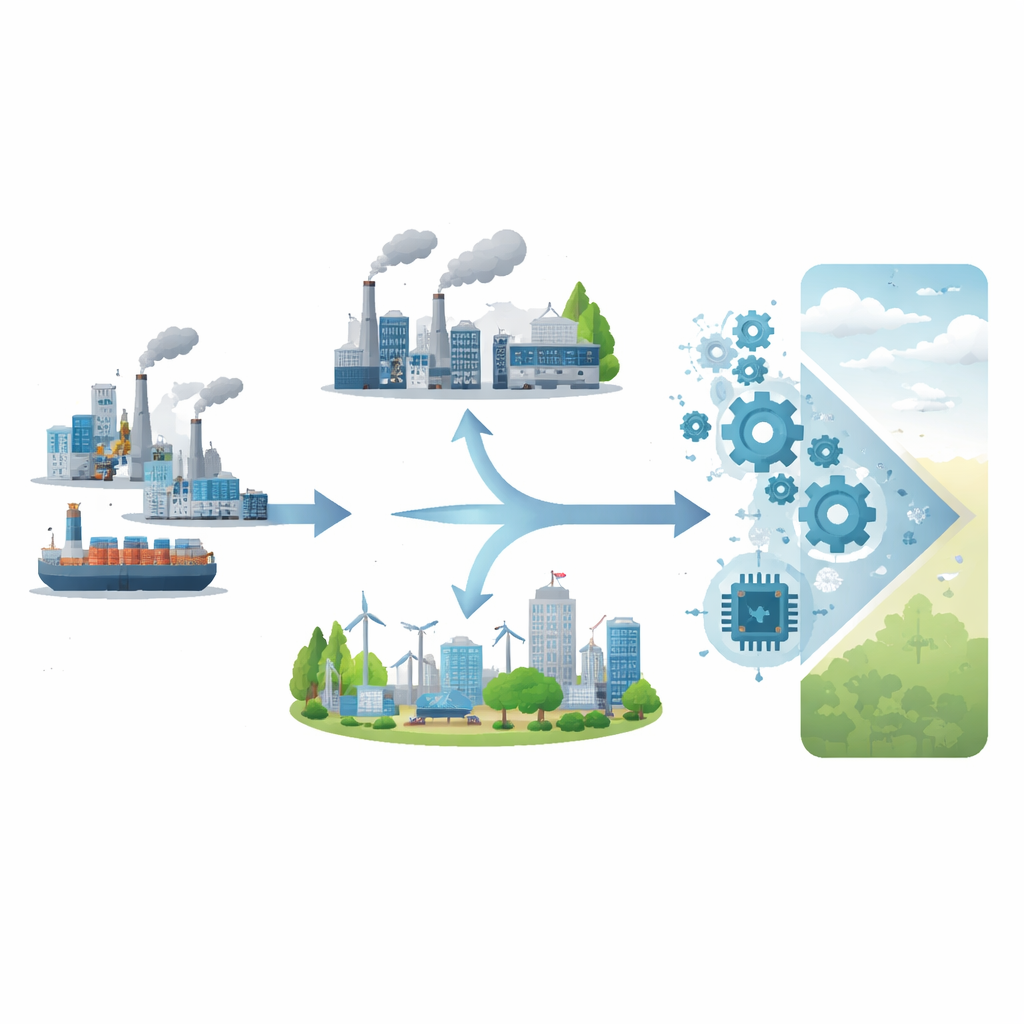
The same patterns play out very differently in rich and poor economies. In wealthier, mainly OECD countries, participating in global value chains can actually reduce emissions at relatively low levels of export intensity and industrialization, thanks to cleaner technologies and stricter environmental rules. But as their export scale grows larger, the benefits erode and emissions begin to climb again. In many developing countries, the story is starker: once exports explode and industry expands, the scale effect on emissions is about five times stronger than in rich economies. There, technological upgrading usually only manages to bring the extra emissions from trade back to neutral, rather than turning global value chain participation into a net climate advantage.
What This Means for Climate Policy
Overall, the study concludes that joining global production networks is not automatically good or bad for the climate; it depends on how big a country’s export sector is, how industrial its economy has become, and how advanced its technology is. To turn global value chains into a tool for cutting emissions rather than driving them up, countries need to move on several fronts at once: managing the pace and direction of export growth, steering their economies toward less carbon-intensive sectors, and rapidly upgrading technology. For developing countries in particular, the bar is higher: without faster access to clean technologies and support for economic restructuring, deeper integration into world production risks locking in a high-emission path instead of helping to escape it.
Citation: Wu, S., Qu, Y. The impact of global value chain participation on CO2 emissions: new evidence based on the nonlinear PSTR model. Sci Rep 16, 9523 (2026). https://doi.org/10.1038/s41598-026-40234-x
Keywords: global value chains, carbon emissions, international trade, industrial structure, green technology