Clear Sky Science · en
Enhanced antifungal and cytotoxic potential of essential oils encapsulated in polydopamine nanocapsules against Candida albicans and Pichia kudriavzevii
Everyday plants taking on stubborn mouth infections
Oral “thrush” and other fungal infections are more than a minor irritation: for people with weakened immune systems, they can be painful, persistent, and hard to treat with existing drugs. This study investigates whether fragrant plant oils—similar to those used in food flavoring and aromatherapy—can be packaged inside tiny protective shells to create a gentler, more powerful way to fight these infections and even harm cancer cells in the lab.
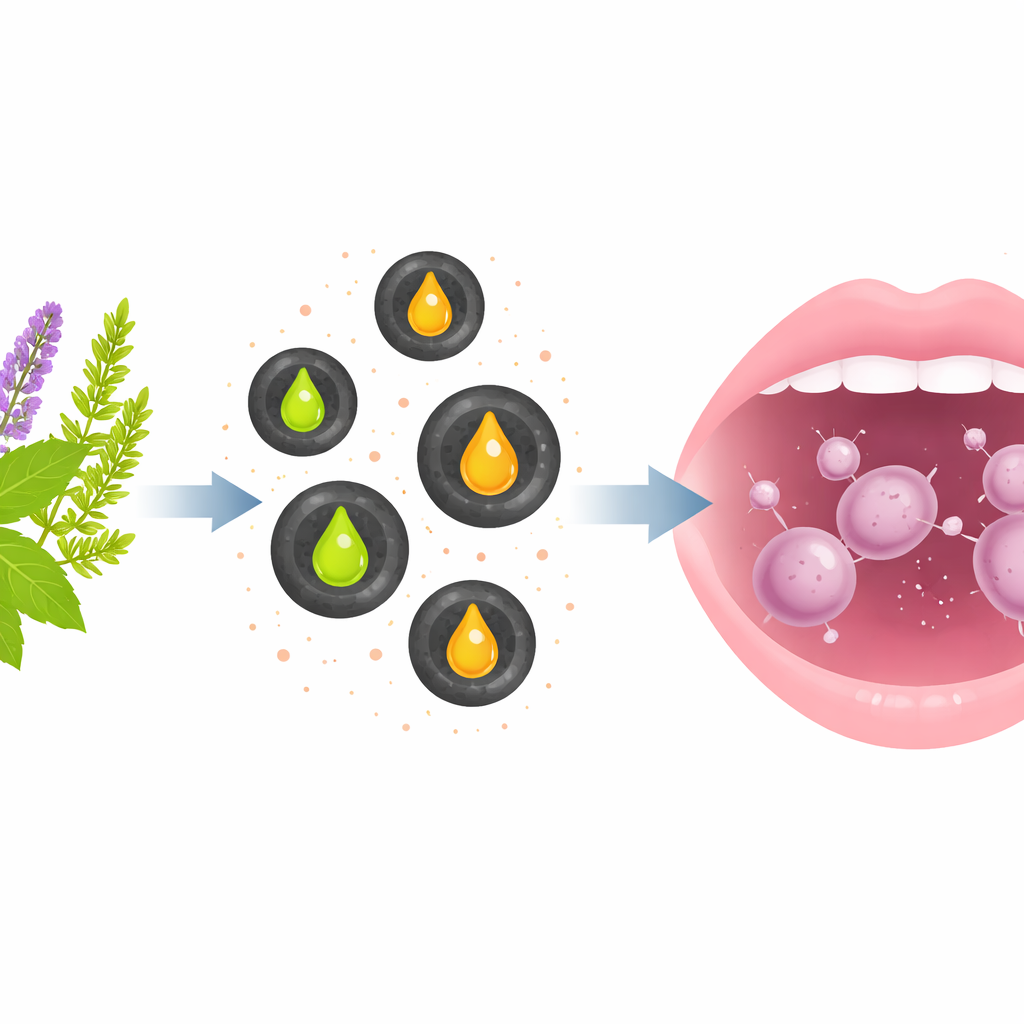
Why mouth fungi are a hidden threat
The human mouth is home to a bustling community of microbes. Most are harmless or even helpful, but some fungi, especially species called Candida albicans and Pichia kudriavzevii, can overgrow and cause infections when the immune system is weakened by illnesses or treatments such as chemotherapy. These infections can be painful, may interfere with eating, and in vulnerable patients can spread deeper into the body. At the same time, resistance to standard antifungal drugs is rising, pushing researchers to look for new treatments that are both effective and safe.
Turning mint and cypress oils into tiny delivery capsules
The researchers focused on essential oils distilled from wild mint (Mentha longifolia) and Monterey cypress (Cupressus macrocarpa). These oils are complex mixtures of natural compounds already known to hinder microbes and act as antioxidants. On their own, however, such oils can be unstable, evaporate easily, and irritate tissues at higher doses. To solve this, the team used a material called polydopamine, inspired by the sticky chemistry that lets mussels cling to rocks. In water-alcohol mixtures, polydopamine forms a thin shell around droplets of oil, yielding nanoscale capsules—thousands of times smaller than a grain of sand—that can protect the oil and release it gradually.
Probing what is inside and how the capsules behave
First, the composition of the two plant oils was mapped using gas chromatography–mass spectrometry, confirming that the cypress oil was rich in compounds such as terpinen-4-ol and camphor, while the mint oil was dominated by strong-smelling “minty” molecules. Spectroscopic tests and electron microscopy verified that the polydopamine shells formed correctly around the oils and that the resulting particles were roughly spherical and tens of nanometers across in the dry state. When dispersed in water, the capsules swelled to a few hundred nanometers and carried a stable negative surface charge, suggesting they remain well separated rather than clumping together. Release tests at mildly acidic conditions, similar to the mouth, showed that the oils seeped out steadily over several hours instead of all at once.
How the new capsules attack fungi and cancer cells
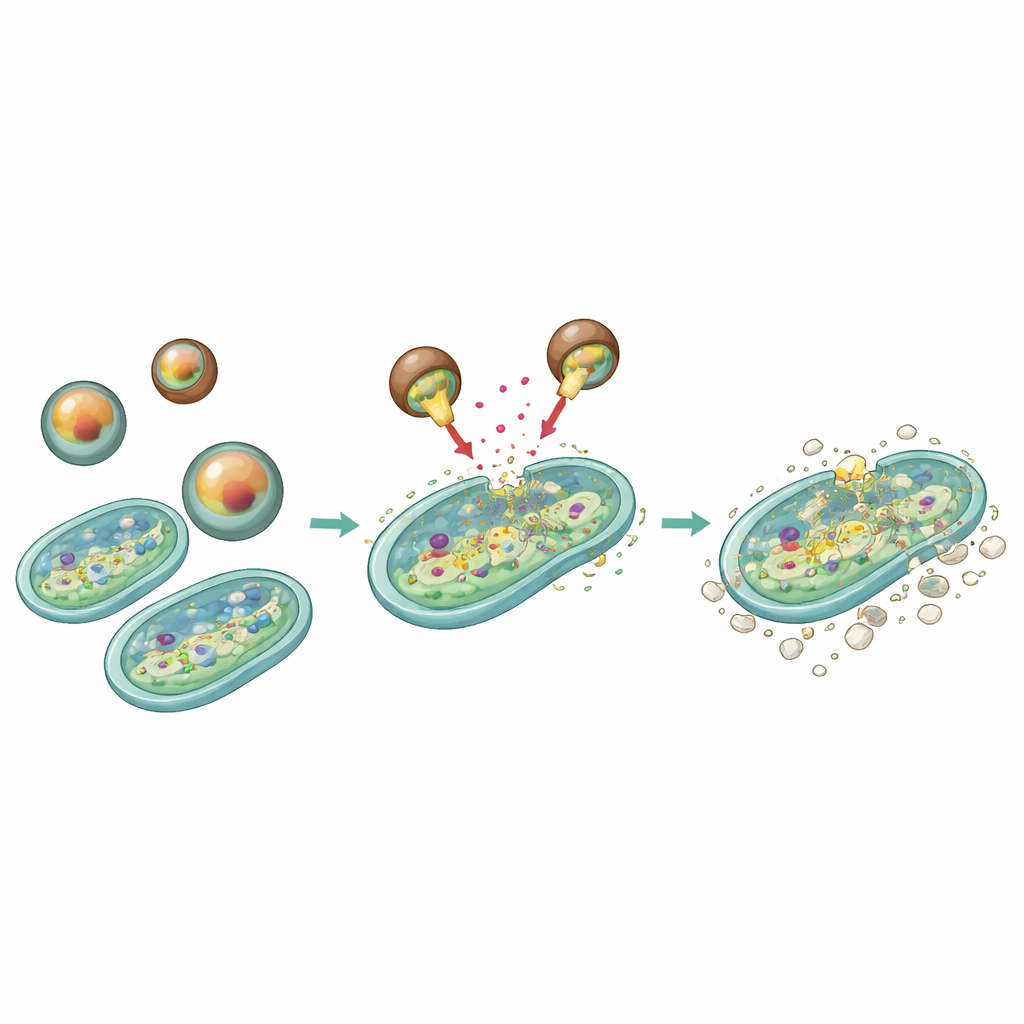
The team next tested how well the oils and the oil-filled capsules could stop the growth of disease-causing yeasts in lab dishes. Both free oils already showed strong antifungal action, but once encapsulated, the minimum dose needed to halt growth fell even further—down to just a few micrograms per milliliter in some cases. Calculations of how the oil and shell worked together indicated a true partnership: the polydopamine was not just a passive container but added its own antifungal punch. Under a powerful electron microscope, treated fungal cells showed clear signs of damage: thick outer walls became ragged, membranes ruptured, and the contents of the cells leaked out, consistent with a mix of programmed cell death and outright cell bursting. The same capsules also scavenged harmful free radicals in a standard antioxidant test and slowed the growth of human liver and breast cancer cell lines, again with stronger effects for the cypress-based formulation.
What this could mean for future treatments
In everyday terms, the study shows that natural plant oils can be turned into “smart bullets” by wrapping them in a thin, biocompatible coating. This packaging makes the oils more stable, allows them to be used at lower doses, and helps them punch holes in problem fungi more efficiently than either the oils or the coating alone. While the work was done in controlled lab systems, not in patients, it points to a future in which mouth rinses, gels, or lozenges based on these nano-capsules could offer a new way to manage oral fungal infections and perhaps complement cancer therapies. Before that can happen, longer-term safety tests and animal studies will be needed, but the results suggest that combining nature’s chemistry with nanotechnology is a promising route to gentler yet more potent antifungal treatments.
Citation: El-Morsy, ES.M., Mohesien, M.T., Abdellatif, M.A.M. et al. Enhanced antifungal and cytotoxic potential of essential oils encapsulated in polydopamine nanocapsules against Candida albicans and Pichia kudriavzevii. Sci Rep 16, 8955 (2026). https://doi.org/10.1038/s41598-026-40233-y
Keywords: oral fungal infections, essential oils, nanocapsules, Candida albicans, antifungal therapy