Clear Sky Science · en
Coupled modular simplicial graph neural network with snow ablation optimization for real-time fraud detection in payment systems
Why catching fraud in milliseconds matters
Every time a card is tapped, a phone is waved, or an online checkout button is clicked, there is a brief moment when a bank must decide: is this a real purchase or a scam? That split second can mean the difference between a safe payment and a drained account. As digital payments explode in number and speed, criminals constantly invent new tricks, while many existing fraud filters are too rigid, too slow, or too easily fooled. This paper presents a new, more flexible way to spot suspicious payments in real time, aiming to protect both customers and financial institutions with fewer false alarms.

The rising tide of digital trickery
Banks and payment companies now sift through hundreds of thousands of card transactions a day, with only a tiny fraction being fraudulent. That imbalance makes the problem especially hard: systems can become biased toward calling everything “normal,” letting clever scams slip through. Older fraud defenses often rely on hand-crafted rules, such as blocking payments above a certain amount or from certain locations. These rules struggle when criminals change tactics, and they frequently flag legitimate purchases, frustrating customers and merchants. Recent machine-learning systems have improved matters, but they still stumble over noisy data, hidden patterns that span multiple accounts, and the need to adapt quickly as behavior shifts.
A smarter pipeline from raw payments to decisions
The authors design an end-to-end pipeline that treats payment data not as isolated rows in a table, but as a living network of relationships between cardholders, merchants, devices, and time. The process starts by cleaning the raw transaction stream using an adaptive filtering step that smooths away glitches and outliers while preserving genuine signals of fraud. Next comes an intelligent feature selector inspired by the foraging behavior of a small Australian animal, the quokka. This algorithm searches through dozens of possible transaction attributes and keeps only those that genuinely help distinguish normal from suspicious behavior, trimming away noise and redundancy so later stages can focus on what matters most.
Letting the network of payments speak
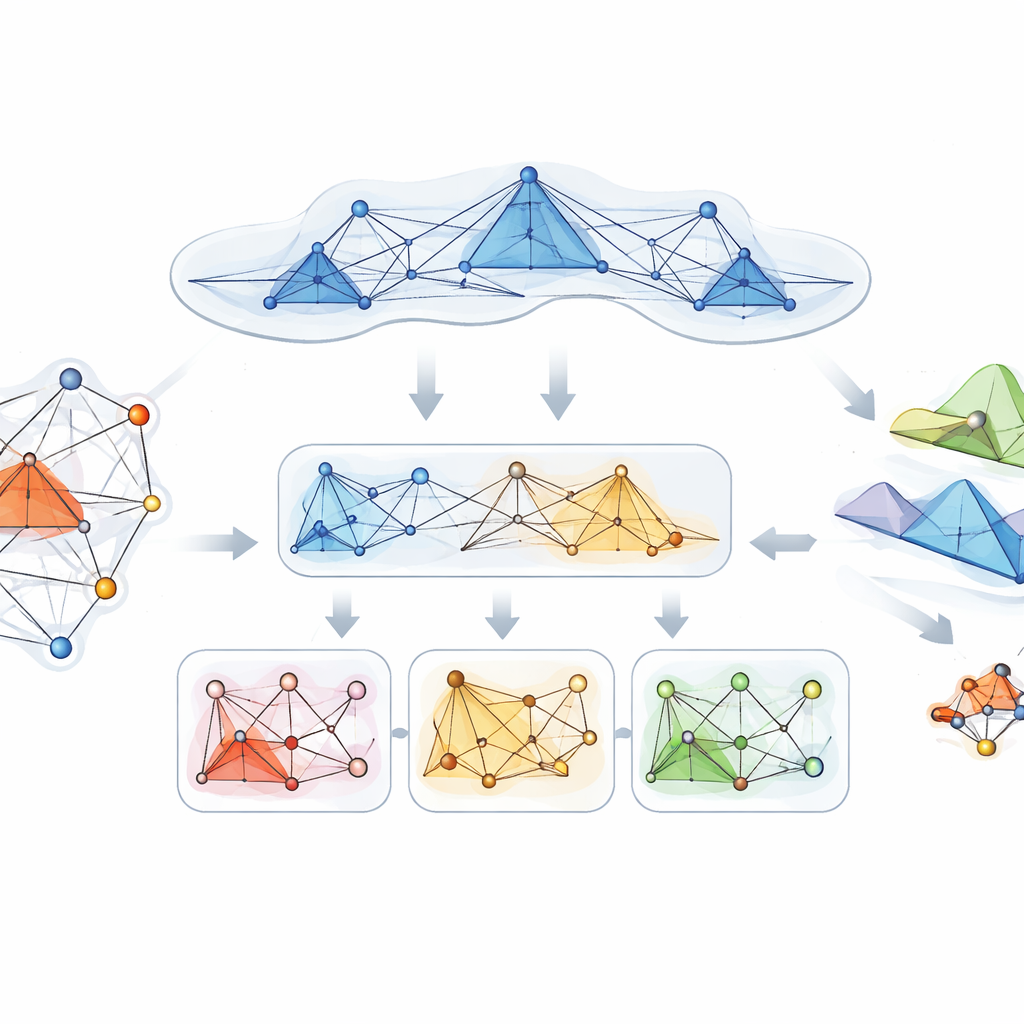
At the heart of the system is a new model called a coupled modular simplicial graph neural network. In simple terms, it breaks the huge tangle of transactions into smaller specialist modules that each learn different aspects of behavior, then reconnects them into a larger "super" model. Unlike traditional approaches that only look at pairwise links, this design also considers higher-order groupings, such as clusters of cards and merchants that frequently interact in unusual ways, which can signal organized fraud rings. An attention mechanism helps the model focus on the most telling connections, allowing it to uncover subtle, multi-party patterns that simple rules or standard neural networks might miss.
Tuning the system for speed and reliability
After learning these complex patterns, the model still needs its internal settings finely adjusted so that it makes the fewest possible mistakes. To do this, the researchers use another nature-inspired method based on how snow melts and slides off mountains. This optimization scheme searches for combinations of model weights that simultaneously raise accuracy and keep the system lean and fast. Tested on a widely used European credit-card dataset with nearly 285,000 real transactions, including fewer than 500 confirmed frauds, the full pipeline achieved about 99.5% accuracy, with similarly high scores for correctly catching fraud and avoiding false alarms. It also generated decisions in fractions of a second, suitable for real-time blocking of risky payments.
What this means for everyday users
Put simply, the study shows that treating payment data as an interconnected web, carefully cleaning it, picking the most useful signals, and then finely tuning a powerful network model can deliver near-perfect fraud detection in realistic conditions. For cardholders, that translates to fewer declined legitimate purchases and stronger protection against theft. For banks and payment platforms, it offers a scalable, fast, and statistically validated framework that can adapt to new fraud strategies while keeping computing costs reasonable. As future versions add better transparency and audit trails, approaches like this could become a backbone technology for keeping digital money safe in an increasingly cashless world.
Citation: Ramoju, V.C.S., Biswal, S., Kotecha, K. et al. Coupled modular simplicial graph neural network with snow ablation optimization for real-time fraud detection in payment systems. Sci Rep 16, 9278 (2026). https://doi.org/10.1038/s41598-026-40226-x
Keywords: credit card fraud detection, graph neural networks, real-time payments, financial cybersecurity, machine learning models