Clear Sky Science · en
β-adrenergic receptors modulate CA1 population coding and synaptic plasticity during cumulative spatial memory formation and updating
Why this brain study matters
Remembering where you parked your car or which kitchen drawer holds the scissors depends on the brain’s ability to link “what” and “where” across repeated experiences. This study looks inside a key memory hub in the brain, the hippocampus, to see how groups of nerve cells build and update these spatial memories over time—and how a common stress-related chemical signal, acting through so‑called beta receptors, helps keep those memories flexible and accurate.
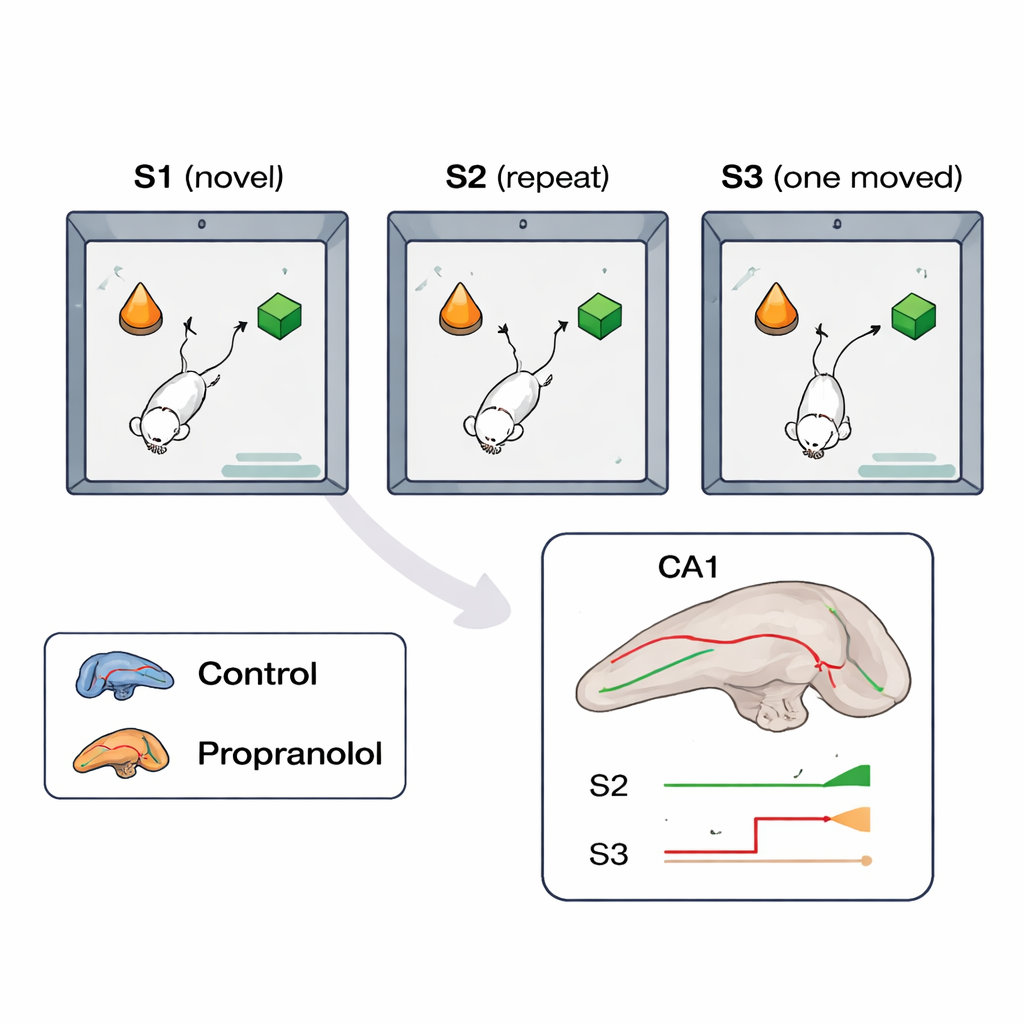
Exploring a tiny world to study memory
The researchers trained mice in a simple task: explore two objects placed in a small square arena. In the first session, the objects and their locations were new. An hour later, the mice returned to exactly the same setup. After another hour, one object was quietly moved to a new spot. Normally, mice spend more time checking out a moved object, showing that they noticed the change and remember the original layout. At the same time, the team recorded brain activity from hundreds of cells in a hippocampal region called CA1 using a head‑mounted microscope, and in a separate group of animals they measured electrical signals that reveal how strongly nerve connections are being strengthened or weakened.
Blocking a key chemical signal hampers learning
To test the role of beta-adrenergic receptors—targets of the neurotransmitter noradrenaline—the scientists gave some mice propranolol, a drug that blocks these receptors, shortly before the first learning session. Control mice behaved as expected: they explored less on the second visit, suggesting the scene was now familiar, and in the third session they clearly preferred the moved object, indicating successful memory and updating. In contrast, propranolol-treated mice did not show a strong preference for the moved object, implying that their ability to form and update the object–location memory was impaired. In the hippocampus of untreated mice, new and changed object layouts triggered a lasting weakening of certain synapses, a form of plasticity called long-term depression; this plastic adjustment did not appear properly when beta receptors were blocked.
How cell groups encode “what was where”
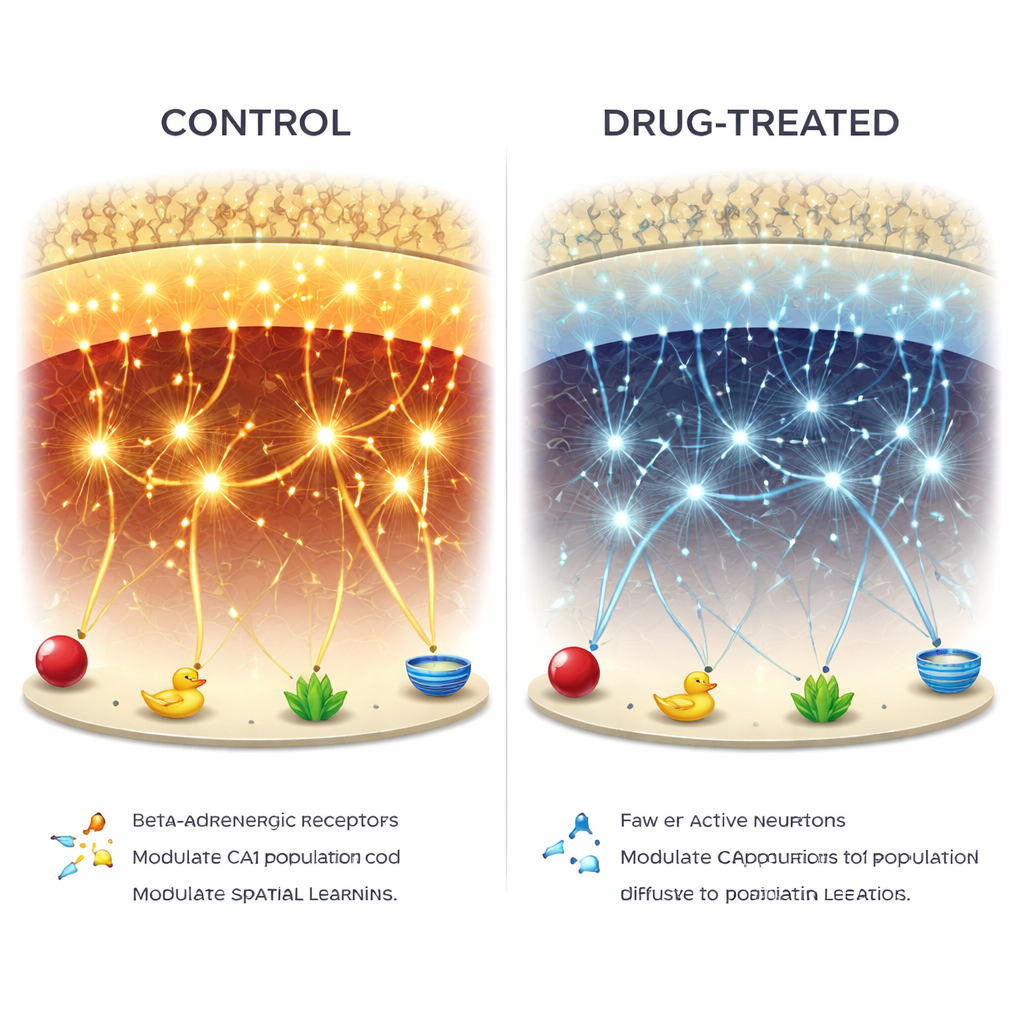
Looking at individual cells and cell groups, the authors found that in normal mice, CA1 neurons were recruited in an organized way across the three sessions. Many of the same cells turned back on when the animals re‑entered the unchanged arena, consistent with reactivating an existing memory. When one object moved, however, the pattern of active cells shifted, as if the network were updating its internal map. Cells whose activity tracked specific locations—“place cell‑like” neurons—became more precise and coherent with experience, and more of them focused their activity around the objects, especially after the layout changed. When beta receptors were blocked, fewer neurons joined the ensemble early on, their reactivation patterns were altered, and spatial tuning became less coherent and less tied to the objects, suggesting a fuzzier and less adaptable internal map.
Brain rhythms and networks under chemical control
Memories are thought to be reinforced by brief, highly synchronized bursts of activity involving many neurons at once. In control mice, such population bursts in CA1 were frequent during learning and recall, consistent with active consolidation of the spatial memory. Propranolol reduced both the number and strength of these bursts, hinting that the drug weakens the coordinated firing needed to stabilize memories. Network analyses treating the recorded cells as a connected graph showed that, in normal animals, the CA1 circuit evolved from a sparse, efficient layout to a denser, more modular organization as learning and updating unfolded—an architecture well suited to integrating new information while preserving old. Under beta-receptor blockade, this evolution was disrupted: connections became either overly redundant or too diffuse, and the network failed to reorganize in a way that cleanly separates old from new spatial information.
What this means for memory and mind
Taken together, the results show that beta-adrenergic receptors help orchestrate memory by tuning both the strength of individual connections and the collective dynamics of hippocampal circuits. When these receptors are active, CA1 neurons form precise, object-linked maps, reuse appropriate ensembles when the world is familiar, and flexibly recruit new patterns when something changes. Blocking the receptors blunts this process, leading to weaker synaptic adjustments, less coordinated bursts, and network states that do a poorer job distinguishing new from familiar situations. For lay readers, this work highlights how a single chemical signaling system can shape not just whether we form memories, but how fluidly we can update them as our surroundings change.
Citation: Shendye, N., Haubrich, J., Weber, J.P. et al. β-adrenergic receptors modulate CA1 population coding and synaptic plasticity during cumulative spatial memory formation and updating. Sci Rep 16, 7390 (2026). https://doi.org/10.1038/s41598-026-40218-x
Keywords: spatial memory, hippocampus, noradrenaline, synaptic plasticity, neuronal ensembles