Clear Sky Science · en
Effect of root promoter on tobacco (Nicotiana tabacum L.) growth and nutrient accumulation at Hunan Province, China
Why early roots matter for farmers
For farmers in southern China, a cold, rainy spring can spell trouble for young tobacco plants. When soil stays chilly and waterlogged, roots grow slowly, plants struggle to take up nutrients, and yields and leaf quality can suffer. This study tested whether simple root-boosting treatments poured around seedlings could help tobacco get off to a strong start in Hunan Province’s challenging transplanting season—and what happens in the hidden world of soil life when we do.

Helping plants through a tough start
The researchers worked in real farmer fields in Hunan, where tobacco is rotated with rice and spring weather is cool and wet. They transplanted the same tobacco variety into plots that either received no treatment or one of three root “promoters”: a mineral-based potassium humate, a fungicide mixture called HIEC, or a natural substance called chitosan. These liquids were simply poured onto the roots at planting. Over the next two months, the team measured root size, plant height, leaf growth, leaf greenness, and how much dry matter and key nutrients—nitrogen, phosphorus, and potassium—each plant accumulated.
Stronger roots, taller plants, greener leaves
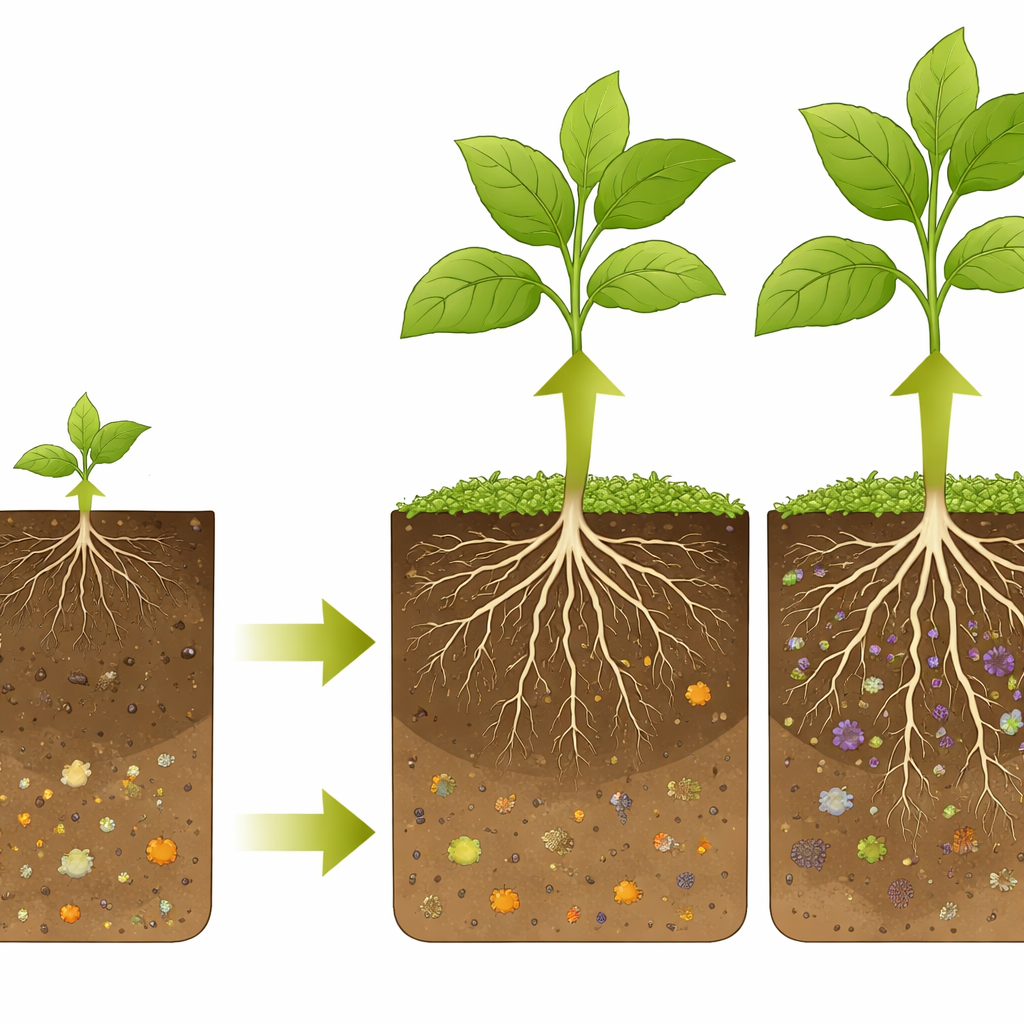
All three root treatments helped tobacco grow better than untreated plants, but two stood out. Potassium humate and HIEC produced much longer roots with greater surface area and more fine tips, the parts that absorb water and nutrients. At 30 days after transplanting, root length in these groups was roughly half to more than double that of the control. Above ground, treated plants were taller, had thicker stems, more leaves, and larger leaf area, especially early on. Potassium humate in particular boosted leaf greenness, a sign of higher chlorophyll and photosynthetic capacity. By 30 days, total plant dry weight had increased by around 60% with the two leading treatments, and even after 60 days they still carried more biomass than untreated plants.
Feeding the plant and reshaping the underground world
Better roots translated into better nutrition. Plants treated with potassium humate and HIEC stored much more nitrogen, phosphorus, and potassium in their roots, stems, and leaves—often tens of percent higher than in untreated plants. At the same time, the soil around them actually showed lower leftover nitrogen and potassium, meaning the roots had been more efficient at pulling these nutrients out of the soil, not that the soil was poorer. Potassium humate also nudged the naturally acidic red soil toward a more balanced pH and slightly raised its organic matter, conditions that make phosphorus more available and friendlier to root growth. Chitosan offered some improvement but could not match the nutrient gains seen with the other two.
Two different paths to a healthier root zone
To understand what was happening beneath the surface, the team analyzed the DNA of soil bacteria clinging to the roots. Potassium humate and chitosan kept the microbial community rich and diverse, similar to untreated soil, with many generalist bacteria that help cycle carbon and nitrogen. HIEC took a different route: overall bacterial diversity dropped, but a smaller group of hardy, helpful microbes flourished. These included types associated with breaking down organic matter, tolerating chemicals, and suppressing plant diseases. Statistical analyses showed that longer, finer roots were tightly linked to higher nutrient uptake, higher leaf chlorophyll, and ultimately more biomass, creating a “positive feedback loop” in which better roots feed better shoots, which in turn support even more root growth.
What this means for crops in bad weather
In plain terms, the study shows that a simple root drench at transplanting can help tobacco withstand cold, wet early-season weather by getting roots growing fast and tapping nutrients more effectively. Potassium humate does this mainly by gently improving soil conditions while keeping the underground microbial community diverse and active. HIEC works by selectively favoring a protective set of soil microbes that defend roots and allow the plant to invest energy in growth instead of defense. Although the work was done in one location and one season, the findings suggest that carefully chosen root treatments could be a practical tool not only for tobacco but potentially for other crops that face stressful starts in the field.
Citation: Li, Y., Azman, E.A., Ismail, R. et al. Effect of root promoter on tobacco (Nicotiana tabacum L.) growth and nutrient accumulation at Hunan Province, China. Sci Rep 16, 8675 (2026). https://doi.org/10.1038/s41598-026-40215-0
Keywords: tobacco roots, soil microbes, plant nutrition, crop resilience, root treatments