Clear Sky Science · en
Knowledge, attitudes, and practices of parents regarding children’s sun protection
Why this study matters for families
Most parents know that too much sun can be bad for their children, but fewer are sure how much protection is really needed, or which habits matter most. This study, carried out in Beijing, takes a close look at what parents actually know, how they feel, and what they do about shielding their children from the sun. By revealing where good intentions fall short of everyday practice, it points to simple changes that could help families reduce the risk of future skin damage and cancer.
Sun, skin, and growing risks
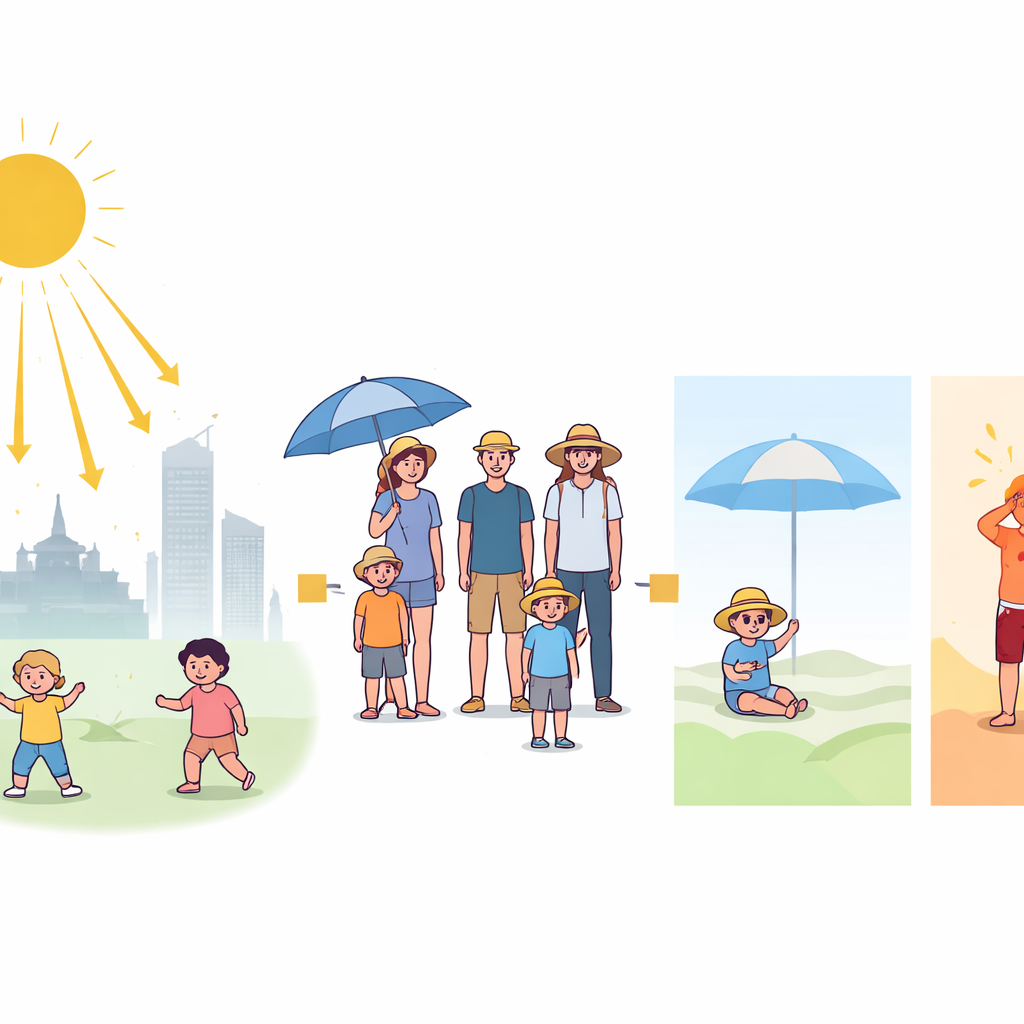
Childhood is a sensitive time for the skin. The sun’s invisible rays accumulate over the years and can lead to early aging of the skin and a higher chance of skin cancer later in life. Globally, skin cancers are among the most common cancers, and while rates in China are still lower than in some Western countries, they are rising. Cities like Beijing have hot summers with strong sunlight, and children often spend hours outdoors. In this setting, parents are the first line of defense, deciding whether their children wear hats, stay in the shade, or use sunscreen.
How the study was carried out
To understand parents’ habits, researchers at a major hospital in Beijing surveyed 477 mothers and fathers of children aged six months to 16 years. Participants answered a structured questionnaire on three areas: what they knew about sun protection, how strongly they felt it mattered, and what steps they usually took for their children. The survey also collected basic family details, such as parents’ education and income, and the child’s age, gender, and typical time spent outdoors. The team then used statistical methods to see how these factors related to one another and which ones best predicted real-world protective behavior.
What parents know and what they really do
The results painted a mixed picture. Overall, parents had only moderate knowledge about sun safety. Many understood that children are vulnerable to sun damage and that sunscreen needs to be reapplied, but gaps and myths remained. A noticeable share believed that sunburn does not happen on cloudy days or that higher product ratings automatically guarantee better protection for children. Attitudes were generally positive: most parents said they cared about sun-related skin damage. Yet everyday habits were far from ideal. Only about one in five parents always took protective measures, and very few consistently reapplied sunscreen or protected less visible areas like the torso. Physical methods—such as hats, clothing, and umbrellas—were favored over regular sunscreen use.
Differences between families
The study also found that protection was not the same for all children. Parents of girls tended to be more cautious than parents of boys, perhaps because of stronger concerns about tanning and marks on the skin. Mothers reported more worry about sun damage, but fathers, somewhat surprisingly, scored higher on practical actions. Education level did not automatically guarantee better behavior; parents with advanced degrees were not more likely, and sometimes were less likely, to follow consistent protective routines. These patterns suggest that social expectations, daily schedules, and personal beliefs can all shape how knowledge is turned—or not turned—into action.

From knowing to caring to acting
When the researchers examined how the three pieces—knowledge, attitude, and practice—fit together, a clear pattern emerged. Parents who knew more tended to protect more, but this effect was modest. Feelings and priorities played a stronger role: parents who cared more deeply about sun damage and saw protection as important were much more likely to put safeguards into place. In other words, facts help, but motivation and concern are what truly drive behavior. The study suggests that good information alone is not enough; it must be delivered in ways that speak to parents’ fears, values, and daily routines.
What this means for everyday life
For families, the takeaway is straightforward: children in Beijing—and in similar sunny cities—are still getting less protection than they need, even when parents mean well. Strengthening both understanding and attitudes could make a real difference. Clear, practical guidance from doctors, schools, and community programs on simple routines—like using hats and shade year-round, applying and reapplying sunscreen, and protecting all exposed skin—can help close the gap between what parents believe and what they do. By turning awareness into daily habits, parents can give their children a safer start under the sun and lower their risk of skin problems later in life.
Citation: Lin, X., Li, T. & Chang, X. Knowledge, attitudes, and practices of parents regarding children’s sun protection. Sci Rep 16, 9508 (2026). https://doi.org/10.1038/s41598-026-40202-5
Keywords: children’s sun protection, parental behavior, skin cancer prevention, ultraviolet radiation, Beijing families