Clear Sky Science · en
Clinical efficacy and cost-effectiveness of four myopia control interventions in children: a single-center retrospective study
Why parents should care about this study
Nearsightedness in children is rising so quickly that experts now call it a global epidemic. Beyond thicker glasses, worsening myopia raises the risk of serious eye disease later in life. Families today face a growing menu of treatments that promise to slow this worsening, from special glasses to reshaping contact lenses to red-light devices. This study looked at how well four common options work over one year in real-world clinic conditions—and, crucially, how much “benefit for the money” each one provides.
How the study was carried out
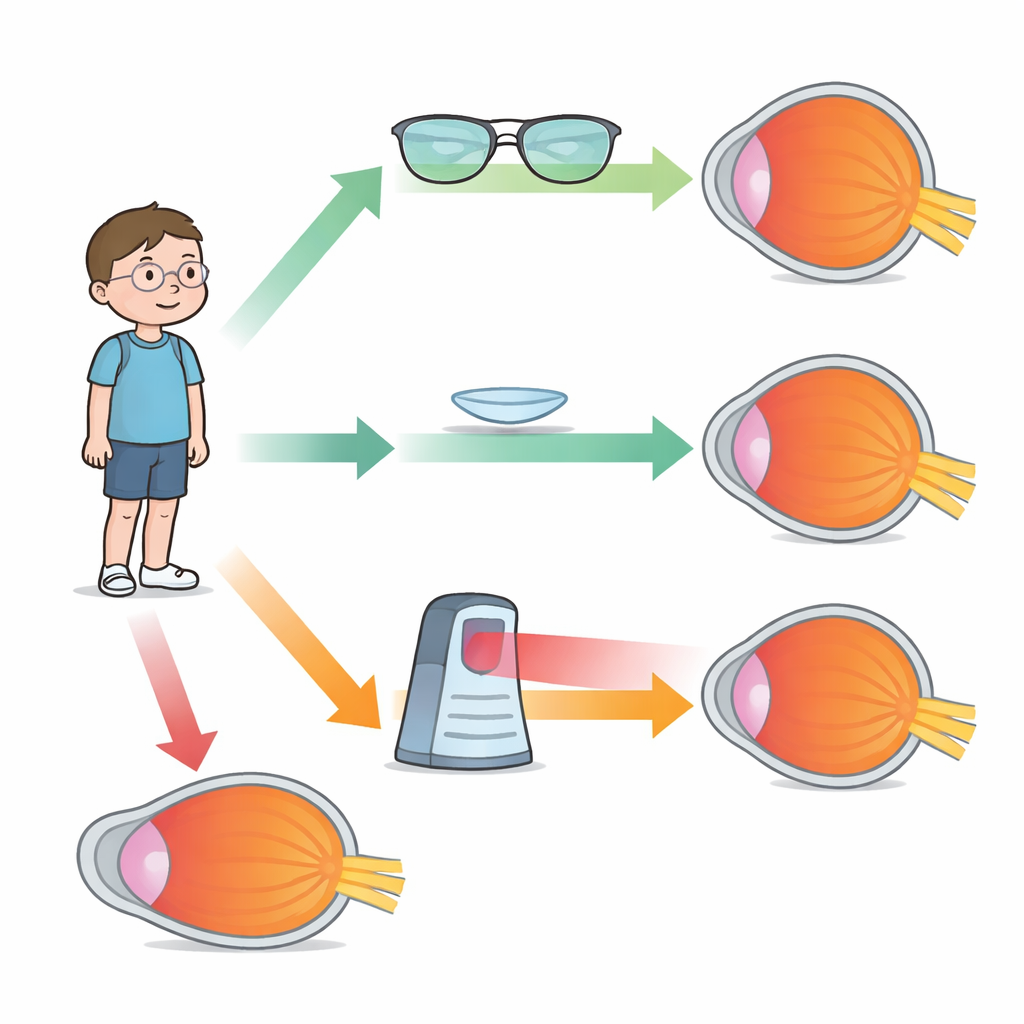
Researchers in a children’s hospital in China reviewed medical records from 206 children aged 8 to 14 who were already using one of four approaches to correct or control myopia. One group wore standard single-vision glasses, which simply make vision clear but do not aim to slow eye growth. A second group used specially designed myopia-control glasses with tiny lens segments around the center. A third group wore overnight hard contact lenses that gently reshape the front of the eye. The fourth group used a home device that shines brief, low-intensity red light into the eyes twice a day, while still wearing regular glasses for clarity. The team tracked how much the eyeball lengthened over one year—a key driver of worsening myopia—and how much each option cost in clinic fees, devices, lenses, and follow-up visits.
Which options slowed eye growth best
Children in the standard glasses group showed the fastest eye growth, confirming that ordinary correction does little to slow myopia. All three “active” treatments reduced eye elongation, but to different degrees. The red-light therapy group showed the strongest effect: on average, their eyes barely lengthened over the year, and nearly one in three actually showed a slight shortening. Overnight reshaping lenses also clearly slowed eye growth compared with standard glasses, while myopia-control spectacles offered a moderate but meaningful reduction in progression. Changes in the children’s prescriptions told the same story: those using red-light therapy had almost no worsening in their measured nearsightedness, while the other active groups fell in between red light and standard glasses.
What the treatments cost
Standard glasses were by far the cheapest to use over a year but offered the least protection. Myopia-control glasses cost about three times as much as standard lenses, reflecting the more complex designs and extra check-ups. Overnight reshaping lenses were the most expensive option, requiring higher upfront fitting costs and more frequent follow-ups, as well as ongoing care solutions. Red-light devices sat in between: they were costlier than special glasses but cheaper than reshaping lenses. To judge value, the researchers calculated how much extra money each treatment required to prevent a small, fixed amount of eye growth compared with standard glasses. By this yardstick, myopia-control glasses delivered the best balance of cost and benefit, red-light therapy was a close second, and reshaping lenses were the least cost-effective despite being clinically helpful.
Promises and remaining questions
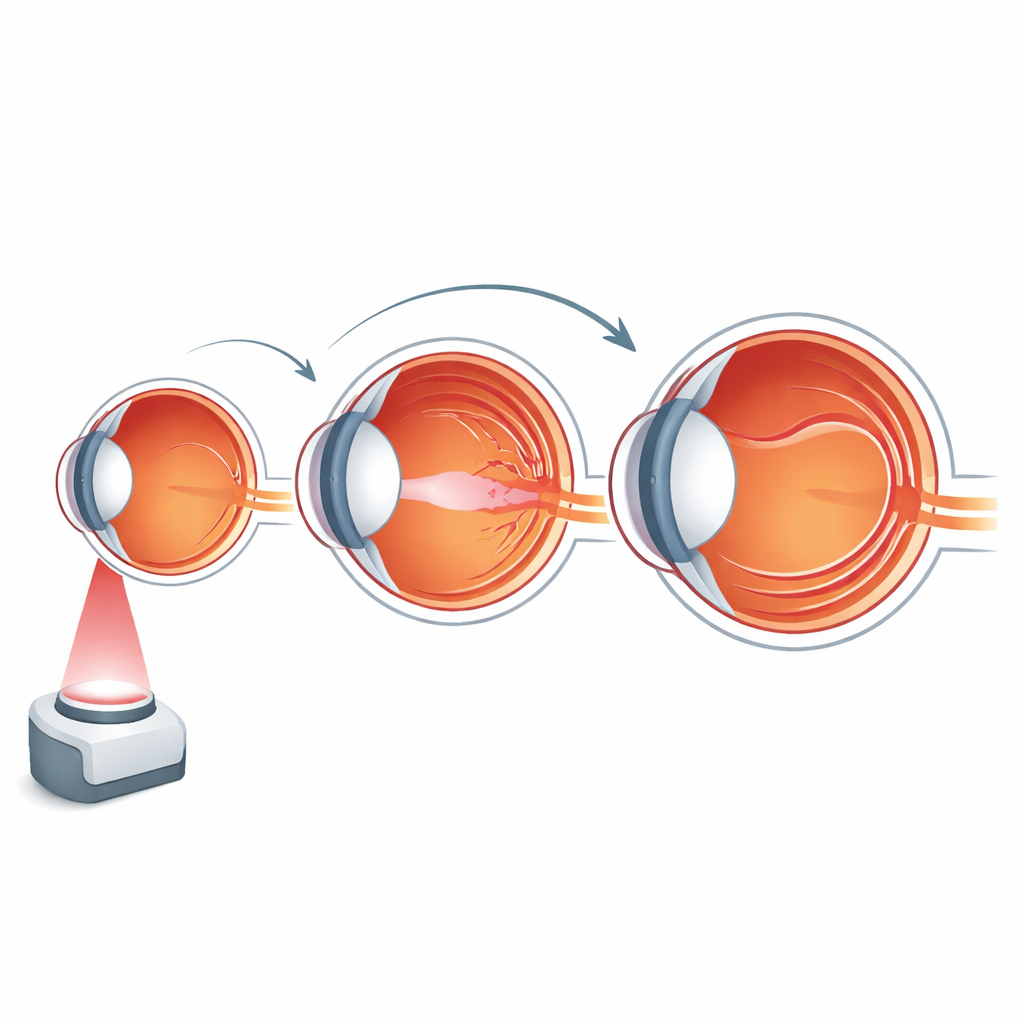
The striking performance of red-light therapy raises both excitement and caution. Its ability to nearly halt eye elongation—and occasionally reverse it—matches results from earlier clinical trials. Scientists suspect that red light may improve blood flow in deeper eye layers and send growth-slowing signals to the tissues that shape the eyeball. However, the same “shortening” that looks encouraging also raises safety questions: it may reflect changes in eye layers that are not yet fully understood. There are reports of mild, reversible retinal changes in a few children treated with similar devices, and other studies suggest that myopia can speed up again once red-light treatment stops. Overnight reshaping lenses, in contrast, have a longer safety track record and may offer the lifestyle benefit of clear vision all day without glasses, though at a higher price. Myopia-control glasses stand out as simple, non-invasive, and broadly affordable, with steady but not dramatic slowing of myopia.
What this means for families
For parents seeking to protect their child’s vision, this study suggests a trade-off between maximum impact and practical value. Over a single year, red-light therapy appeared to slow eye growth the most, but it is still a relatively new, “high-reward, high-uncertainty” option that needs longer and larger studies to confirm its true safety and durability. Myopia-control glasses emerged as the most cost-effective choice, offering solid protection with fewer unknowns and easier day-to-day use. Overnight reshaping lenses remain an effective but expensive route that may suit highly active children who value freedom from daytime eyewear. Ultimately, the best choice depends on a family’s risk tolerance, budget, and lifestyle, guided by an eye-care professional who can explain both the benefits and the remaining uncertainties.
Citation: Kang, D., Yuan, L., Lanca, C. et al. Clinical efficacy and cost-effectiveness of four myopia control interventions in children: a single-center retrospective study. Sci Rep 16, 9126 (2026). https://doi.org/10.1038/s41598-026-40199-x
Keywords: childhood myopia, myopia control, red-light therapy, orthokeratology, myopia-control glasses