Clear Sky Science · en
Evaluating the impact of assisted natural regeneration and afforestation on soil erosion dynamics using high-resolution imagery in semi-arid Ethiopia
Why planting and protecting trees matters for everyday life
In many farming communities, soil is the foundation of food, income, and safety from floods and landslides. In Ethiopia’s highlands, however, this foundation is crumbling as steep hillsides lose their protective vegetation. This study explores a hopeful counter-story: how two different ways of restoring trees—planting new ones and helping nature regrow on its own—can slow the loss of precious soil in a dry, erosion-prone district of Ethiopia.
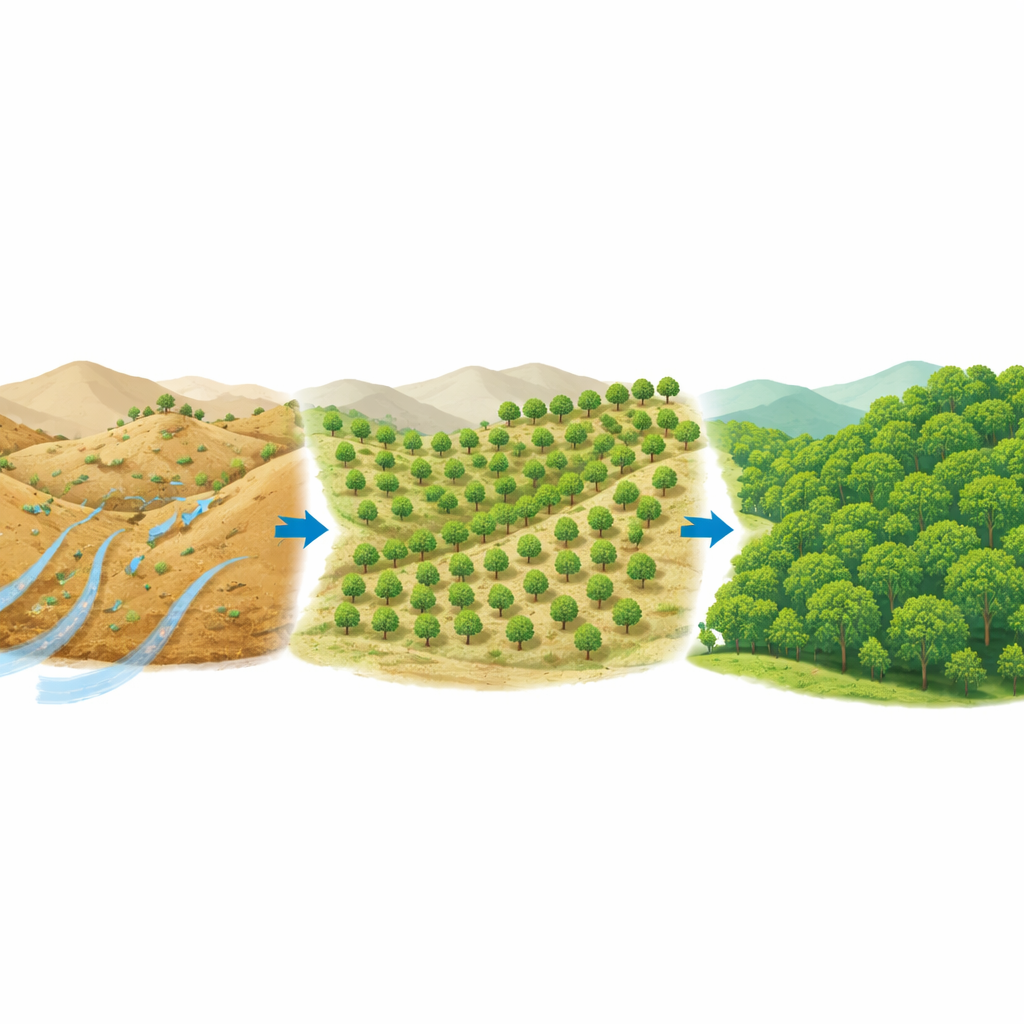
A landscape under pressure
The Kembata Tembaro district in central Ethiopia sits on rolling plateaus and valleys where most families depend on small-scale farming. Over recent decades, population growth, cutting of trees, and unpredictable rains have stripped hillsides of their protective cover. Without enough plants and roots, rainwater rushes over the surface instead of soaking in, carving channels, washing away fertile topsoil, and leaving behind poorer fields that yield less food. National programs and international partners launched major tree-based restoration efforts here starting in 2015, but it was not yet clear how much these efforts were actually slowing soil loss on the ground.
Two ways to bring back trees
The study focused on two main restoration strategies. Afforestation involves actively planting trees on land that was previously bare or used for crops. Assisted natural regeneration, by contrast, works with the forest remnants that are already there—protecting remaining stumps, seedlings, and wild trees from grazing and cutting so they can recover on their own. Both approaches were put in place under a forest-protection program known as REDD+, which aims to reduce damage to forests while supporting local livelihoods. Researchers selected three sites for each approach within the district and tracked how the land changed between 2015, when the program began, and 2024.
Watching the land change from space
Because visiting every hillside is impossible, the team turned to detailed satellite images that can pick out features just a few meters across. They combined these images with digital maps of elevation, rainfall, and soil properties to estimate where erosion is most intense. Using a widely applied soil-loss formula, they calculated how much soil is likely being carried away each year under different land covers, from croplands and grass to shrubs and forests. By comparing two snapshots—before and after nearly a decade of restoration—they could see how expanding tree cover changed the pattern and severity of erosion across the sample sites.
More trees, less soil washed away
The results show a clear and encouraging trend. Across all six sites, forest cover rose from about 7% of the area to nearly one-third by 2024, with very little forest converted back to other uses. In areas managed through assisted natural regeneration, forest cover grew from just under 2% to more than 22%, and the estimated average yearly soil loss dropped from about 13 to 9.5 tons per hectare. At the planted sites, forest cover jumped from 8.5% to almost 35%, and soil loss fell from around 43 to 31 tons per hectare. In other words, both strategies sharply reduced the amount of soil being stripped off hillsides, with tree-planting delivering the largest absolute reduction where erosion had been worst.
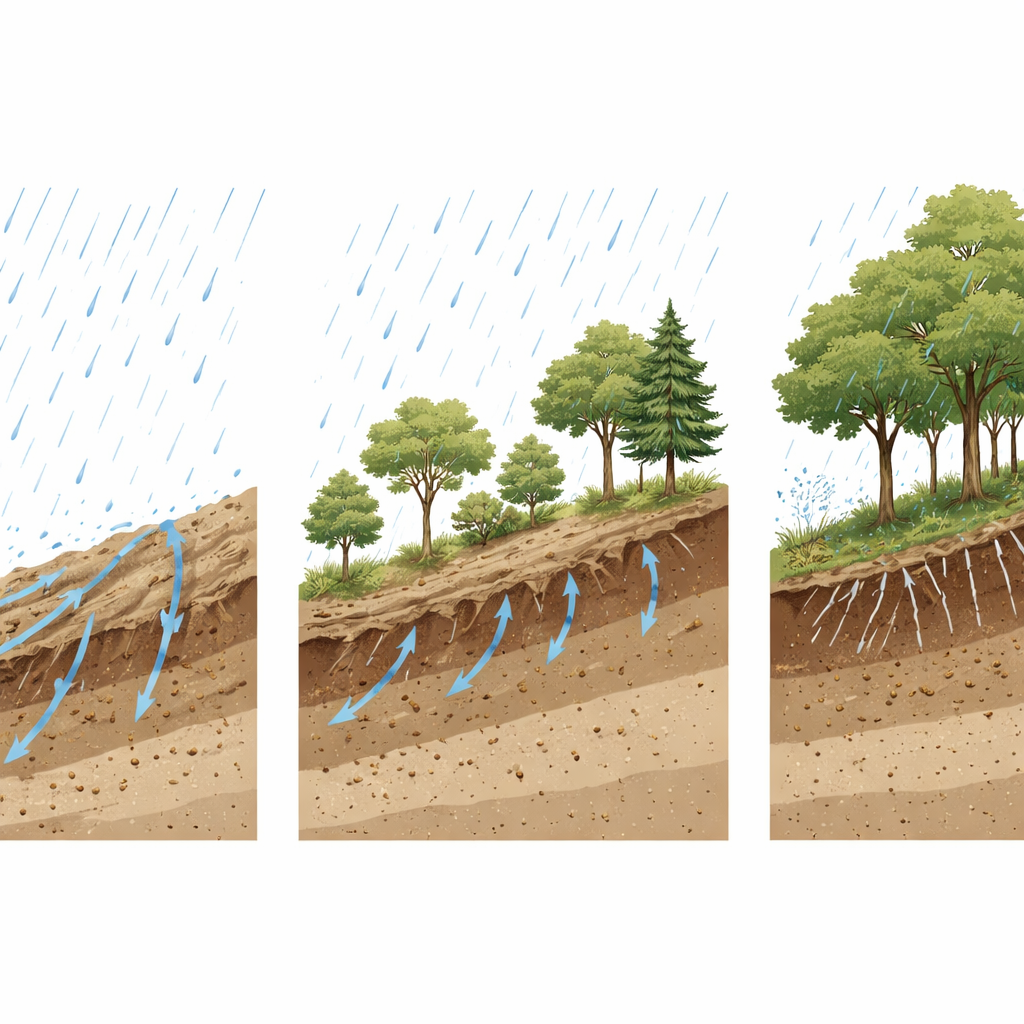
How deeper roots bring wider benefits
These gains are more than just numbers on a map. When trees and shrubs cover the ground, their leaves soften the force of raindrops, and their roots weave through the soil like a net, holding it in place. Water moves more slowly, giving it time to sink in instead of roaring downhill in muddy torrents. Over time, this helps keep fields fertile, reduces the risk of floods and mudslides, and supports local springs and streams. The study also showed that the soil-loss estimates from the computer model matched well with real signs of erosion on the ground, adding confidence that the observed improvements are genuine.
A practical path to protect land and climate
For non-specialists, the key message is simple: bringing trees back—whether by planting them or by giving nature a chance to heal—can make a big difference in protecting soil in dry, fragile landscapes. Afforestation can quickly transform the most damaged hillsides, while assisted natural regeneration offers a lower-cost, community-friendly option wherever some vegetation remains. Together, these approaches are helping Ethiopian communities hold on to their soil, strengthen their farms, and contribute to broader climate and conservation goals. The findings suggest that expanding such efforts across similar highland regions could be a powerful way to safeguard both people’s livelihoods and the land they depend on.
Citation: Sisay, M.W. Evaluating the impact of assisted natural regeneration and afforestation on soil erosion dynamics using high-resolution imagery in semi-arid Ethiopia. Sci Rep 16, 9795 (2026). https://doi.org/10.1038/s41598-026-40176-4
Keywords: soil erosion, forest restoration, afforestation, Ethiopia, REDD+