Clear Sky Science · en
Harnessing artificial neural networks for accurate PV system parameters determination: radiation, temperature, and MPPT
Smarter Solar Power for Everyday Life
Solar panels are now found on rooftops, farms, and even parking lots, but getting the most electricity out of them is trickier than it seems. Sunlight and temperature change constantly, and traditional control circuits can be slow and wasteful. This study shows how artificial neural networks—computer systems inspired by the brain—can help solar panels automatically squeeze out nearly every possible watt of power, while using fewer sensors and cheaper hardware.
Why Sun and Heat Make Solar Power Unsteady
Solar panels work best at a particular operating point where voltage and current combine to give maximum power. This sweet spot shifts all day long as clouds pass, the sun angle changes, and panels heat up. Conventional controllers hunt for that point by nudging the operating voltage up and down and watching how power responds. These methods are simple but often overshoot, take time to settle, and waste energy by constantly oscillating around, rather than locking onto, the true maximum power point.
Cutting Sensors Without Losing Insight
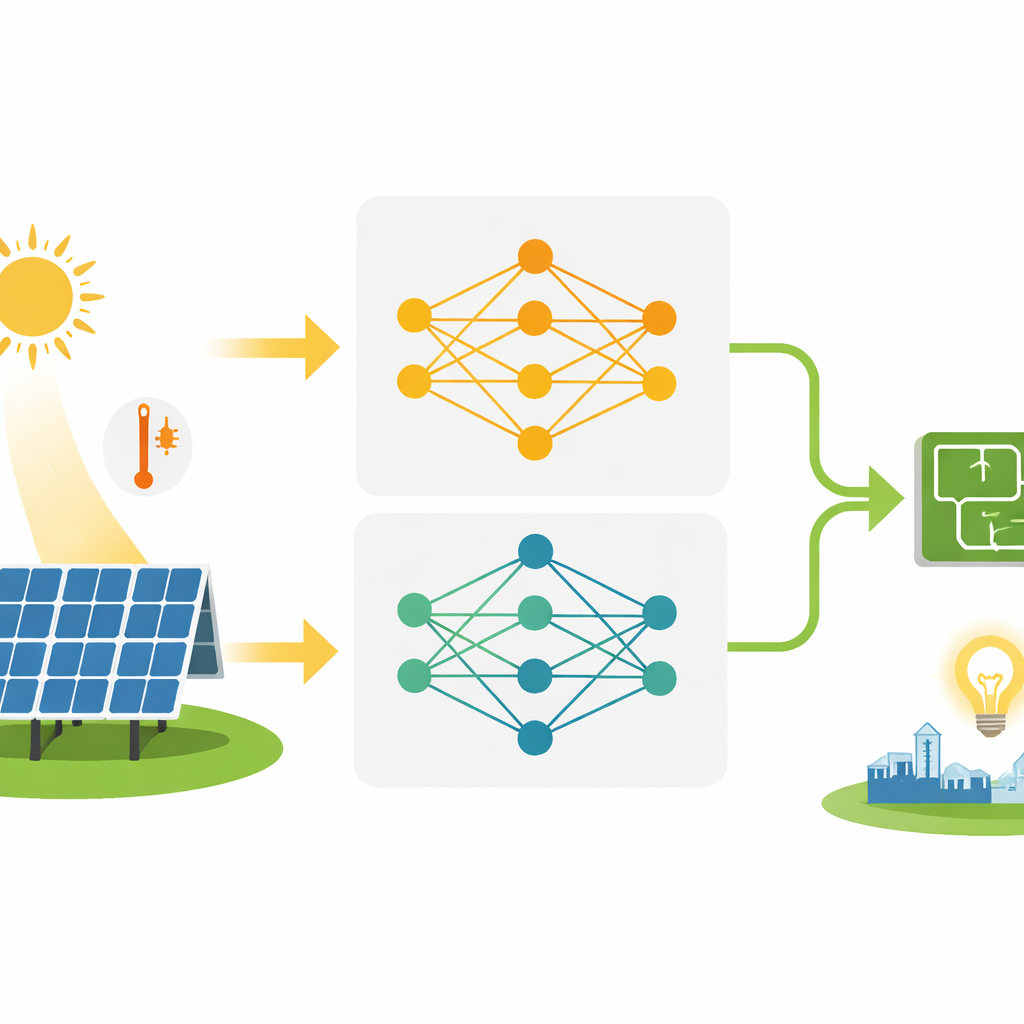
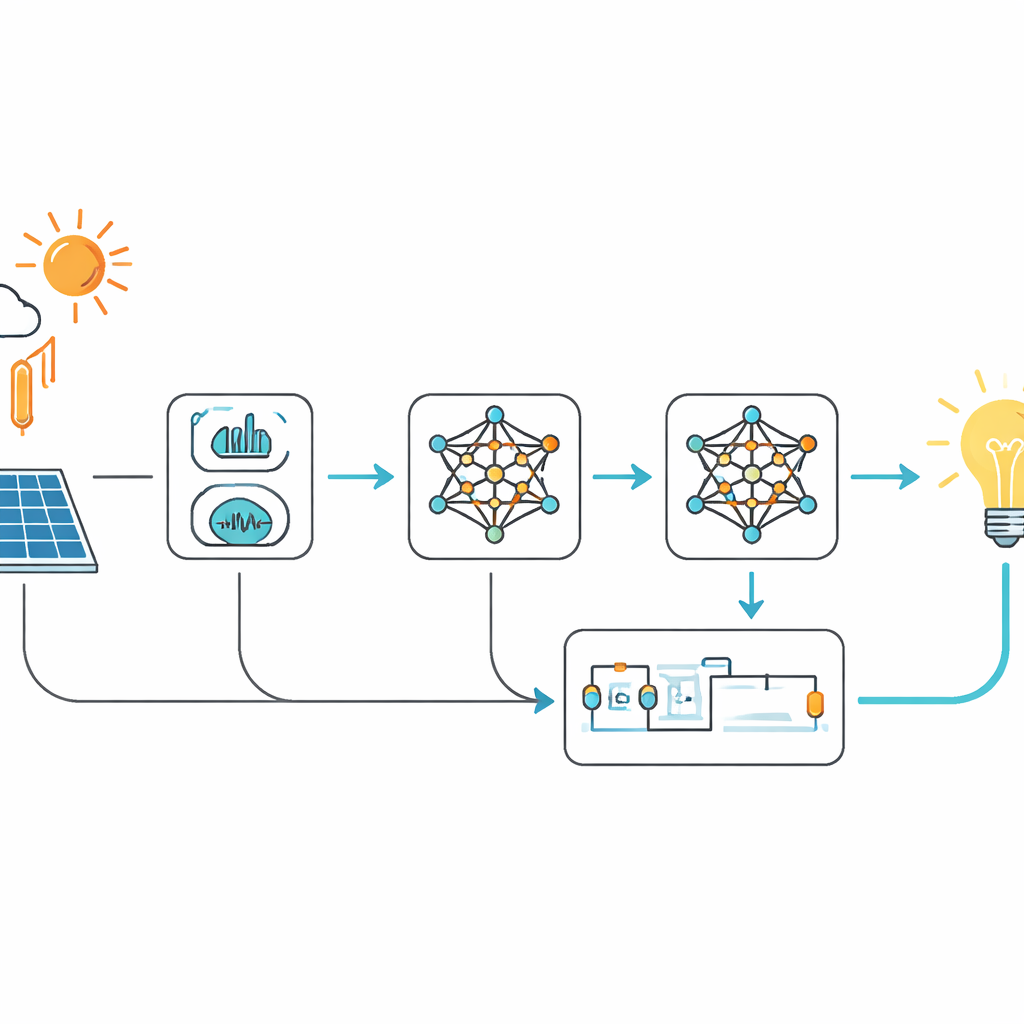
To track the best operating point precisely, engineers traditionally measure how much sunlight hits the panel and how hot the cells are, using a light sensor (pyranometer) and temperature probes. These instruments add cost, complexity, and maintenance needs—especially in large solar farms. The researchers propose a first neural network that skips these dedicated sensors entirely. Instead, it looks only at two basic electrical measurements from a single reference panel: the open-circuit voltage and the short-circuit current. From these values, the network learns to infer how bright the sun is and how hot the panel has become, even under rapidly changing weather.
Letting the Network Drive the Power Converter
Once sunlight and temperature are estimated, the next challenge is steering the power electronics so the panels operate exactly at their maximum power point. Here, a second neural network takes over. It receives the estimated sunlight and temperature as inputs and outputs the optimal “duty cycle” setting for the DC–DC converter that links the panels to the load. This duty cycle determines how the converter boosts the panel voltage and shapes the flow of current. By learning directly from detailed simulations of the solar system, the network can jump almost instantly to the best setting instead of slowly searching for it.
Testing Under Real Skies
The team put their two-stage approach through a set of computer simulations and real-world experiments. They first trained and tested the networks using data from panel specifications and then with actual weather records from the sunny coastal city of Hurghada in Egypt. Finally, they built hardware setups both indoors, using programmable power supplies to mimic panels, and outdoors, using three real solar modules. In all cases, the neural-network system estimated sunlight and temperature far more accurately than traditional formulas and drove the power converter to extract nearly all available energy, with very small ripples in voltage and current and response times of only a few thousandths of a second.
What This Means for Future Solar Power
For a non-specialist, the outcome can be thought of as giving solar panels a kind of “smart sense” of their environment. By relying on fast-learning algorithms instead of many physical sensors and trial-and-error control, the system turns changing weather from a problem into something it can quickly adapt to. The study shows that with carefully trained neural networks, a solar installation can reach close to 100% of its theoretical power output while remaining simple and relatively low-cost. As these ideas are extended to larger solar plants, grid-connected systems, and more advanced machine-learning models, they promise cleaner, more reliable, and more affordable solar electricity.
Citation: Abdelqawee, I.M., Selmy, M., ALI, M.N. et al. Harnessing artificial neural networks for accurate PV system parameters determination: radiation, temperature, and MPPT. Sci Rep 16, 9682 (2026). https://doi.org/10.1038/s41598-026-40175-5
Keywords: solar energy, photovoltaic systems, neural networks, maximum power point tracking, renewable energy control