Clear Sky Science · en
Automated assessment of technological and financial drivers of greenhouse gas reduction in sustainable renewable energy systems
Why this matters for our energy future
As nations race to cut greenhouse gas emissions, governments and utilities are pouring money into solar panels, wind farms, and batteries. Yet a deceptively simple question remains surprisingly hard to answer: which specific choices about technology and funding actually make the biggest dent in emissions? This paper tackles that question with advanced data-analysis tools, showing how storage technology and smart financial support can work together to squeeze more climate benefit from each unit of clean energy.
Looking under the hood of clean power projects
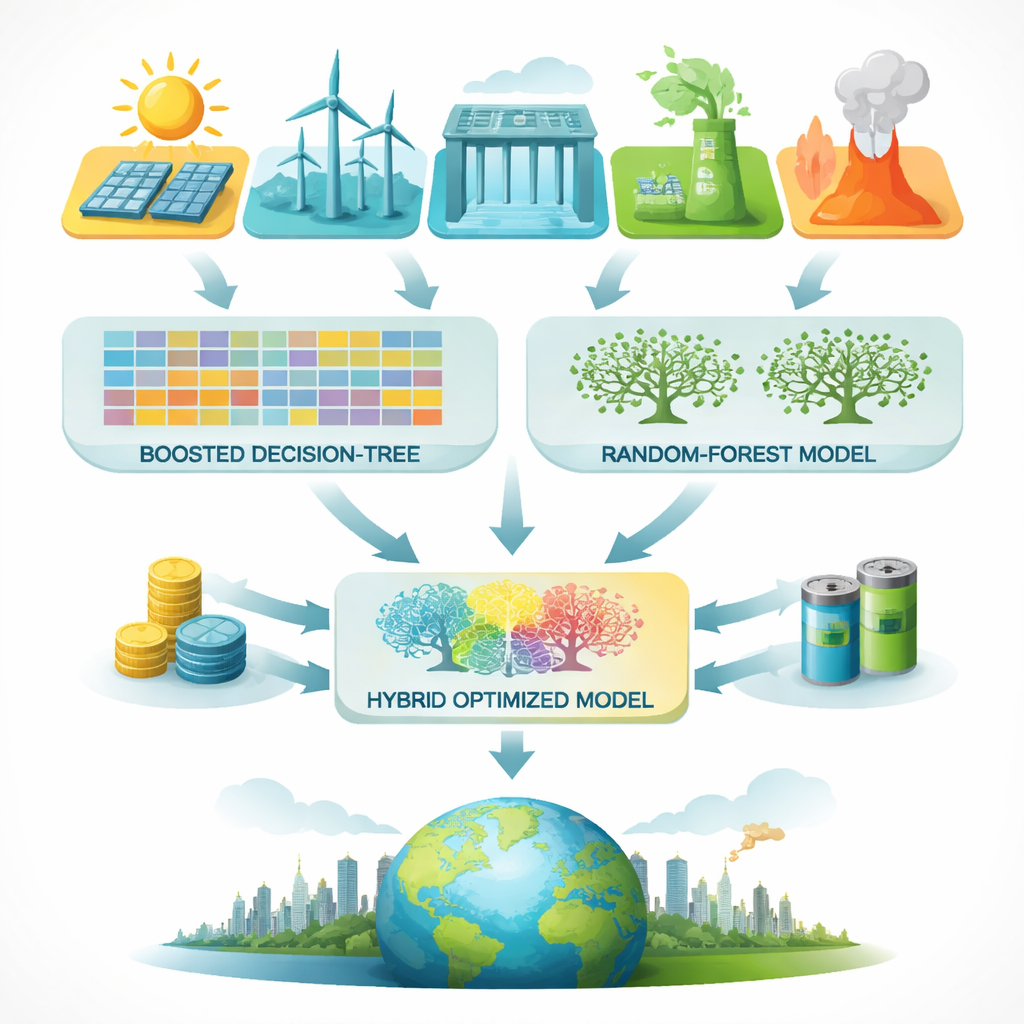
The researchers gathered a large, carefully constructed dataset representing 15,000 renewable energy projects, spanning solar, wind, hydro, geothermal, biomass, tidal, and wave systems. For each project, the data captured not only how big the installation was and how much electricity it produced, but also how much storage it had, how efficient that storage was, how well the project was connected to the grid, how much it cost, what kinds of funding and incentives it received, and indicators of both greenhouse gas cuts and cleaner local air. Rather than focusing on one country or technology, the dataset was designed to mimic realistic ranges and relationships seen across many kinds of projects worldwide.
Teaching machines to predict climate gains
To see which factors matter most for cutting emissions, the team trained two modern prediction engines that are especially good at handling messy, real-world data: a boosted decision-tree model (CatBoost) and a random-forest model. They then paired these with two optimization methods inspired by physics and astronomy, which automatically tune model settings so the predictions become as accurate and stable as possible. The strongest combination, a CatBoost model optimized with the Archimedes-based algorithm (the authors call it CAAO), learned to predict emissions reductions with striking precision while also running fast enough to be useful for large planning exercises or frequent policy updates.
What really drives emission cuts
With a reliable prediction engine in hand, the researchers turned to two complementary tools to interpret what the model had learned. A sensitivity method known as FAST examined how much each input contributes to overall variation in outcomes when all factors interact. This global view pointed squarely at energy storage: the size of storage systems and, especially, how efficiently they store and release power dominated the long-term behavior of emissions. At the same time, a model-explanation method called SHAP looked at how each feature nudged individual predictions up or down across thousands of cases. From this perspective, financial incentives emerged as the single most influential factor, with storage efficiency close behind and local air-quality improvements tracking closely with deeper climate benefits.

Bridging technology and money
At first glance, these two stories might seem to clash: one says storage hardware rules, the other points to policy-driven cash flows. The authors argue they are actually two sides of the same coin. Storage capacity and efficiency shape the physical backbone of a low-carbon grid, determining how smoothly variable solar and wind can displace fossil fuels over the long haul. Financial incentives, in contrast, strongly influence near-term investment decisions, speeding up or slowing down the rollout of those very storage systems and other clean technologies. Seen together, the results suggest that lasting emission cuts require both sturdy technical foundations and well-calibrated economic signals, rather than relying on technology or policy alone.
What this means for decision makers
For non-specialists making choices about climate and energy—whether in government, utilities, or finance—the study’s message is straightforward. If the goal is to get the most climate impact per dollar, it is not enough to simply build more renewables; attention must focus on how much storage is installed, how efficiently it operates, and how incentives are structured to encourage these improvements. The work does not prescribe country-specific policies, but it offers a practical, data-driven framework that others can adapt with local information. By combining advanced prediction tools with careful feature analysis, the study shows how to move from broad slogans about “more renewables” toward concrete levers—better batteries and smarter financial support—that can reliably push emissions down.
Citation: Chandra, S., Abdulhadi, A.R., Hdeib, R. et al. Automated assessment of technological and financial drivers of greenhouse gas reduction in sustainable renewable energy systems. Sci Rep 16, 10138 (2026). https://doi.org/10.1038/s41598-026-40170-w
Keywords: renewable energy, energy storage, greenhouse gas reduction, financial incentives, machine learning models