Clear Sky Science · en
Enhancing strawberry maturity assessment using mid-infrared spectral analysis with advanced variable selection and supervised classification
Why smarter fruit checking matters
Anyone who has bitten into a beautiful but tasteless strawberry knows that looks can be deceiving. Farmers, retailers, and shoppers all want fruit that is picked at just the right moment—ripe enough to taste great, but firm enough to travel well. Today, checking ripeness still relies heavily on human eyes, squeeze tests, or lab measurements that destroy the fruit. This study explores a faster, cleaner way to judge strawberry maturity using invisible light and clever computer algorithms, potentially transforming how fruit quality is monitored from greenhouse to grocery shelf.
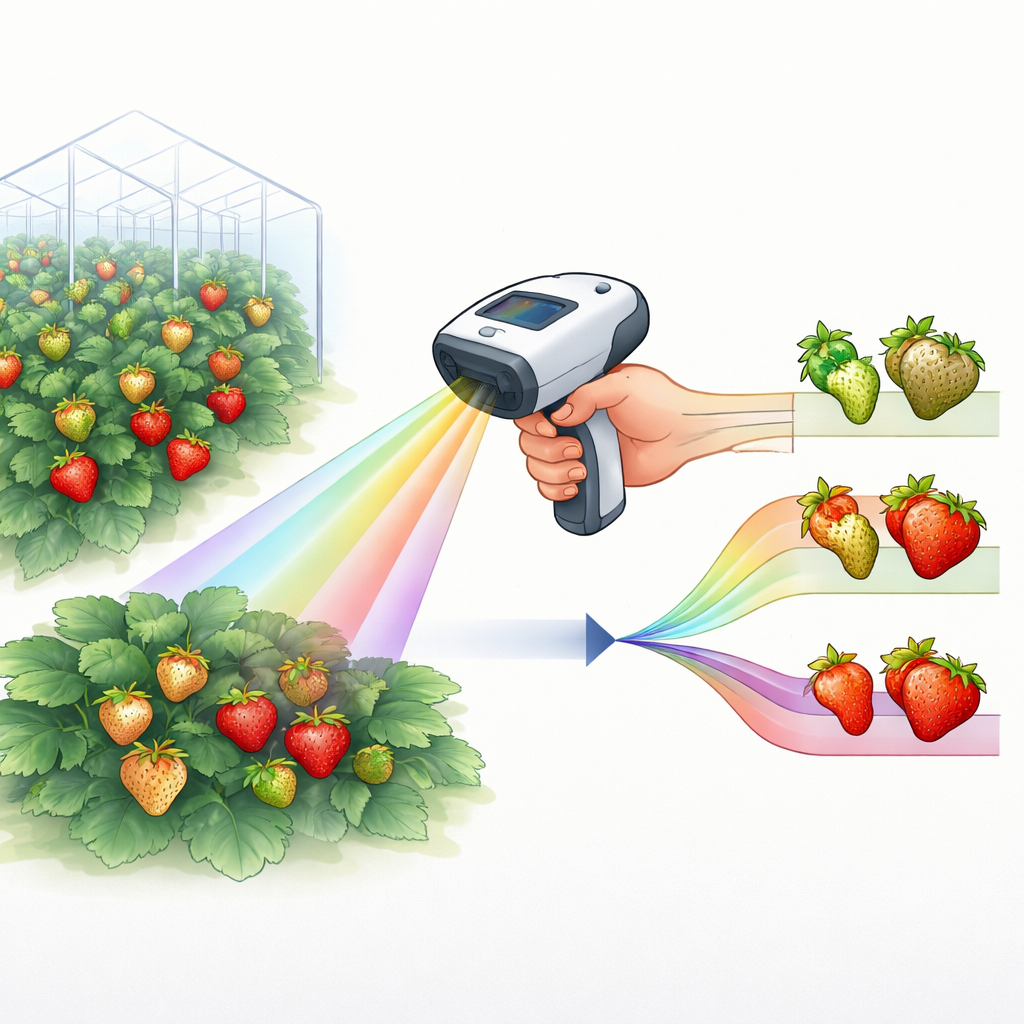
Looking inside strawberries with invisible light
Instead of cutting fruit open or relying only on color, the researchers used mid‑infrared light, a region of the spectrum our eyes cannot see but molecules respond to strongly. When this light shines on a strawberry, some wavelengths are absorbed and others reflected, creating a kind of chemical fingerprint called a spectrum. These fingerprints capture changes in sugars, acids, water, and cell walls as the fruit ripens. Using a portable handheld instrument, the team recorded spectra from 443 strawberries grown in French greenhouses, each carefully labeled into one of eight maturity stages ranging from green to deep red.
Teaching algorithms to spot the ripeness signal
Each spectrum contained around 900 measurement points, far more than needed for simple decisions and potentially noisy or redundant. To focus on the most informative parts, the scientists turned to a family of search strategies known as metaheuristics. These algorithms take inspiration from nature—such as evolution, wolf packs, bee swarms, and ant trails—to explore many possible combinations of spectral points and keep those that best separate the ripeness stages. Six such strategies were tested side‑by‑side and paired with four standard classification methods that learn to assign each spectrum to the correct maturity level.
Finding a small set of powerful ripeness clues
By letting these search algorithms compete under the same conditions, the team discovered that some combinations stood out. In particular, a genetic algorithm—loosely modeled on natural selection—paired with a method called linear discriminant analysis repeatedly found very small sets of mid‑infrared points, often fewer than 20 out of 900, that still classified strawberries with about 95–99% accuracy in cross‑validation tests. Other approaches, such as bee‑ and gravity‑inspired searches, also performed well but usually needed more spectral points. Crucially, when no feature selection was used and all 900 points were fed directly to a classifier, accuracy dropped sharply and the models became less reliable, underscoring the value of carefully choosing which parts of the spectrum to trust.
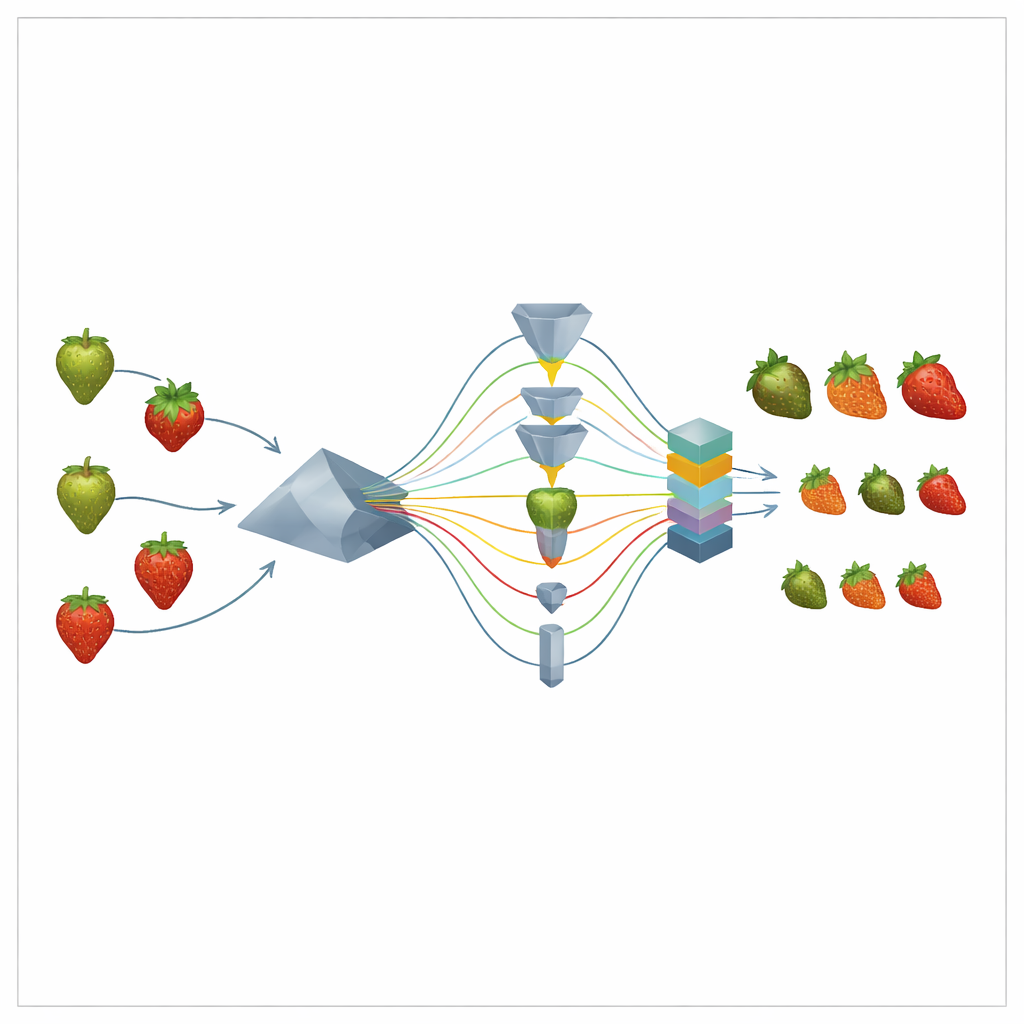
Linking light patterns to real fruit changes
Because mid‑infrared light interacts directly with chemical bonds, the selected spectral points could be traced back to specific types of molecules. The most useful regions corresponded to signals from sugars, organic acids, water, and structural components of the fruit. These are exactly the features that shift as strawberries move from hard and sour to soft and sweet. This chemical interpretability is a key advantage over image‑only or black‑box deep learning methods: it not only predicts how ripe a berry is, but also hints at why the model made that decision, building trust for growers and quality controllers.
What this means for future fruit quality checks
Put simply, the study shows that a handheld mid‑infrared sensor, combined with well‑chosen algorithms, can quickly and non‑destructively tell how ripe a strawberry is with high accuracy using only a tiny slice of the available data. This opens the door to smart, in‑field tools that help farmers decide the best harvest time, packers sort fruit for local sale versus long transport, and suppliers reduce waste by avoiding over‑ or under‑ripe shipments. While more testing is needed across different varieties and growing conditions, the approach points toward a future where invisible light and intelligent software quietly safeguard the taste and quality of the berries we buy.
Citation: Rammal, A., Assaf, R., Perrin, E. et al. Enhancing strawberry maturity assessment using mid-infrared spectral analysis with advanced variable selection and supervised classification. Sci Rep 16, 10154 (2026). https://doi.org/10.1038/s41598-026-40157-7
Keywords: strawberry ripeness, infrared spectroscopy, fruit quality, machine learning, precision agriculture