Clear Sky Science · en
A comparative analysis of gamma and neutron radiation shielding properties of Gd2O3 nanoparticles within HDPE composites irradiated with argon ion beam
Why safer shields matter
From medical scanners to nuclear power plants, many modern technologies rely on intense radiation. That same radiation, made of high‑energy gamma rays and flying neutrons, can damage living tissue and the environment if it is not carefully contained. Heavy concrete and lead have long been the workhorses of shielding, but they are bulky, rigid, and difficult to handle or dispose of. This study explores a lighter, more flexible alternative: a plastic filled with tiny particles of a rare‑earth oxide that can block both gamma rays and neutrons, and whose performance can be further boosted using a stream of charged atoms.
Building a smarter plastic shield
The researchers start with high‑density polyethylene (HDPE), a common, tough plastic already used around reactors because it is rich in hydrogen, which is good at slowing fast neutrons. They then mix in nanoscale particles of gadolinium oxide (Gd2O3), a compound of a heavy rare‑earth metal known for its exceptional ability to soak up neutrons and interact strongly with gamma rays. Using a sol–gel process and careful stirring and ultrasonication, they prepare thin plastic sheets containing different amounts of these nanoparticles, ranging from a few percent up to 40 percent by weight. These flexible nanocomposites are designed to combine the best traits of both components: the lightness and processability of a plastic with the stopping power of a dense, neutron‑hungry metal oxide. 
Peering inside the new material
To understand how these shields are built at the microscopic level, the team examines their internal structure and chemistry using several standard tools. X‑ray diffraction reveals that the gadolinium oxide forms well‑defined crystals only a few tens of billionths of a meter across, and that adding them does not destroy the basic crystalline structure of the plastic itself. Electron microscopes show that the nanoparticles are spread fairly evenly through the HDPE, without clumping, especially at higher loadings. Other techniques confirm which atoms are present and how chemical bonds in the plastic change when the particles are added. Together, these measurements indicate that the gadolinium oxide is well integrated into the polymer, laying the groundwork for efficient interaction with incoming radiation.
Using an ion beam as a tuning tool
In a second step, the scientists deliberately bombard some of the samples with a beam of low‑energy argon ions, a stream of positively charged gas atoms. Computer simulations and structural measurements show that this treatment jostles atoms in the composite, creating tiny defects, slightly reorganizing the crystal regions, and altering chemical groups on the surface. These subtle rearrangements change how tightly the chains of the plastic pack and how the nanoparticles sit within them. Mechanical tests reveal a trade‑off: the plastic becomes somewhat less stiff but more stretchable, especially when gadolinium oxide is present, which could be useful for wearable or flexible shielding. Importantly, the authors find that these ion‑driven changes also influence how the material interacts with radiation.
Putting the shields to the test
To measure real‑world performance, the team fires gamma rays of different energies at the samples and counts how many photons make it through. They find that even without ion treatment, adding gadolinium oxide greatly improves stopping power, especially at lower photon energies where heavy atoms are most effective. For example, at one commonly used energy, a composite with 30 percent gadolinium oxide attenuates gamma rays about 175 percent better than pure HDPE. The experimental numbers line up well with established computer calculations, giving confidence in the results. When the same samples are exposed to a mixed neutron field, the trend is similar: more gadolinium means a higher chance that a passing neutron will be captured. After argon ion irradiation, both gamma and neutron shielding improve further in many cases. For some compositions, the effective neutron‑blocking ability jumps by 70 to more than 80 percent compared with untreated material, likely because ion‑induced defects and rearranged regions create additional sites where neutrons and their secondary radiation can be absorbed or scattered. 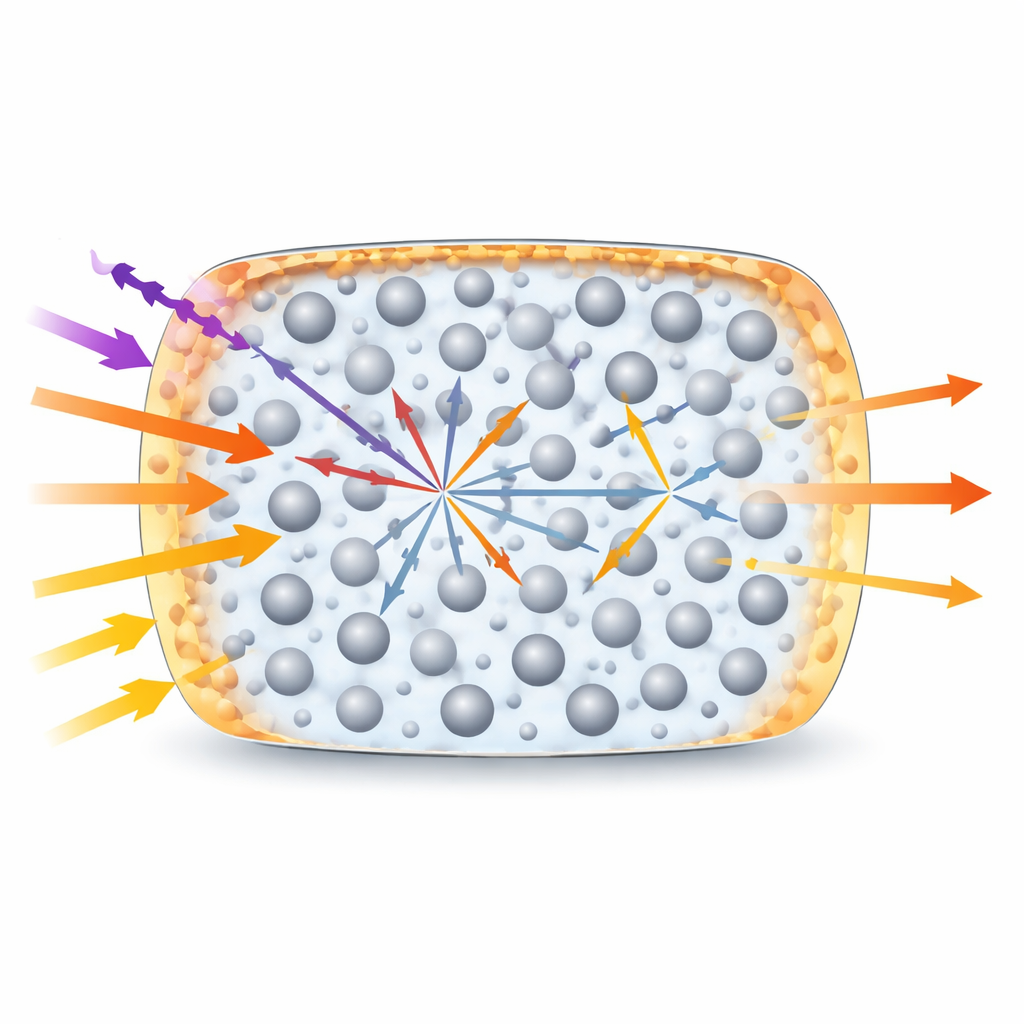
What this means for everyday protection
Overall, the study shows that a relatively simple recipe—mixing gadolinium oxide nanoparticles into a familiar plastic, then tuning the structure with a controlled ion beam—can yield lightweight sheets that block harmful gamma rays and neutrons more effectively than the base plastic alone. Because HDPE is flexible and easy to shape, such nanocomposites could be molded into personal protective gear, movable barriers, or lining materials for equipment and rooms where radiation is present. The work also demonstrates that ion treatment is a promising knob for fine‑tuning both the mechanical feel and shielding performance of polymer‑based materials, helping bring safer and more comfortable radiation protection closer to everyday use.
Citation: Shabib, M., Tawfik, E.K., Reheem, A.M.A. et al. A comparative analysis of gamma and neutron radiation shielding properties of Gd2O3 nanoparticles within HDPE composites irradiated with argon ion beam. Sci Rep 16, 8954 (2026). https://doi.org/10.1038/s41598-026-40153-x
Keywords: radiation shielding, gamma rays, neutrons, polymer nanocomposites, gadolinium oxide