Clear Sky Science · en
Extent of stabilized streambed region by alkaline activated cement around bridge piers and abutments in clear water condition
Why safer bridges matter
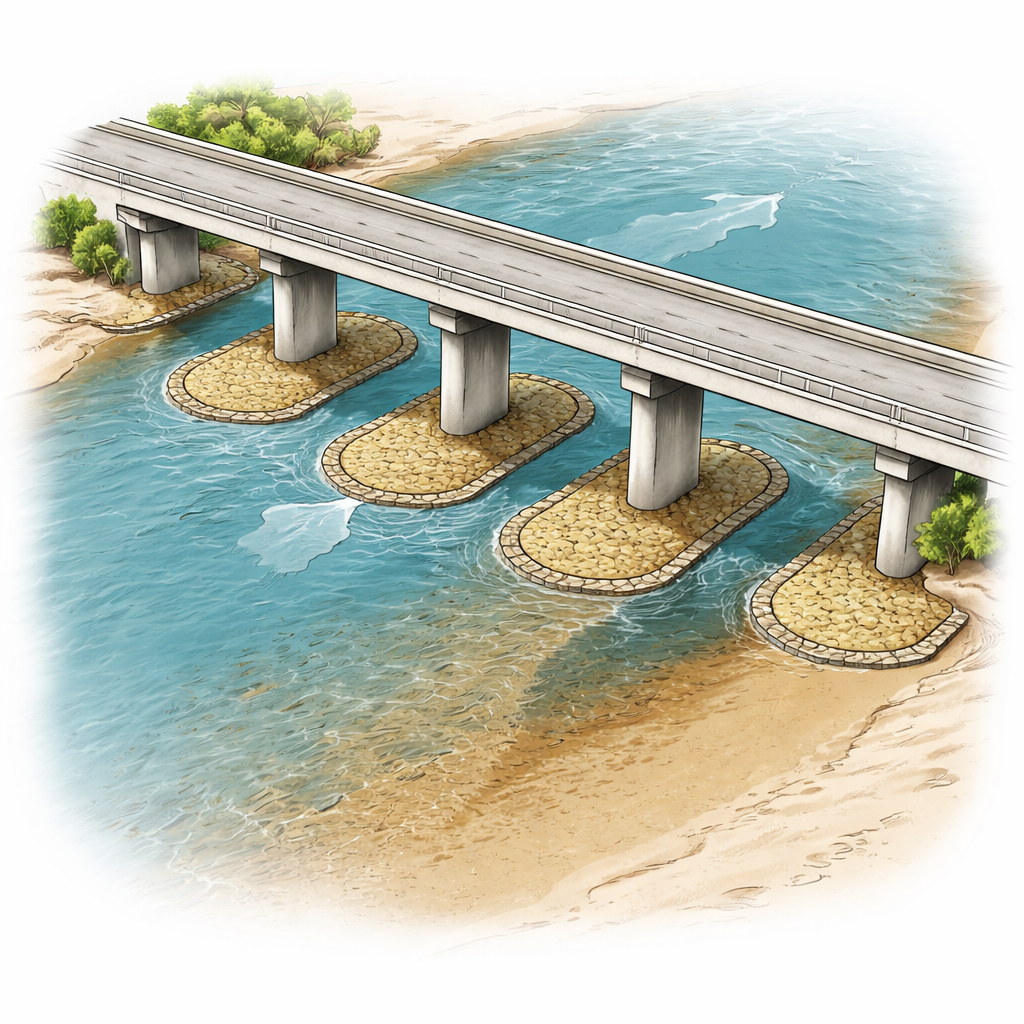
When rivers flood, fast-moving water can quietly dig away the sand and gravel around bridge supports, a process called scour. Around the world this hidden erosion is one of the main reasons bridges weaken, fail, and demand costly repairs. With climate change bringing fewer but more intense floods, engineers urgently need ways to protect bridges that are not only effective and affordable, but also kinder to the environment. This study explores a new approach: using a green, cement-like material to harden just the right amount of riverbed around bridge piers and abutments so that damaging holes cannot form where they can threaten the structure.
How bridges get eaten from below
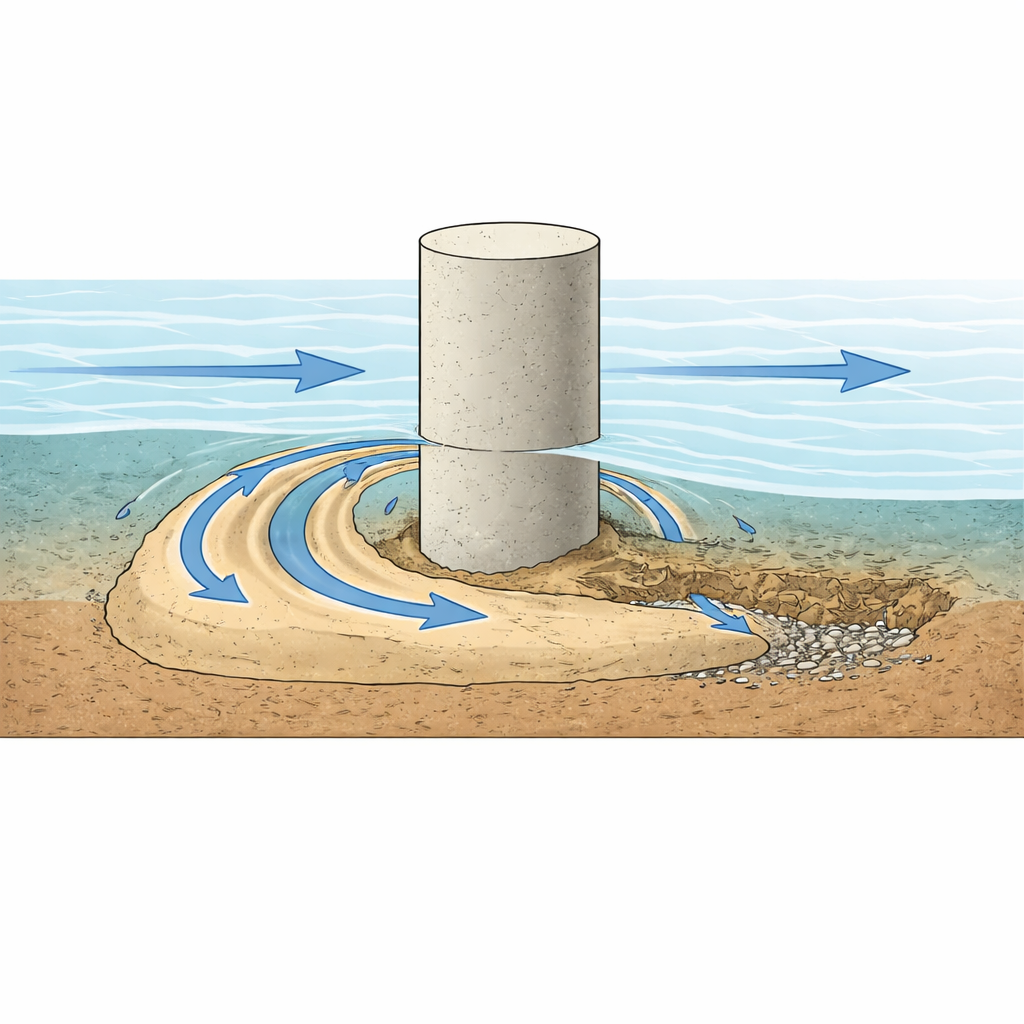
As river water rushes toward a bridge, it slams into the piers and abutments that hold up the deck. The flow is forced downward and around these obstacles, peeling off twisting whirlpools that curl around their bases and sweep sediment away. Over time, these swirling currents carve deep holes in the bed, especially during floods. If the hole grows large enough, it can expose foundations and compromise the bridge. Traditional defenses—such as dumping layers of rock around the piers—can work, but they are heavy, expensive to install, and often require quarrying and transporting large amounts of stone. Ordinary Portland cement can also be used to harden the bed, but its production carries a large carbon footprint and other environmental burdens.
A greener way to harden the riverbed
The researchers tested a different kind of binder known as alkaline-activated cement, made by combining a steel-industry byproduct called ground granulated blast furnace slag with a simple alkaline solution. When mixed into the existing sand on the riverbed surface, this blend forms a thin, solid crust that strongly binds the grains together while leaving the underlying soil’s permeability almost unchanged. Earlier work had shown that adding only a small amount of this material can increase the resistance of bed sediment to flowing water by up to a hundredfold, without releasing harmful substances into the water. In their experiments, the authors molded five-centimeter-thick slabs of treated bed around scale models of circular and rectangular bridge piers and two common abutment shapes, then placed these in a laboratory flume to simulate river flow.
Finding the right size of protection
The core question was not whether the hardened bed works, but how far it needs to extend in different directions to keep the bridge safe without wasting material. Using carefully controlled water depths and two strong flow levels—representing demanding but still sediment-stable flood conditions—the team ran dozens of tests. They varied how far the treated patch reached upstream, downstream, and sideways from each pier or abutment, observing where scour holes formed after more than a day of steady flow. The design rule they adopted was practical: a small hole forming downstream of the treated area was acceptable, as long as it never cut back under the hardened region or reached the structure itself. By trial and error, they identified “just enough” geometries for each shape and flow condition.
How much erosion can be held back
With these optimal layouts, the hardened patches around circular and rectangular piers, and around both types of abutments, cut the maximum depth of scour by roughly 70 to 80 percent compared with unprotected beds. Importantly, the deepest part of the hole was pushed downstream, away from the pier or abutment, leaving the treated zone intact and stable. The required protected area grew as the flow became more intense, and vertical-wall abutments needed larger zones than wing-wall abutments because they generate stronger downward currents. Additional tests using coarser sediment hinted that not only the strength of the flow but also a key dimensionless measure of its speed and depth (the Froude number) influences how large the hardened area must be.
What this means for real bridges
For non-specialists, the takeaway is straightforward: by selectively hardening a relatively thin, well-sized patch of riverbed around bridge supports with an eco-friendlier cement made from industrial byproducts, engineers can dramatically reduce dangerous erosion and push any remaining scour to a safer location. This approach can use far less material and equipment than rock armoring, while avoiding many of the environmental drawbacks of traditional cement. The study also offers practical starting dimensions for different pier and abutment shapes under clear-water conditions, and highlights what still needs to be explored—such as more energetic flows with moving bed sediment and different flow angles—before full design rules can be written for real-world rivers.
Citation: Ghaedi Haghighi, A., Zarrati, A., Karimaei Tabarestani, M. et al. Extent of stabilized streambed region by alkaline activated cement around bridge piers and abutments in clear water condition. Sci Rep 16, 9178 (2026). https://doi.org/10.1038/s41598-026-40143-z
Keywords: bridge scour, river engineering, sediment stabilization, alkaline activated cement, bridge safety