Clear Sky Science · en
Ultrasonographic and cephalometric assessment of tongue thickness across angle’s classes of malocclusion in skeletal class I patients
Why the Tongue Matters for Your Smile
Most people think crooked teeth are all about the bones and teeth themselves, but the tongue quietly shapes the way our mouths grow and how our bites line up. This study looks at how thick the tongue is in teenagers with different bite patterns and tests two ways of measuring it: a traditional side‑view X‑ray of the head and a radiation‑free ultrasound scan from under the chin. Understanding how the tongue’s size relates to common bite problems could help orthodontists plan more precise, more stable treatments.
The Hidden Muscle Shaping the Teeth
The tongue is a powerful muscle that helps us chew, swallow, talk, and taste, but it also constantly presses on the teeth and jaws. These soft‑tissue forces must balance the pressures from the lips and cheeks. If that balance is off—because the tongue is larger, smaller, or held in an unusual position—the shape of the dental arches and the way the upper and lower teeth meet can change. Earlier work suggested that very large tongues may be linked with jaw growth problems or open bites, but there has been surprisingly little research on how tongue thickness relates to everyday dental bite types in otherwise normal jaws.
Comparing Bites and Tongues in Teenagers
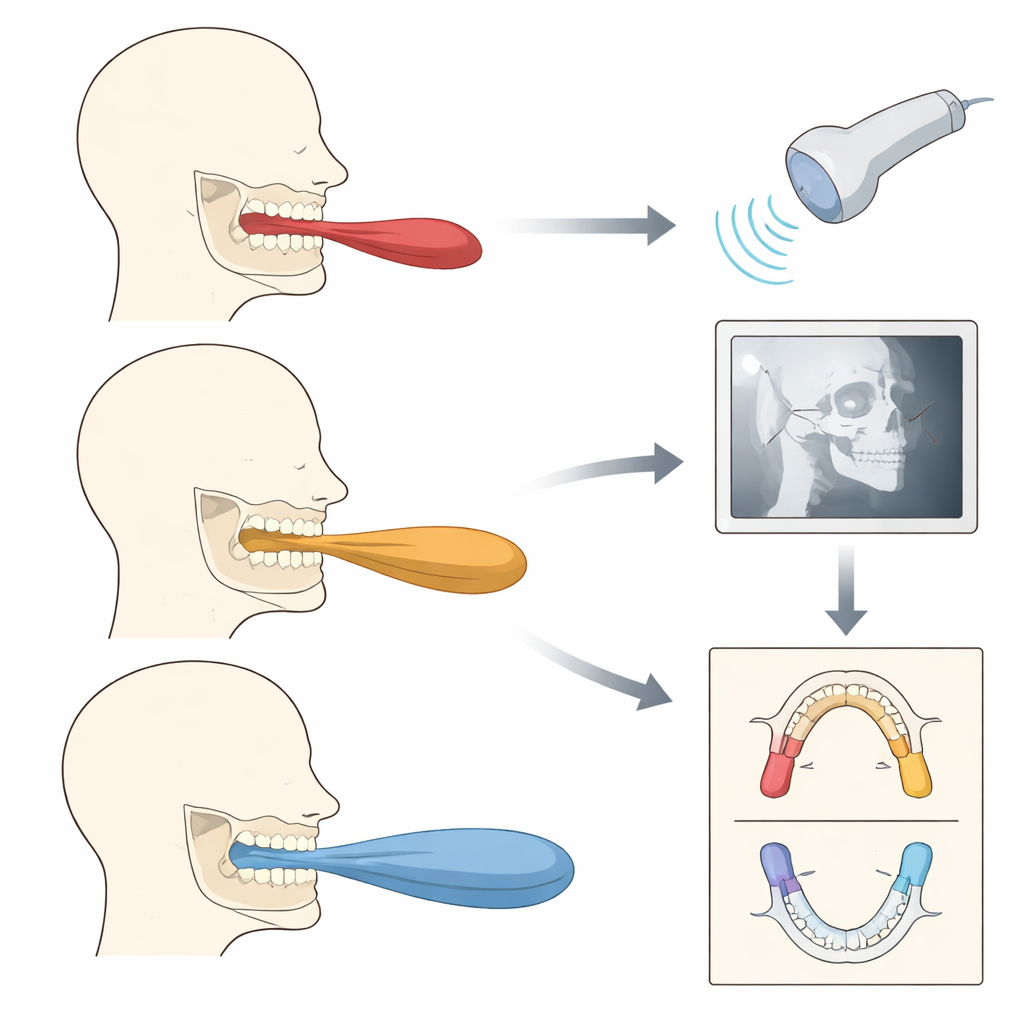
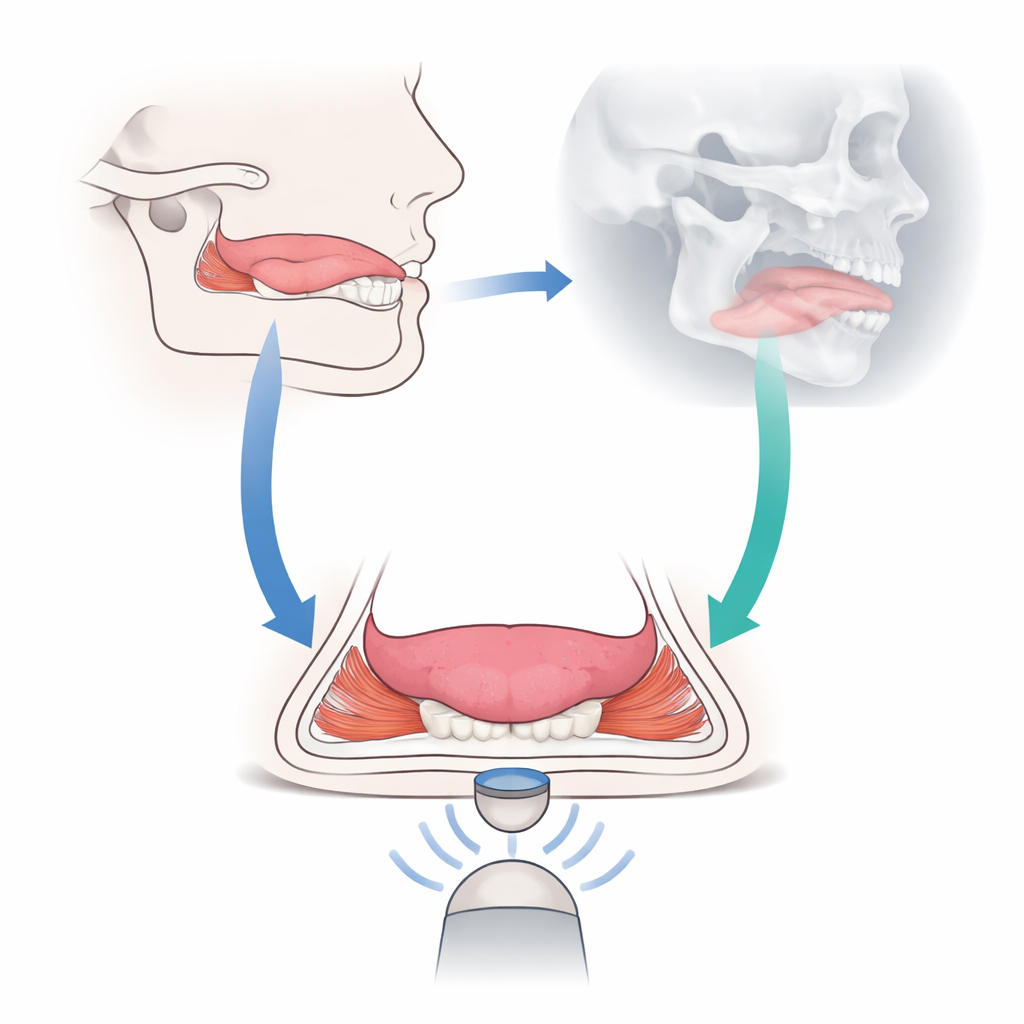
The researchers studied 90 adolescents, all with the same basic jaw relationship (skeletal Class I), but with three different dental bite patterns based on how the upper and lower back teeth fit together: Class I (considered normal), Class II (upper teeth more forward), and Class III (lower teeth more forward). Everyone had healthy swallowing and no major crowding or missing teeth, to keep the groups comparable. Tongue thickness was measured in two ways: on standard lateral head X‑rays, where the outline of the tongue can be seen in profile, and with ultrasound placed under the chin, which visualizes the tongue and nearby muscles in real time. Each measurement was repeated to check how consistent the methods were.
What the Study Found About Tongue Size
Across all 90 teens, tongue thickness clearly differed between bite types. Both the X‑ray‑based and ultrasound‑based measurements showed the same overall pattern: the thickest tongues were found in Class III bites, followed by Class I, and the thinnest tongues in Class II. In numbers, tongues in the Class III group were several millimeters thicker on average than those in Class I or II. When the researchers looked at boys and girls separately, they found that males tended to have thicker tongues than females, whether measured by X‑ray or ultrasound. This suggests that tongue size is not only related to how the teeth fit together, but also to sex‑related body size differences.
Ultrasound Versus X‑Ray: A Clearer Picture
The team also wanted to know which imaging method gives more dependable measurements. When they compared repeated readings taken weeks apart, ultrasound showed smaller differences from one measurement to the next than X‑rays did. Statistical checks confirmed that ultrasound was more precise and less variable, even though both methods were generally reliable. While the two techniques tended to move in the same direction—thicker tongues by one usually meant thicker by the other—the correlations within each bite group were not strong enough to treat them as interchangeable. In practice, that means ultrasound captures tongue thickness in a more consistent way, likely because it is designed for soft‑tissue imaging and avoids some of the blurring and overlap seen on X‑rays.
What This Means for Braces and Beyond
For patients and parents, the key message is that the tongue is part of the orthodontic story. Thicker or thinner tongues appear to be linked with different bite patterns, even when the jaw bones themselves are in a normal relationship. Because ultrasound can measure tongue thickness accurately without radiation, it could be added to routine orthodontic evaluation in selected cases. By factoring in tongue size alongside teeth and bone, orthodontists may be able to choose treatments—such as how much to widen an arch or how to manage space—that are better matched to each person’s soft‑tissue environment. That, in turn, could make it easier to achieve a stable, comfortable bite that lasts.
Citation: Aras, R.Ç., Geduk, G. & Cicek, O. Ultrasonographic and cephalometric assessment of tongue thickness across angle’s classes of malocclusion in skeletal class I patients. Sci Rep 16, 8459 (2026). https://doi.org/10.1038/s41598-026-40135-z
Keywords: tongue thickness, dental malocclusion, orthodontic diagnosis, ultrasonography, cephalometric radiography