Clear Sky Science · en
Biotic and abiotic drivers of biomass carbon storage in peri-urban forests in Burkina Faso
Why city-edge forests matter for a warming world
As cities in West Africa grow and heat up, the patches of forest on their outskirts may quietly decide how livable these places remain. This study looks at three such peri-urban forests in Burkina Faso, near the fast-expanding cities of Ouagadougou and Bobo-Dioulasso. By asking how tree communities and local climate conditions shape the amount of carbon stored in these forests, the authors show how thoughtful management of city-edge greenery can pull carbon from the air and soften extreme heat for millions of urban residents. 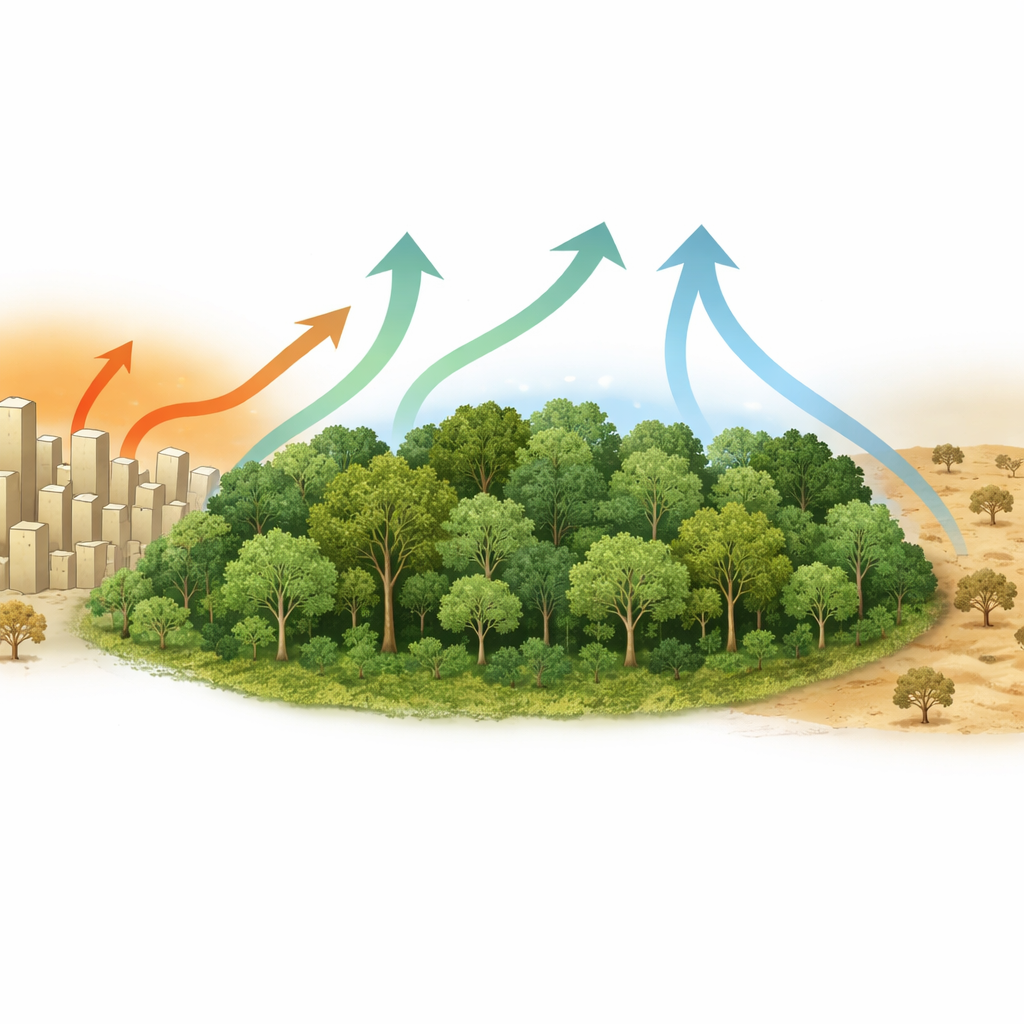
Cities, heat, and the green buffer around them
Urban areas already produce most of the world’s greenhouse gas emissions and tend to be much hotter than their surroundings. In Burkina Faso, the built-up area of the two main cities has grown rapidly in recent decades, driving up land surface temperatures year after year. Forests in and around these cities act as green infrastructure: they filter air, slow stormwater, and, crucially, store large amounts of carbon in their wood. Yet, until now, very little was known about how much carbon these peri-urban forests actually hold, which tree species provide most of that storage, and how local climate and terrain help or hinder their role as carbon sinks.
Measuring thousands of trees at the city’s edge
The researchers surveyed 158 square plots across three protected forests—Gonse, Dinderesso, and Kua—located just outside the urban cores. In each plot they identified every tree and shrub thicker than a small pole, measured trunk diameter and height, and combined these data with species-specific wood density to estimate the mass of living wood above ground. Half of that mass was treated as carbon. They also compiled information on rainfall patterns, temperature, elevation, and slope for each plot, and calculated how many species were present, how many individual trees grew there, and how varied the tree sizes were. Using statistical tests and a structural equation model, they teased apart which factors most strongly explained differences in carbon storage from place to place. 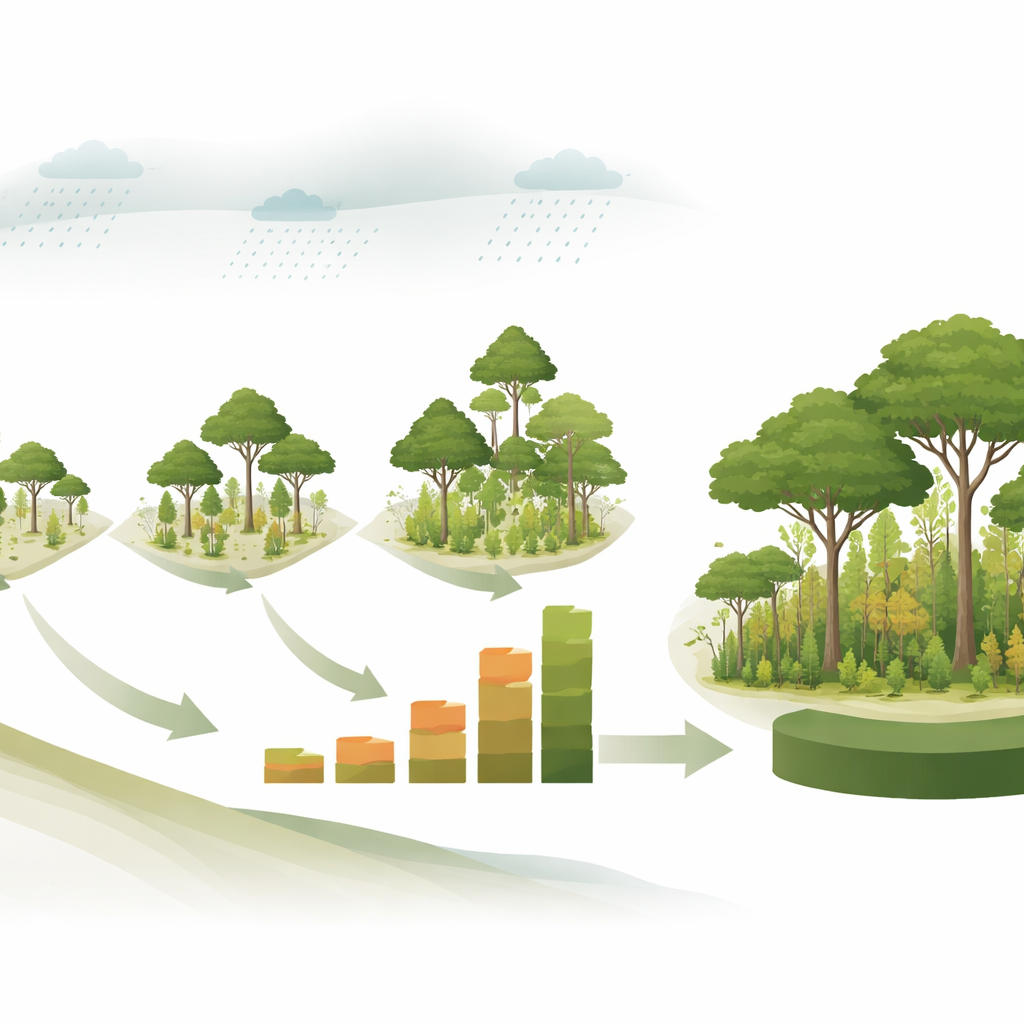
Where the carbon really sits in these forests
Carbon stocks differed sharply among the three forests and among tree size classes. Surprisingly, the driest forest, Gonse, held the highest average carbon per hectare, more than the wetter forests of Dinderesso and Kua. The authors link this to heavier human disturbance in the wetter sites, where farmland expansion and the introduction of non-native trees have reduced natural biomass. Tree size also mattered: in some forests the largest trees held most of the carbon, but in others medium or even small trees were the main contributors, depending on how stands were structured. Across all sites, just ten tree species in each forest provided between roughly three quarters and over ninety percent of the total carbon stored. Many of these are already valued locally for food, fodder, or timber, such as shea, African locust bean, neem, and teak.
How life and landscape shape carbon storage
The modeling results revealed that not all “more” is better when it comes to forest makeup. Plots with more individual trees and greater variation in tree size stored more carbon, highlighting the importance of dense, multi-layered canopies. In contrast, plots with a greater number of different tree species tended to store less carbon, at least at the small spatial scale of this study, hinting at a trade-off between maximizing biomass and maximizing local species counts. Elevation and strongly seasonal rainfall were both linked to lower carbon stocks, either directly or through their effects on which species thrive. In other words, harsher or more variable environmental conditions can limit how much carbon peri-urban forests can lock away, even when trees are protected.
What this means for greener, cooler African cities
For city planners and communities, the study offers concrete guidance. Protecting and restoring peri-urban forests can deliver carbon storage on par with some rural reserves, but doing so effectively means favoring denser stands with a mix of tree sizes and prioritizing species known to hold a lot of carbon—especially those that also support local livelihoods. At the same time, managers must be cautious with fast-growing non-native species that can become invasive or harm local ecosystems. The work makes clear that these forests are not just leftover land at the edge of town: they are strategic assets for climate mitigation and urban comfort, whose performance depends on the interplay of tree density, size structure, species choice, and a changing climate.
Citation: Balima, L.H., Ganamé, M., Bayen, P. et al. Biotic and abiotic drivers of biomass carbon storage in peri-urban forests in Burkina Faso. Sci Rep 16, 9363 (2026). https://doi.org/10.1038/s41598-026-40132-2
Keywords: urban forests, carbon storage, Sahel, climate change mitigation, urbanization