Clear Sky Science · en
Quantum-inspired optimization for current stress reduction in DAB converters for ultra-fast EV charging
Faster charging without frying the hardware
Ultra-fast charging promises to make topping up an electric vehicle feel more like filling a gasoline tank. But forcing huge amounts of energy into a battery in minutes can overwork the electronics hidden inside the charger, making them hot, inefficient and prone to early failure. This paper explores a smarter way to control one of the most promising building blocks of future fast chargers so that it delivers high power while treating its internal components much more gently.
Why these chargers struggle today
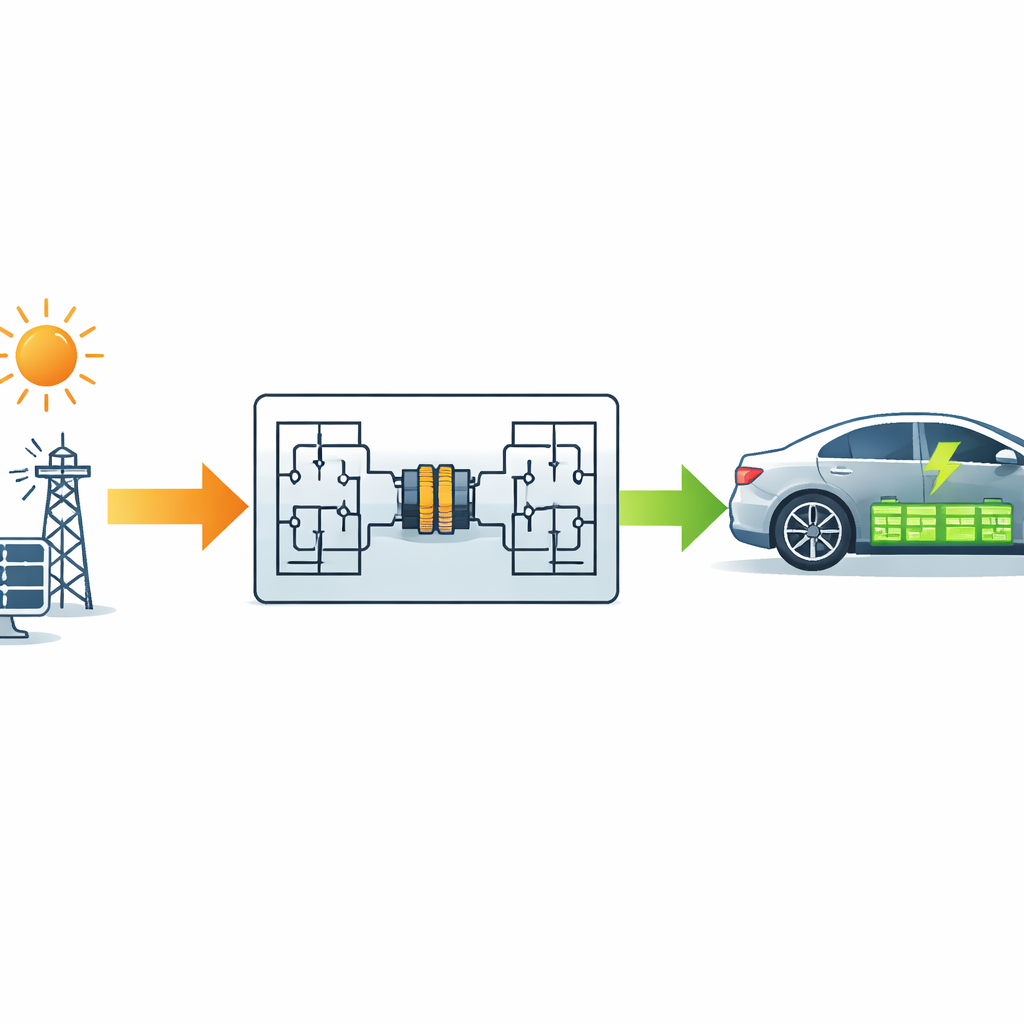
Modern ultra-fast charging stations often use a device called a dual active bridge converter to move energy from the grid, or even from solar panels and batteries, into an electric car. This converter acts like a high-speed, isolated power bridge between two DC systems. The simplest and most common way to run it uses a single timing delay between its two sides. That approach is easy to implement, but it drives large, rapidly changing currents through the transformer and switches inside the converter. Those high currents waste energy as heat, increase electrical stress, and shorten the lifetime of costly components.
A new way to time the power pulses
The authors propose a different control rhythm for the converter. Instead of relying on just one timing shift, their method introduces two separate delays: one on the input side and one on the output side of the high-frequency transformer. This creates a more finely shaped voltage pattern, spreading energy transfer more evenly over each switching cycle. The result is a three-level voltage waveform rather than a simple two-level on–off pattern, which cuts down on unwanted power flowing back toward the source and reduces the size of current spikes inside the inductor and transformer.
Borrowing ideas from quantum thinking
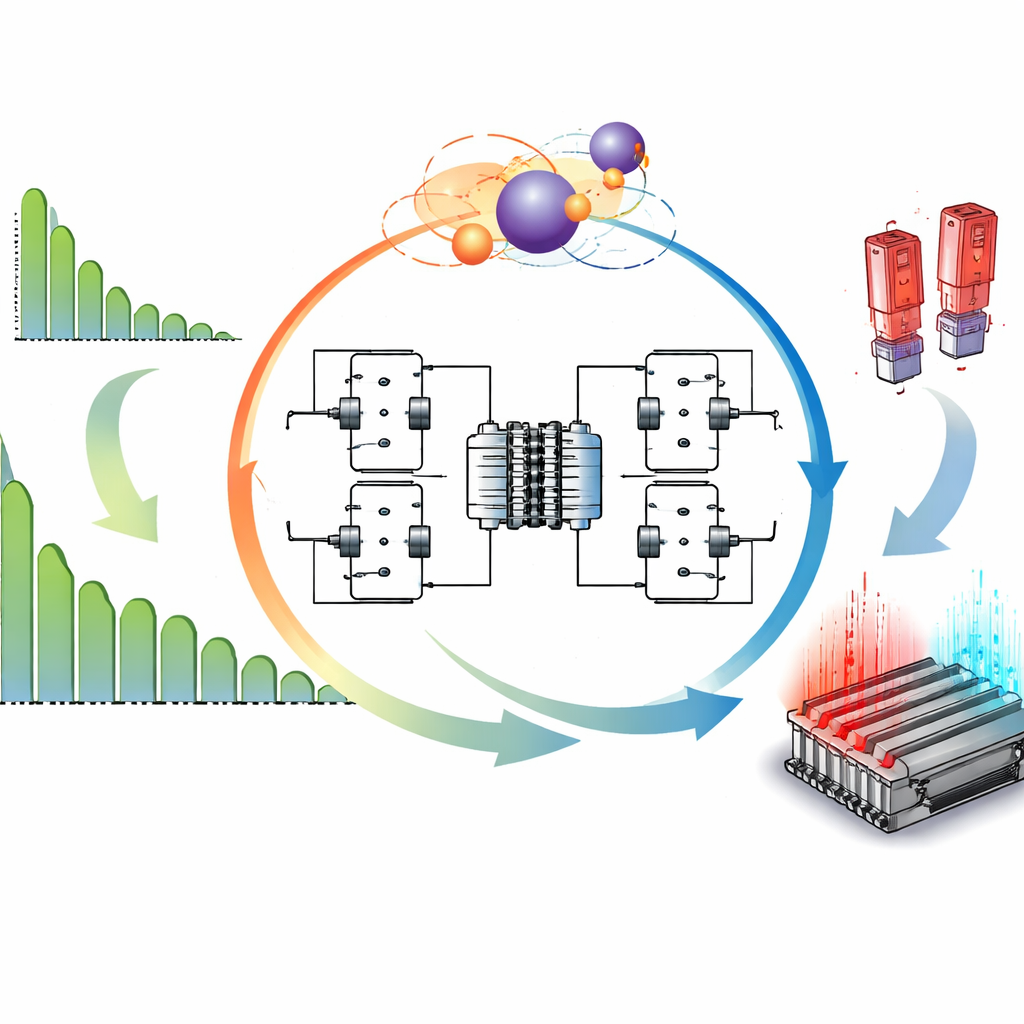
Choosing the right delay values and tuning the feedback controllers that regulate current and output voltage is not trivial, because the converter’s behavior changes with load, voltage and switching conditions. Instead of hand-tuning or relying on traditional trial-and-error methods, the team uses a quantum-inspired optimization algorithm. This algorithm imitates certain features of quantum systems, such as exploring many possibilities in parallel and updating them probabilistically, to hunt efficiently for the best combination of controller settings. It evaluates how well a given setting keeps the current and voltage on target while minimizing error over time, then iteratively refines the parameters until it settles on a near-optimal solution.
Gentler currents, cooler parts, longer life
Simulations and lab experiments show that the new modulation scheme about halves the peak current stress compared with the standard approach. In the prototype, the maximum inductor current drops from roughly the equivalent of ten and a half units to about five and a bit units, with the same output voltage and power. Lower currents mean lower conduction and switching losses, so less heat is generated in the semiconductor switches and magnetic components. The study also confirms that all switches continue to turn on when the voltage across them is effectively zero, a desirable "soft switching" condition that further reduces losses. Using a widely accepted fatigue model that links temperature swings to wear-out, the authors show that these current reductions can translate into a many-fold increase in expected lifetime.
What this means for future charging stations
For a casual observer, the key takeaway is that this work points to ultra-fast chargers that are not just powerful but also more durable, compact and energy-efficient. By reshaping when and how the converter applies its switching pulses, and by letting a quantum-inspired algorithm fine-tune the controls, the system keeps internal currents under control without adding extra hardware or exotic circuitry. This makes it easier to scale up reliable DC-connected charging stations that can work directly with renewable sources, helping electric vehicles charge quickly while keeping costs and component stress in check.
Citation: Mateen, S., Haque, A., Khan, M.A. et al. Quantum-inspired optimization for current stress reduction in DAB converters for ultra-fast EV charging. Sci Rep 16, 9133 (2026). https://doi.org/10.1038/s41598-026-40131-3
Keywords: ultra-fast EV charging, dual active bridge converter, power electronics reliability, current stress reduction, quantum-inspired optimization