Clear Sky Science · en
Comparative analysis of shallow and hybrid deep learning models for predicting the cooling efficiency of nanofluid-cooled photovoltaic panel across multiple materials
Why keeping solar panels cool matters
Solar panels work best when they are cool, but under strong sun their temperature can soar, quietly eroding how much electricity they produce. For homeowners, utilities, and anyone betting on clean energy, that drop in performance means fewer kilowatt-hours than expected. This study looks at a new twist on panel cooling: circulating special "nanofluids" behind a solar panel and using artificial intelligence to predict how well the cooling will work. The goal is to cut down on slow, expensive outdoor experiments while keeping solar power efficient in real-world heat.
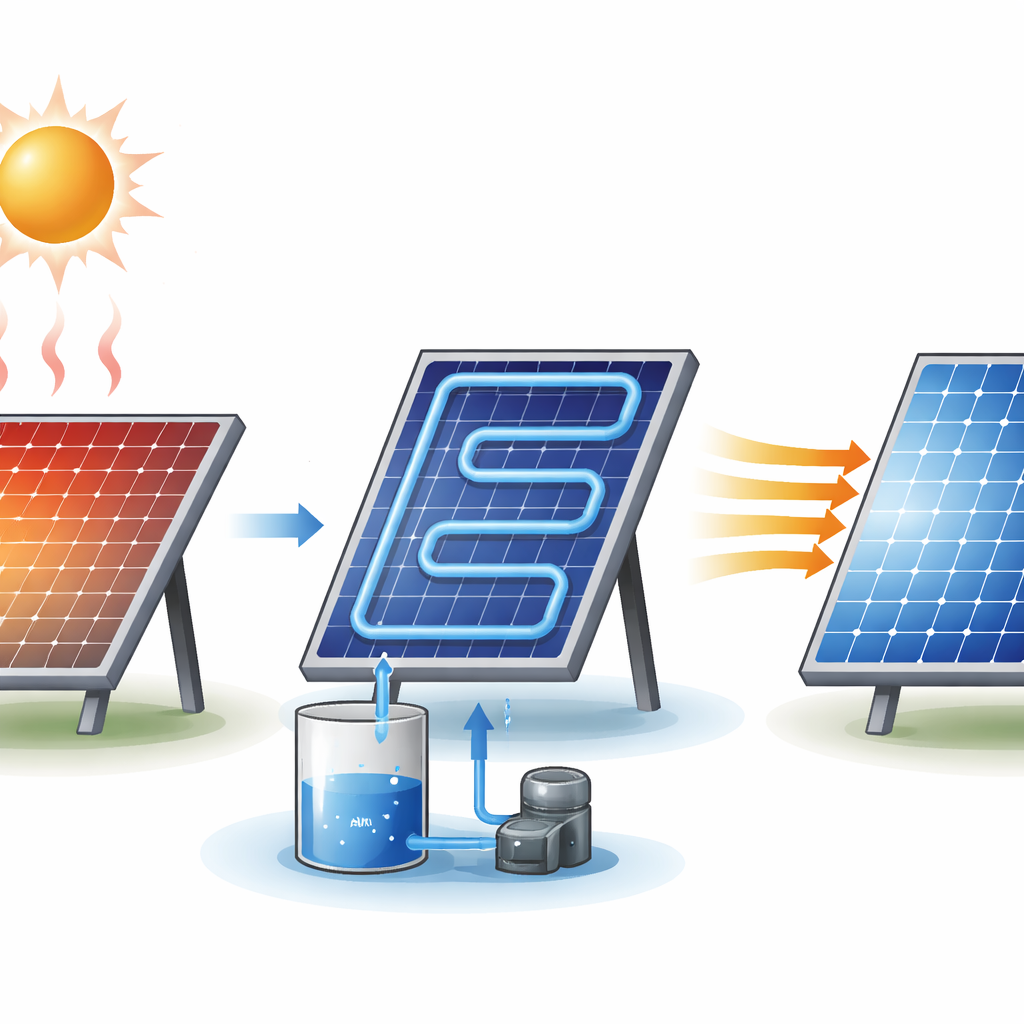
How tiny particles can help hot panels
Standard solar panels simply sit in the sun and heat up, which reduces their output by roughly half a percent for every degree Celsius of temperature rise. One way to fight this is to actively cool the panel using a thin network of tubes attached to the back. In this setup, a liquid is pumped through the tubes, carrying away heat. Instead of using plain water alone, the researchers tested nanofluids: water containing extremely small particles of aluminum oxide (Al₂O₃) or titanium dioxide (TiO₂) at very low volume fractions (0.01%, 0.1%, and 1%). These nanoparticles can improve the liquid’s ability to pick up and transport heat, potentially keeping the panel cooler and more efficient than water by itself.
Real-world outdoor testing across seven coolants
The team installed two identical 50-watt solar panels on a university campus in a hot, dry region of Turkey. One panel was equipped with copper tubes and fins on the back for cooling, while the other was left uncooled as a reference. A pump circulated either water or one of six nanofluid mixtures at a fixed flow rate through the cooling pipes. Over several days, they collected outdoor measurements every 30 minutes for six hours at a time, creating 13 data points per coolant. For each run, they recorded solar irradiance, wind speed, air temperature, panel surface temperatures at multiple spots, fluid inlet and outlet temperatures, and the electrical voltage and current from both the cooled and uncooled panels. From these, they calculated how much the cooling system improved the panel’s electrical efficiency.
Teaching algorithms to stand in for experiments
Because repeating full-day outdoor tests for every new coolant or operating condition is slow and labor-intensive, the authors trained computer models to learn the relationship between the measured conditions and the resulting cooling efficiency. They tried several relatively simple approaches—Bayesian Ridge regression, support vector regression, and random forests—alongside a more advanced hybrid deep learning model that combines convolutional neural networks (CNNs) and long short-term memory (LSTM) units. The simpler "shallow" models treated each measurement snapshot on its own, while the CNN+LSTM model also looked at how values changed over time, capturing short-term fluctuations in sunlight and temperature.
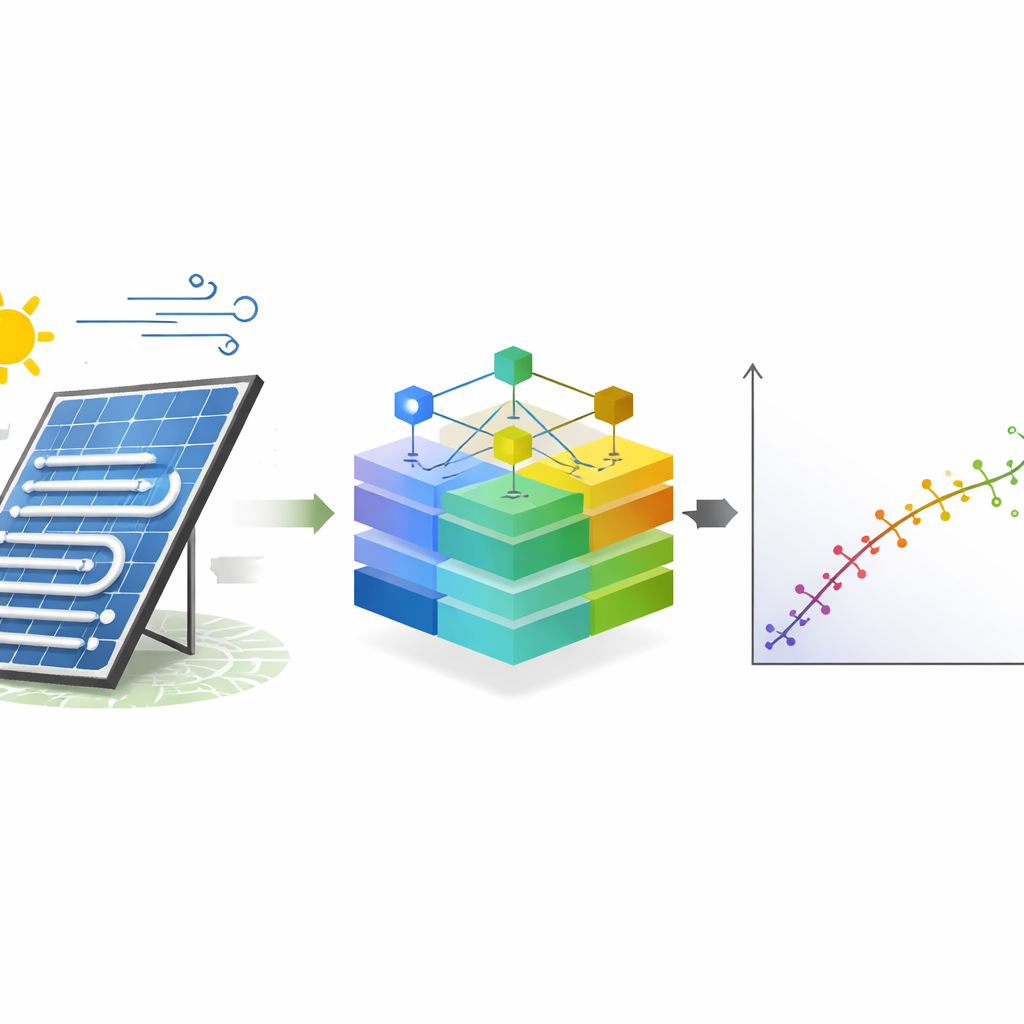
What the models learned about cooling performance
Across all seven fluids, Bayesian Ridge regression consistently delivered accurate predictions, with only small errors between predicted and measured efficiencies and high agreement scores. The hybrid CNN+LSTM model pushed the accuracy even further for some materials, reaching very low error levels and explaining almost all of the variation in cooling performance. To open up these "black box" models, the researchers applied a technique called SHAP, which scores how much each input factor influences a prediction. This analysis showed that ambient temperature, solar irradiance, and the cooled panel’s own electrical output (voltage and current) were the main drivers of cooling efficiency, while wind speed and some of the detailed surface-temperature readings contributed much less.
What this means for future solar systems
In plain terms, the study shows that well-chosen machine learning models can reliably predict how much benefit you will get from actively cooling a solar panel with water or nanofluids, using only a modest amount of experimental data. Rather than running new full-day tests every time a coolant recipe, concentration, or weather pattern changes, engineers can lean on these trained models to explore "what if" scenarios in seconds. The work also highlights that a few key measurements—how hot the day is, how strong the sunlight is, and how the cooled panel is performing electrically—carry most of the information needed. While the authors note that larger and more varied datasets are still required before such tools can be applied everywhere and at all scales, their results point toward smarter design and control of cooled solar panels, squeezing more clean electricity out of the same sunlight.
Citation: Özdemir, Y., Ziyadanoğulları, N.B., Bakış, E. et al. Comparative analysis of shallow and hybrid deep learning models for predicting the cooling efficiency of nanofluid-cooled photovoltaic panel across multiple materials. Sci Rep 16, 9216 (2026). https://doi.org/10.1038/s41598-026-40129-x
Keywords: solar panel cooling, nanofluids, photovoltaic efficiency, machine learning, deep learning