Clear Sky Science · en
Impact of measurement noise on escaping saddles in variational quantum algorithms
Why random quantum noise can be a hidden helper
Today’s quantum computers are still small and noisy, yet researchers hope to use them to tackle chemistry, materials, and optimization problems that stretch classical machines. A leading strategy is the Variational Quantum Eigensolver (VQE), which repeatedly measures a quantum circuit and tweaks its settings to lower an energy-like score. Because each measurement is intrinsically random, the algorithm never sees a perfectly sharp signal. This study asks a subtle but practical question: does that unavoidable “shot noise” simply get in the way, or can it actually help VQE escape bad solutions and find better ones faster?
Climbing hills with a fuzzy compass
VQE works a bit like hiking across a landscape of hills and valleys, where height represents the energy of a quantum system. The goal is to find the deepest valley, corresponding to the ground state. At each step, the algorithm estimates the slope of the landscape and adjusts the circuit’s parameters in the direction that goes downhill. On a real quantum device, however, this slope must be estimated from a finite number of measurements, or shots. Because each shot produces a probabilistic outcome, the estimated slope jitters from step to step: even if the true slope is the same, the measured value fluctuates. This turns the usual smooth “gradient descent” into a stochastic, or noisy, version known as stochastic gradient descent.
Getting unstuck from flat ridges
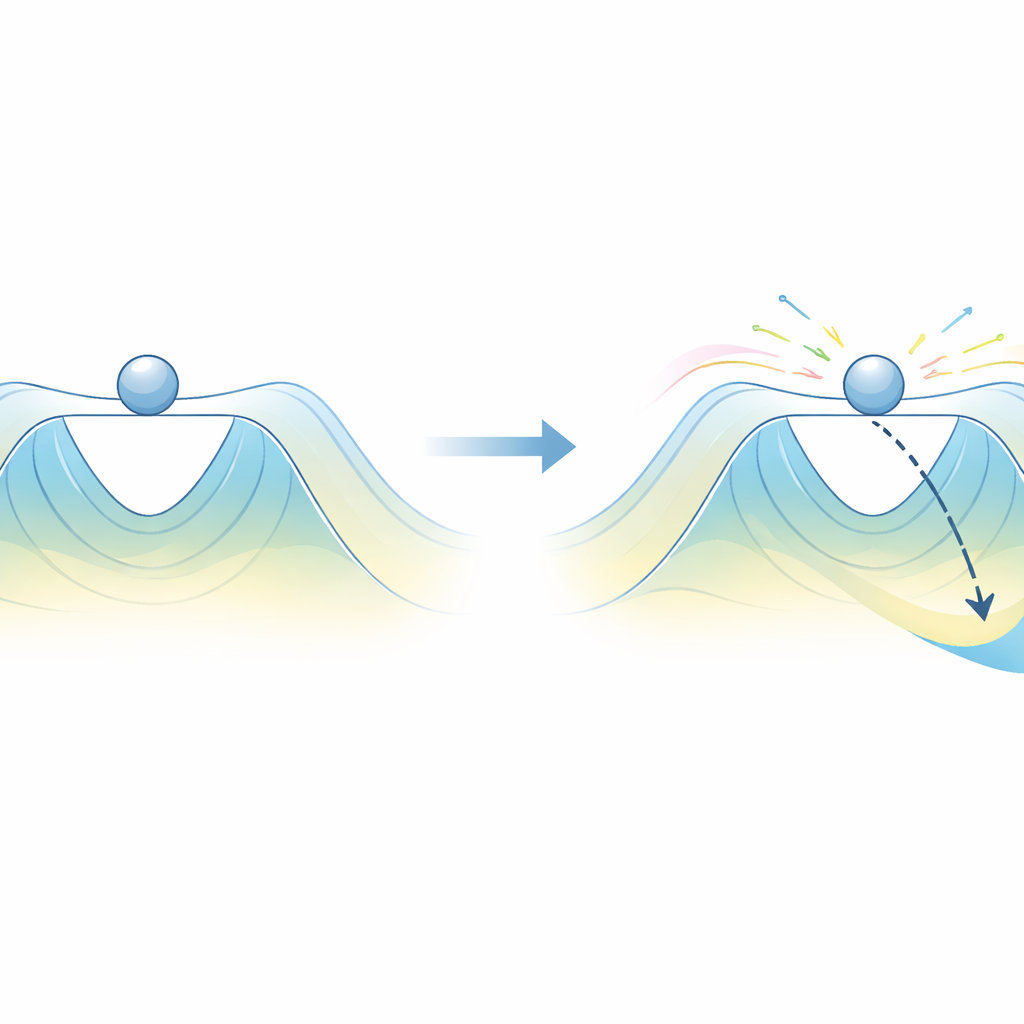
In high-dimensional landscapes, the main obstacles are often not local valleys but saddle points—flat ridges that look like a valley from some directions and a hill from others. A purely deterministic algorithm can drift along these plateaus for a long time before finding a way out, wasting valuable quantum measurements. The authors show that the randomness from finite-shot measurements can knock the parameters off such saddles more quickly. By simulating VQE on models of interacting quantum spins, they find that the time needed to escape a saddle shrinks in a regular way as the effective noise level grows. Crucially, this noise level depends on two knobs under the user’s control: the learning rate (how big each parameter step is) and the number of shots used to estimate each gradient.
A continuous picture for a stepwise process
Although VQE updates its parameters in discrete steps, the authors model its behavior using a continuous random-motion equation, similar to those used in physics to describe particles buffeted by thermal noise. In this picture, the learning rate plays the role of a time increment, and the randomness of measurement outcomes appears as a fluctuating force. This framework predicts that what really matters for escaping saddles is a combined quantity built from the learning rate and the number of shots, which acts as an effective noise strength. The team carefully checks where this approximation works and where it fails, finding that while it does not perfectly capture long-term, steady fluctuations, it accurately describes the crucial transient behavior of leaving saddles and excited-state plateaus.
How noise, step size, and measurement budget trade off
By scanning different learning rates and shot counts in their simulations, the researchers uncover simple power-law rules: roughly speaking, the time to escape a saddle declines like a fixed power of the effective noise strength. This means that increasing the learning rate or decreasing the number of shots per step can have nearly equivalent effects on how quickly the algorithm moves on from a plateau. They also define an overall measurement cost—the total number of quantum shots needed to get unstuck—and show how it scales with the same effective-noise parameter. Extending the study to larger, six-qubit systems reveals that noise-assisted escape works best when the landscape around a stationary point has many unstable directions; in highly over-parameterized regimes where these directions are scarce, extra noise does little good.
What this means for future quantum algorithms
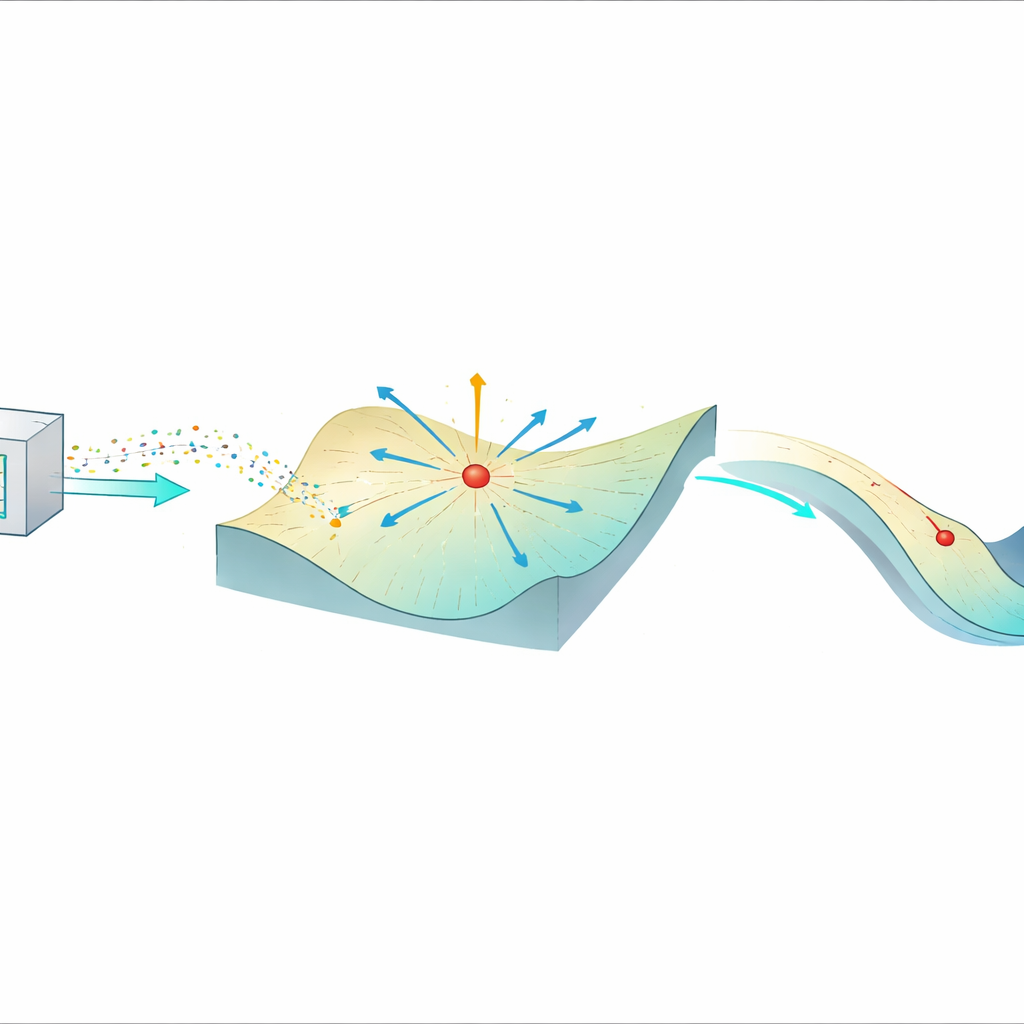
For non-specialists, the key takeaway is that not all quantum noise is purely harmful. The unavoidable randomness in measurement outcomes can, under the right conditions, help VQE slip off flat or marginally stable regions and move toward better solutions more efficiently. The work provides a concrete recipe for thinking about the trade-off between learning rate and measurement count in terms of a single effective noise strength, and it clarifies when a smooth, continuous model reliably predicts real optimization behavior. As quantum hardware improves and larger VQE problems are tackled, such insights can guide practitioners in choosing step sizes, shot budgets, and circuit designs that make the most of their limited quantum resources—sometimes by letting a little noise do useful work.
Citation: Kaminishi, E., Mori, T., Sugawara, M. et al. Impact of measurement noise on escaping saddles in variational quantum algorithms. Sci Rep 16, 9390 (2026). https://doi.org/10.1038/s41598-026-40123-3
Keywords: variational quantum eigensolver, measurement noise, stochastic gradient descent, saddle point escape, quantum optimization