Clear Sky Science · en
Prediction of athlete performance based on a gradient regression model
Why predicting performance matters
Anyone who has watched sports wonders why some athletes keep improving while others plateau, even when they seem to train just as hard. This study explores whether modern data and algorithms can turn that puzzle into a practical tool: a way to forecast how well an athlete is likely to perform based on their age, training hours, sleep, nutrition, and other everyday factors. Such predictions could help coaches fine‑tune training plans, reduce injury risk, and support athletes in making smarter choices off the field.
From raw numbers to a single performance score
The researchers worked with a public dataset of 1,000 athletes that includes demographic details (such as age and gender), body measurements, training volume, sleep, hydration, and nutrition, along with an overall performance score. Because real-world data are messy, they first cleaned and organized the information: missing values were filled in sensibly, measurements were put on comparable scales, and categories like training program type were converted into numerical form. They also engineered extra signals, such as training load (combining hours and intensity), and used feature-selection methods to keep only the most informative inputs. This created a compact yet rich picture of each athlete that could be fed into different prediction models.

How the smart model learns patterns
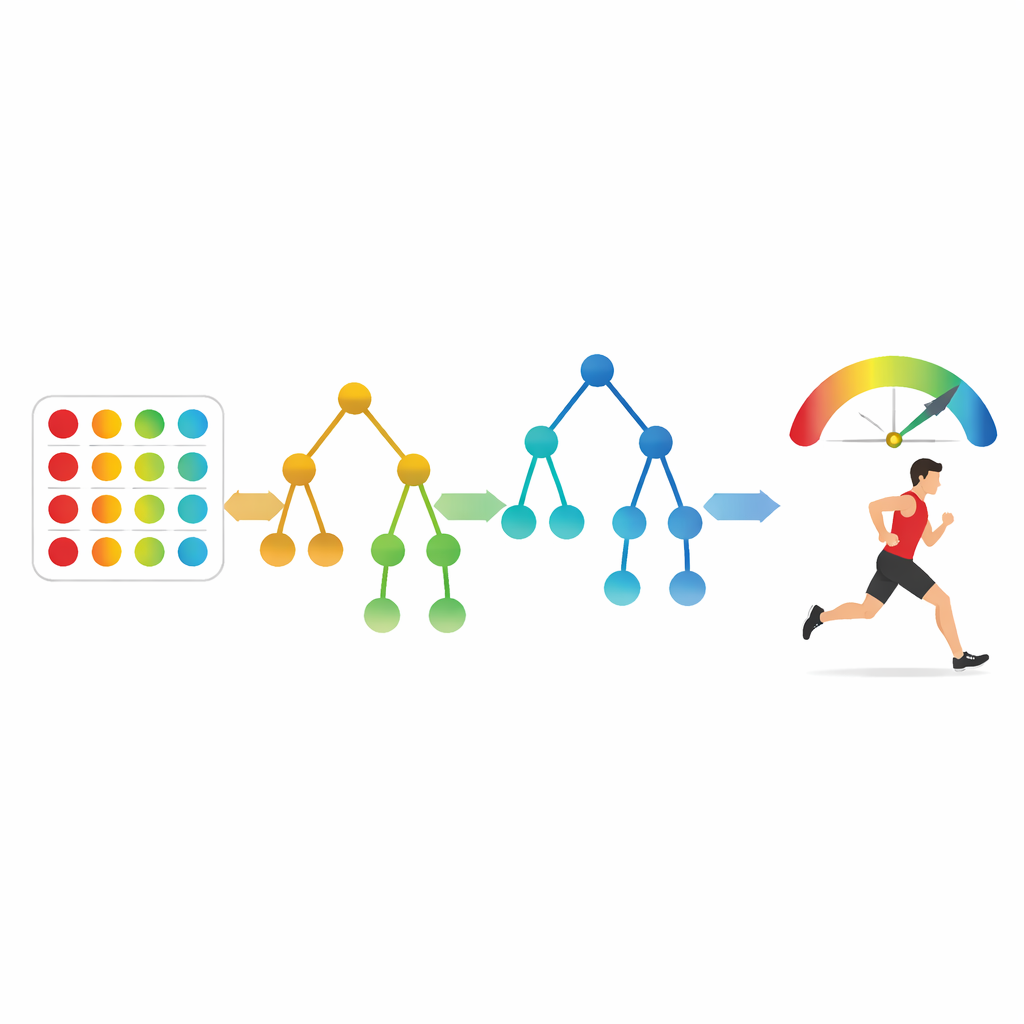
Instead of relying on classic straight-line statistics, the team turned to a method called gradient regression, implemented with a popular toolkit known as XGBoost. Rather than trying to explain performance in one step, this approach builds many small decision rules, or “weak learners,” one after another. Each new learner focuses on the errors made by the previous ones, gradually correcting the model’s mistakes. The process is carefully controlled with settings such as learning rate, tree depth, and the number of steps, and it is monitored with cross‑validation: the data are repeatedly split into training and validation portions so that the model is constantly tested on athletes it has not yet seen. Early stopping prevents the model from overfitting to quirks in the training data.
Stacking up against other methods
To see whether this layered strategy really helped, the authors compared gradient regression with several familiar alternatives: simple linear and ridge regression, support vector regression, random forests, and a small neural network. They judged performance using three common measures: how much of the variability in scores the model could explain, and how large its typical errors were. Across 10 rounds of cross‑validation and on a separate test set, gradient regression came out on top. It explained about 92% of the variation in performance scores and had the smallest average and large errors, beating even the neural network and random forest. Visual checks—such as plotting predicted scores against actual ones and examining the pattern of remaining errors—showed that its predictions lined up closely with reality and did not drift badly for weaker or stronger athletes.
Seeing what drives success
Powerful predictions are only useful if coaches and athletes can understand them. To open up the model’s “black box,” the researchers used an explanation technique called SHAP, which estimates how much each factor pushes a prediction up or down. This allowed them to rank which variables most strongly influenced performance scores across the group and to inspect how specific combinations shaped an individual’s forecast. Although the study stresses that these are associations, not proof of cause and effect, the analyses highlighted training hours, sleep, and nutrition as especially important, echoing common wisdom but now backed by a systematic, data‑driven view. Residual checks and learning‑curve plots further suggested that the model was stable and robust rather than fragile or overly tuned to one subset of athletes.
What this means for athletes and coaches
The authors conclude that a well‑designed gradient regression pipeline offers a practical balance: it predicts athlete performance more accurately than traditional tools and some deep‑learning baselines, while remaining fast and explainable enough for everyday sports use. In principle, such a system could support personalized training plans, early warnings when performance is likely to dip, and clearer conversations between analysts, coaches, and athletes about which habits matter most. At the same time, the study was based on 1,000 athletes from a single source and on snapshots rather than long‑term tracking. Future work will need larger and more varied datasets, time‑aware designs, and sport‑specific outcome measures before this kind of model can be trusted as a universal guide. For now, it demonstrates that smart, transparent analytics can turn routine training and lifestyle data into meaningful insight about athletic potential.
Citation: Wei, X., Liang, S. & Diao, W. Prediction of athlete performance based on a gradient regression model. Sci Rep 16, 9724 (2026). https://doi.org/10.1038/s41598-026-40117-1
Keywords: athlete performance, sports analytics, machine learning, gradient boosting, training optimization